Acute viral hepatitis does not look the same across the five viruses (HAV, HBV, HCV, HDV and HEV, the viruses of hepatitis A to E). The incubation period, the likelihood of jaundice, the severity of symptoms and the speed of recovery all vary with the agent, and the illness classically passes through a prodromal phase, an icteric phase and a recovery phase.
Incubation period
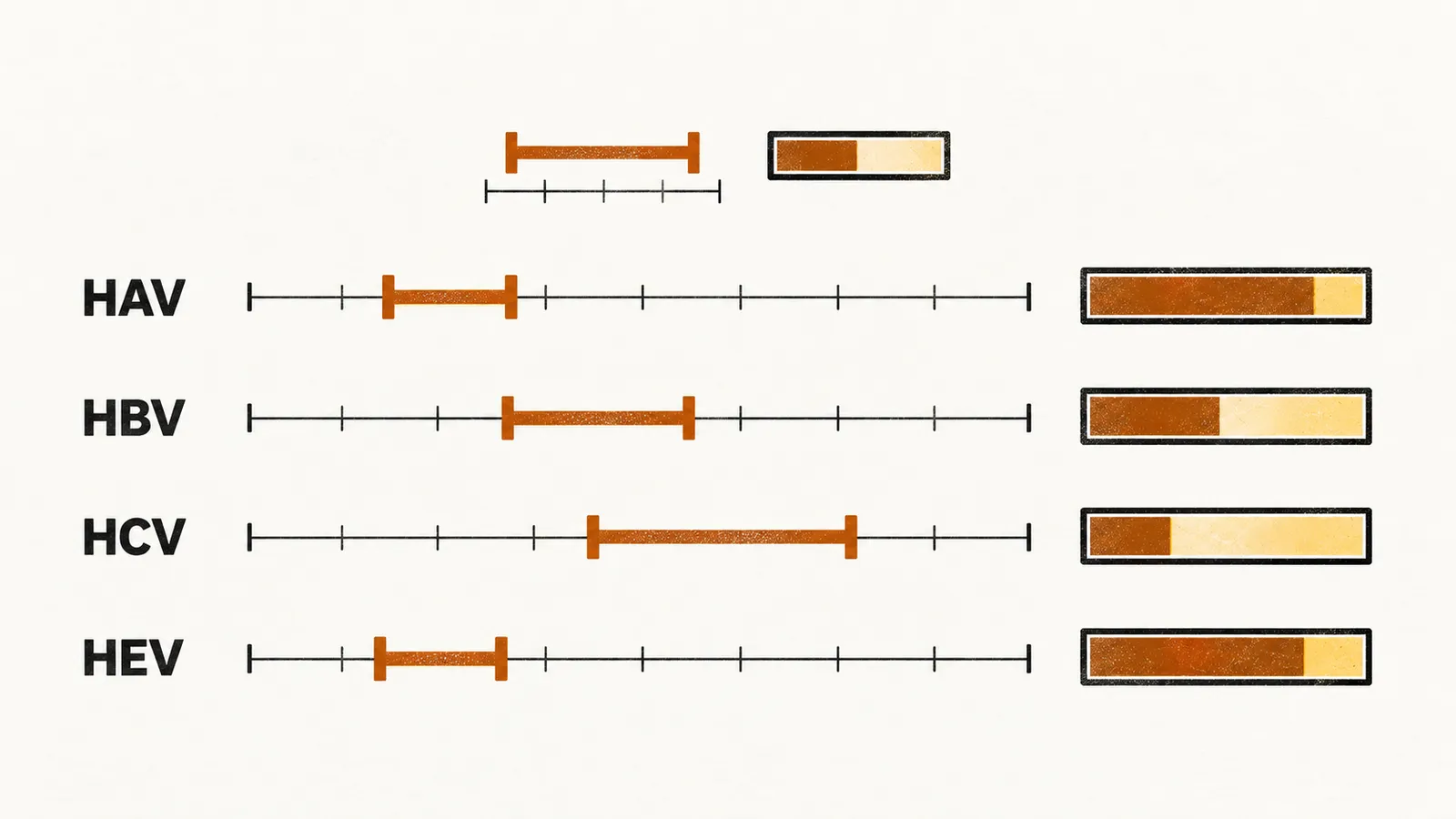
The incubation period, the interval from exposure to the onset of illness, differs between the viruses: about one month for HAV, about two to three months for HBV, about 7 weeks for HCV and about 5-6 weeks for HEV. The prodromal phase follows.
Prodromal phase
The first phase is the prodromal (pre-icteric) phase, and its symptoms are non-specific: anorexia, nausea and vomiting, fatigue, arthralgia and myalgia, headache, photophobia, pharyngitis, cough and coryza. Low-grade fever is more common with HAV and HEV than with HBV and HCV.
Two timing details are clinically useful. Dark urine and clay-coloured faeces can be reported 1-5 days before jaundice appears, because bilirubin is being excreted in the urine while its flow into the gut falls. The prodromal symptoms precede the jaundice by 1-2 weeks and, with the appearance of clinical jaundice, usually disappear. A substantial proportion of patients with viral hepatitis never become icteric, so the absence of jaundice does not exclude acute hepatitis.
Icteric phase
When jaundice (yellowing of the skin and eyes from raised bilirubin) appears, the patient enters the icteric phase. The signs and symptoms of this phase are pain and discomfort of the right upper quadrant of the abdomen, splenomegaly (an enlarged spleen) in 10-20% of cases, cervical adenopathy (enlarged neck lymph nodes) in 10-20% of cases, and spider angiomas (small spider-like skin vessels).
Recovery phase
After the icteric phase comes the recovery phase, in which the symptoms are mostly relieved, though some symptoms such as pain and biochemical signs such as elevated enzymes can persist. Complete recovery from acute hepatitis occurs after different lengths of time depending on the virus:
- HAV — 1-2 months after onset of jaundice, in all cases
- HBV — 3-4 months after onset of jaundice in self-limiting forms, which in healthy individuals happens in 95-99% of cases
- HCV — 3-4 months after onset of jaundice in self-limiting forms, which in healthy individuals happens in only 15-20% of cases
- HEV — 1-2 months after onset of jaundice, in all cases
When complete recovery does not occur for HBV and HCV, the infection persists and the virus can later reactivate. Reactivation has viral and host causes: viral-related factors include pre-core mutant HBV (a variant that does not express HBeAg), and host-related factors include the use of immunomodulators or immunosuppression.
Because the prodromal symptoms are non-specific and jaundice may be absent, the clinical picture alone cannot establish that a patient has viral hepatitis, let alone which virus. Laboratory tests are needed.