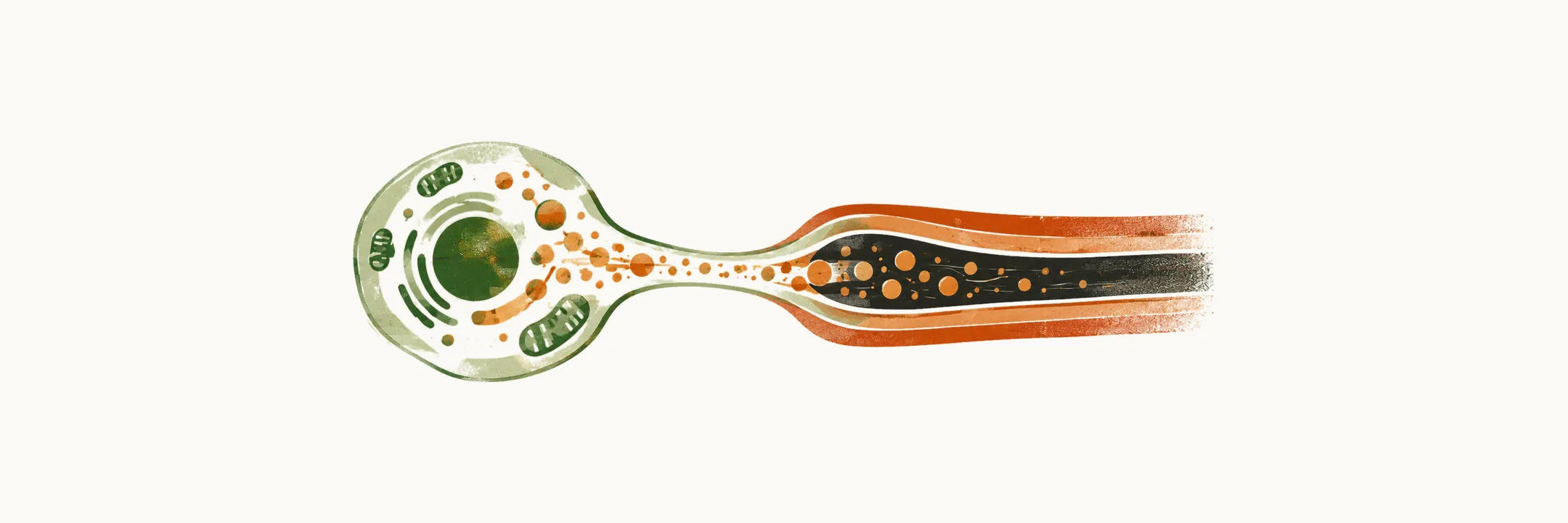
Think of the body’s water as two rooms. The larger room lies inside the cells. The smaller lies outside them, and it has two parts. This picture has one question running through it: does the size of the outside room tell us how well the tissues are supplied?
How much of the body is water?
In a healthy adult man weighing 70 kg, total body water is about 60% of body weight. That is about 42 liters. It is a reference figure for an average man, and the share moves with body composition, so the number is not fixed.
How is that water divided?
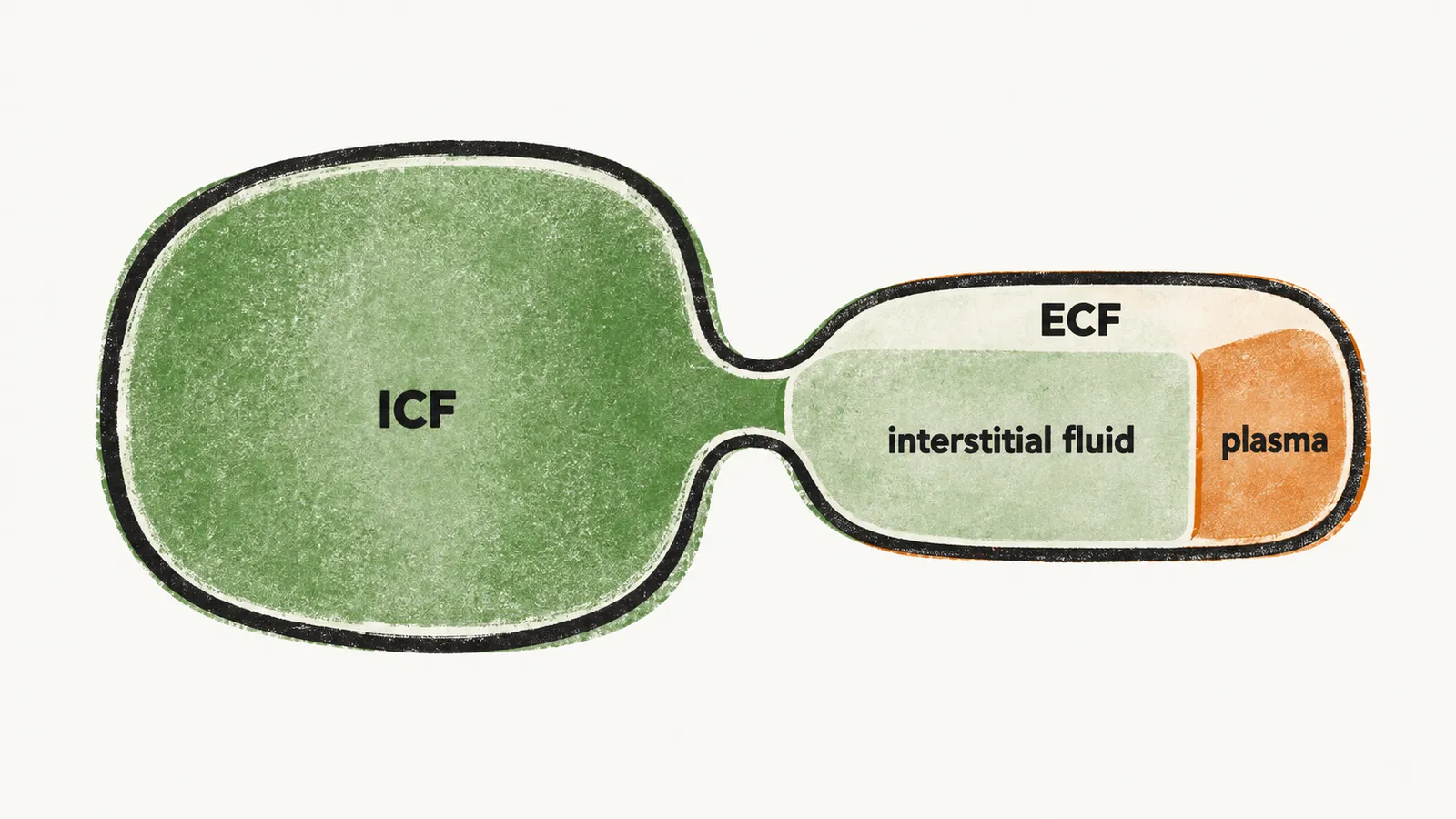
The 42 liters is not one pool. It is divided between two compartments.
- Intracellular fluid (ICF) lies inside the cells. It holds about two thirds of body water, roughly 28 liters.
- Extracellular fluid (ECF) lies outside the cells and surrounds them. It holds the remaining one third, roughly 14 liters.
The ECF is itself divided. The interstitial fluid lies between the cells and makes up about three quarters of the ECF, roughly 10.5 liters. The plasma is the fluid part of the blood and makes up the remaining quarter, roughly 3.5 liters.
Why is the share not always the same?
The 60% is a reference for an average man, so what moves it? The percentage of body weight that is water varies with age, sex and body composition. Muscle holds more water than fat. So the same body weight contains less water when fat mass is higher, and total body water is a lower percentage in obese individuals.
What is in each room?
Each room holds different main ions. In the ECF the main cation is sodium, and the main anions are chloride and bicarbonate. In the ICF the main cation is potassium, and the main anions are phosphate and proteins.
Why are the cations different? The sodium-potassium pump moves sodium out of the cells and potassium into them. So sodium is kept high outside and potassium high inside. That is why sodium is the main cation of the ECF and potassium of the ICF.
Why does losing outside fluid harm the tissues?
The main harm of losing ECF is a fall in tissue perfusion.
This can happen in two ways. In hypovolemia, water and sodium are lost together. In hypernatremia, water is lost.
Is the size of the outside room the same as the supply to tissues?
Reading ECF volume as a measure of perfusion is natural, but the two do not always move together.
The part of the vascular volume that is actually perfusing tissue has its own term, the effective intravascular volume. It can fall even when total ECF volume has risen.
Why do cirrhosis and heart failure break that link?
In cirrhosis, ECF volume rises while tissue perfusion falls, because of the systemic vasodilation these patients develop.
In heart failure, ECF volume also rises while cardiac output is too low to perfuse tissues properly.
What decides the sodium in this fluid?
What sets the sodium concentration of plasma, and how does the body keep the amount of sodium held in the ECF steady?