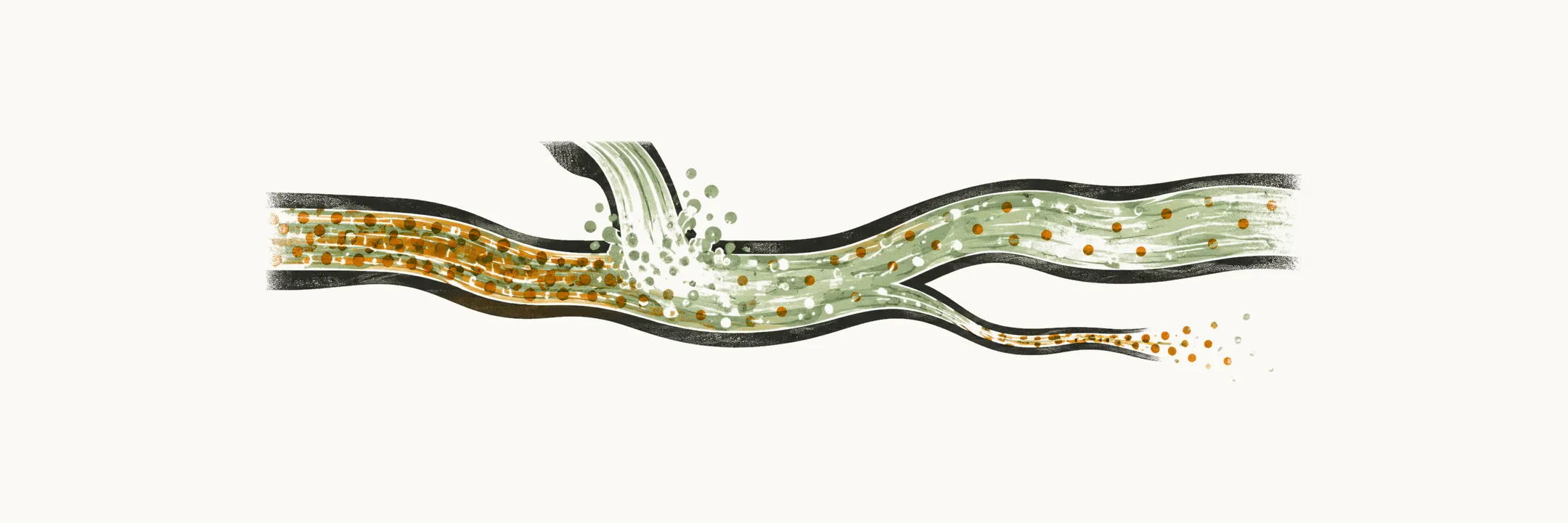
Water and sodium are kept by different controls, and a disorder appears when water or sodium leaves or enters out of step. The kidney decides how much water leaves: when ADH is high it keeps water, and when ADH is low it lets dilute urine go. Thirst is the second control, and it drives drinking. What stays behind changes according to how the lost fluid compares with the body fluid. So each disorder can be placed by asking what was lost, and in what proportion.
Hyponatremia and hypernatremia are disorders of water balance. Hypovolemia and edema are disorders of sodium balance: in them, water and sodium are lost together or retained together.
When does the body hold too much water?
Plasma sodium concentration is the sodium divided by the fluid it sits in. So the concentration falls when the body holds too much water, and it rises when the body has lost too much water.
Hyponatremia is mostly caused by an excess of water in the body. It appears when water intake is higher than water excretion. The kidney lets water out when ADH is low, so when water comes in faster than the kidney can release it, the plasma is diluted.
Why would the kidney hold water?
The intake gap is not the whole story. The kidney can also keep water it should release, and there are two main routes to hyponatremia.
The first route is reduced water excretion because the kidney is hypoperfused. This happens in cirrhosis and heart failure. In both, the effective intravascular volume is low even though the extracellular fluid volume is raised. In cirrhosis the cause is systemic vasodilation, and in heart failure it is low cardiac output. The kidney responds to effective intravascular volume, not to the total ECF volume. When it falls, the body triggers a neurohumoral response that holds sodium and water.
The second route is SIADH. ADH normally rises with plasma osmolality and is low when plasma is dilute. In SIADH it is released despite a low plasma osmolality. The kidney therefore keeps water, and the plasma stays dilute. SIADH is the most common cause of euvolemic hyponatremia.
When does the body have too little water?
The opposite error raises the concentration instead. Hypernatremia is mostly caused by excess water loss from the body, and it appears when water loss is not matched by water intake. It is a relative shortage of free water, so water lost without replacement raises the concentration.
What normally prevents this? Thirst is the body’s response to a detected deficit in body fluid, and it drives water intake. Working thirst and free access to water are what normally prevent hypernatremia. That is why hypernatremia mainly develops in patients who lack a thirst mechanism or lack access to water: nothing then replaces the water lost.
Which losses take water and sodium together?
Some losses leave the concentration alone and change the volume instead. Losing sodium and water from the body leads to hypovolemia. It arises from diarrhea, vomiting, diuretic therapy, bleeding and third-space sequestration of blood. Each cause takes sodium and water out by a different route: blood, kidney, gut, or loss into a third space.
When the fluid lost is isotonic with the body fluid, no change in plasma osmolality or sodium concentration is expected, so the disorder is one of volume. Those losses fall on perfusion. Depending on severity, hypovolemia can lead to hypotension, or even to shock and organ hypoperfusion. Here the effective intravascular volume falls, with the same consequences as in cirrhosis and heart failure.
Why does sodium retention cause edema?
Retaining water and sodium is the mirror of those losses: the volume grows instead of shrinking. This expands the extracellular fluid. When the kidney keeps sodium and water, the extracellular volume grows, and the extra fluid collects in the tissues.
What does the lost fluid do to the fluid left behind?
The direction depends on the solute in the lost fluid compared with the solute in the body fluid. The effect on ECF osmolality depends on the osmolality of the fluid retained or lost. That osmolality is set by the sodium and potassium the fluid contains, since sodium and its anions are the main solutes of the ECF and potassium is the main solute of the ICF. For hypovolemia, the final effect depends on the osmolality of the lost fluid.
The lost fluid is called hyperosmolar, iso-osmolar or hypo-osmolar when it is more concentrated than, equal to, or more dilute than the body fluids.
- Hyperosmolar lost fluid carries more solute than water. Proportionally more solute is removed, so relatively more water is left, and the body fluids become more dilute. The effect is hypo-osmolar.
- Iso-osmolar lost fluid has the same solute concentration as the body fluid. Bleeding is the example: blood is iso-osmolar, so losing it leaves plasma osmolality and sodium concentration unchanged. The effect is iso-osmolar.
- Hypo-osmolar lost fluid carries relatively less solute than water. More solute stays in the body fluid, so osmolality rises and the body fluids become more concentrated. The effect is hyper-osmolar.
Which losses push in opposite directions?
A thiazide and diarrhea show the two directions. The urine a thiazide produces is hyperosmolar, so the effect is hypo-osmolar, as above.
In diarrhea the total osmolality of the sodium and potassium in the lost fluid is below that of the body fluid. The body fluid is concentrated, and the effect is hyper-osmolar.
Does the body answer the loss?
The comparison can be overridden, since in some patients the body responds through ADH. The effect of hypovolemia on body fluid osmolality is not always predictable from the osmolality of the lost fluid.
In some patients frank hypotension follows the hypovolemia and activates ADH secretion. Decreased baroreceptor signals from the low arterial blood volume trigger the release, and significant hypotension is a stronger stimulus than a rise in osmolality. When ADH is high the kidney retains water and dilutes the blood. Hyponatremia then develops regardless of the fluid lost, even though fluid and sodium were lost.
What reaches the cells?
Water crosses the cell membrane, so whichever way the osmolality of the body fluid shifts, the cells respond to it. Why should brain cells be the ones that show it clinically?