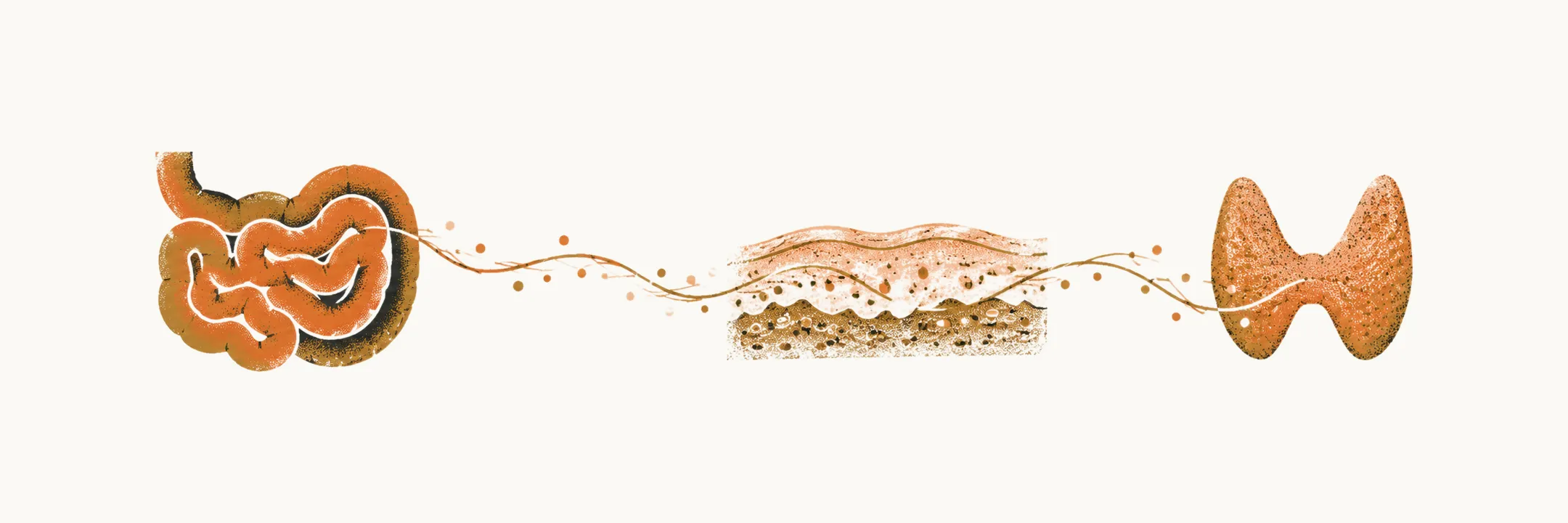
A large number of disorders occur more commonly in patients with celiac disease (CD). They are either autoimmune conditions or disorders that occur more commonly with the same HLA haplotypes, HLA-DQ2/DQ8, the gene variants that confer susceptibility to CD. Recognising them matters both for finding undiagnosed celiac disease and for managing a patient already known to have it.
Autoimmune diseases
Autoimmune diseases, in which the immune system attacks the body’s own tissues, are strongly associated with CD, with a prevalence of 20% in adults with CD. Autoimmune thyroid disorders are common in patients with CD, and hypothyroidism is more common than hyperthyroidism. Type 1 diabetes mellitus (T1DM) is strongly associated with CD, which in part reflects the increase of celiac-associated DQ alleles in its pathogenesis.
Dermatitis herpetiformis
One association involves the skin. Dermatitis herpetiformis (DH) is a papulovesicular condition (small raised and blistering lesions) occurring on the extensor parts of the limbs, the buttocks, the scalp and the neck, and it is intensely pruritic (itchy). It has its own autoantigen: the dominant autoantigen of DH is epidermal transglutaminase (type 3 TG), while in CD the dominant autoantigen is type 2 TG (tTG). The diagnosis of DH is made by biopsy immunofluorescence findings of IgA in the skin in a granular or speckled manner.
DH is considered the celiac disease of the skin, but the two can occur completely independently: 80% of patients with DH have tissue-proven CD, while only a minority of CD patients have DH. About 5-15% of patients with DH-like skin lesions are diagnosed with a similar condition called linear IgA disease, which is characterised by linear deposition of IgA in the skin.
Hyposplenism and microscopic colitis
Hyposplenism (reduced splenic function) and splenic atrophy (shrinkage of the spleen itself) carry a higher risk of infections. Hyposplenism is a functional rather than an anatomical problem, whereas splenic atrophy is a change in the organ’s structure. This infection risk is the reason vaccination status is reviewed in patients with celiac disease.
Microscopic colitis, an inflammation of the colon seen only under the microscope, is also associated with celiac disease. These conditions can both cause chronic diarrhea, so in a patient with known celiac disease who continues to have diarrhea on a strict gluten-free diet, microscopic colitis is one of the alternatives to consider; how such non-responsive disease is approached is covered in Treatment of Celiac Disease.
Because these conditions raise the likelihood of celiac disease, they also help decide who should be tested, which is the subject of Diagnosis of Celiac Disease.