The gastric mucosa is constantly under attack by endogenous and exogenous damaging factors such as acid, pepsin and pepsinogen, bile salts, bacteria, drugs and alcohol. A sophisticated mucosal barrier is therefore needed to prevent damage to the gastric mucosa. This barrier has three layers, or levels.
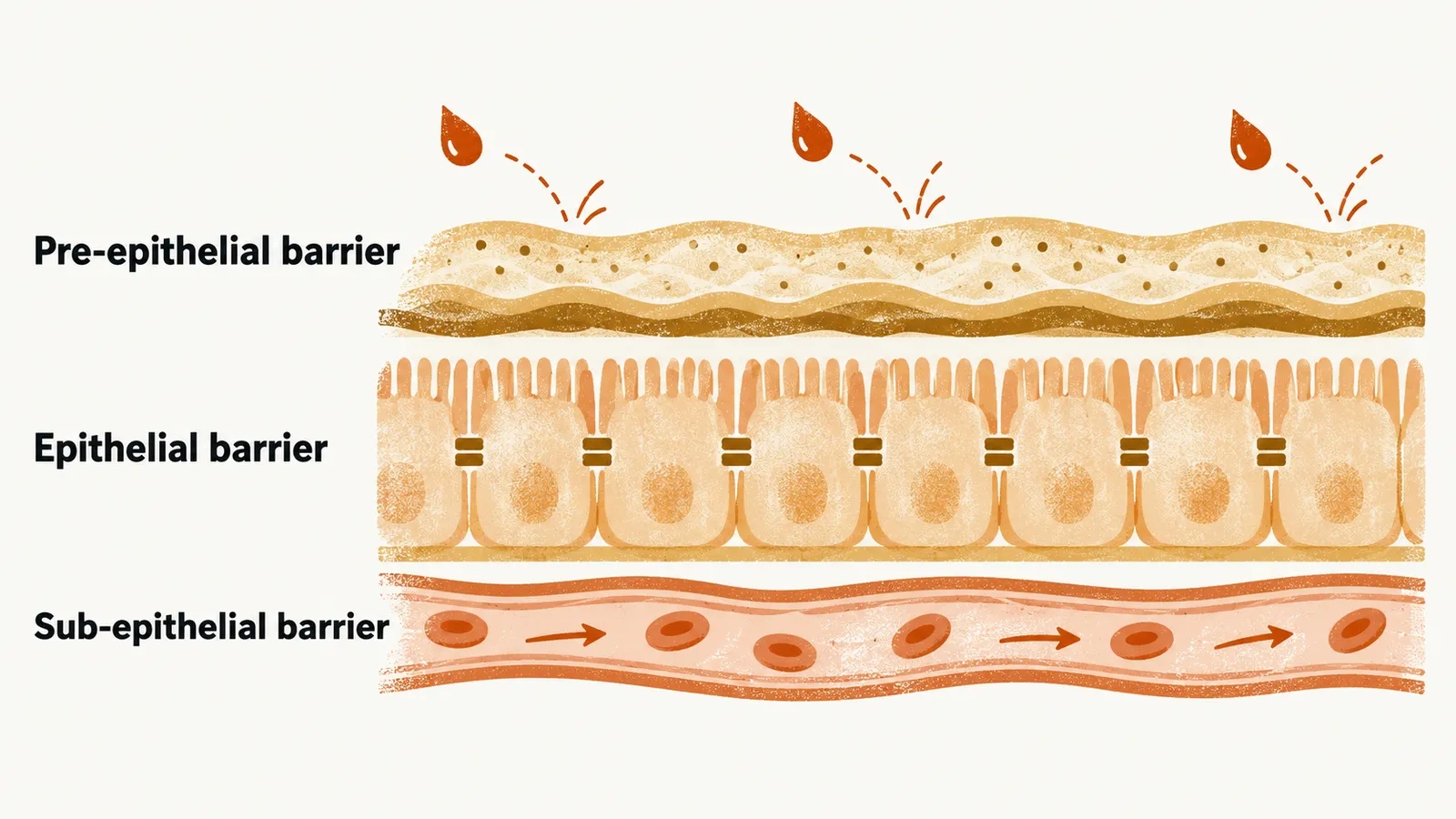
Pre-epithelial barrier
The pre-epithelial elements form the mucus–bicarbonate–phospholipid complex, which the epithelial cells of the gastroduodenal system secrete in two parts. The first is mucus, made up mainly of water and glycoprotein: this relatively thick layer is a physicochemical barrier that prevents molecules such as pepsin or proton ions from reaching the cells. The second is bicarbonate, which sets up a gradient of pH that runs from 6–7 at the epithelial surface to 1–2 in the lumen, so that the cells sit against a near-neutral layer even while the lumen is strongly acidic.
Epithelial barrier
The epithelial cells of the gastroduodenal region protect themselves in several ways: they produce mucus, they transport ions to maintain intracellular pH and to make bicarbonate, and they seal the space between adjacent cells with intercellular tight junctions.
The epithelium also repairs itself. When some epithelial cells are damaged, the surrounding intact cells migrate to the site of injury and cover it, a process called restitution; several growth factors take part, including epidermal growth factor (EGF), transforming growth factor (TGF) and fibroblast growth factor (FGF). Larger damage that restitution cannot close needs cell proliferation, which depends on prostaglandins and TGF. Renewal of the epithelium rests on gastric stem cells, and parietal cells, which also express the sonic hedgehog gene, are believed to control them.
Sub-epithelial barrier
The sub-epithelial elements act mainly through the microvasculature, which is rich in hydrogen sulfide (H2S), nitric oxide (NO) and prostaglandins. These keep the vessels of the stomach vasodilated, so that blood flow stays high enough to prevent hypoxic damage. Prostaglandins, if not the main actor in gastric mucosal defence, play an important part: they inhibit parietal cells from over-producing acid, dilate the microvasculature and keep the vessels patent, stimulate bicarbonate and mucus production, and stimulate epithelial cell restitution.