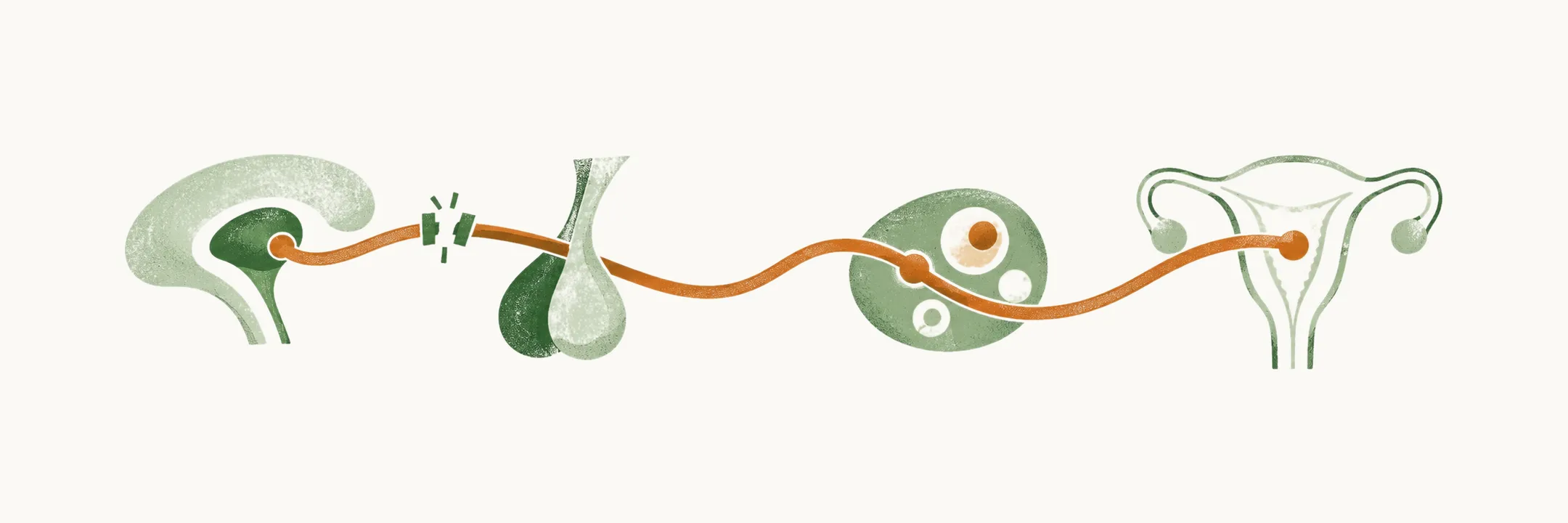
Amenorrhea is the absence of menstruation during the reproductive years when it is not caused by pregnancy, lactation or menopause. Menstrual cycles occur at intervals of 28 ± 3 days in two thirds of women, and the normal range is 21–35 days. Amenorrhea can be defined in two ways:
- Primary amenorrhea: absence of menarche in a girl after the age of 15 years.
- Secondary amenorrhea: lack of menses for 3 consecutive months in a woman with a past history of menstruation.
A sign, not a diagnosis
A definition says only that bleeding is missing, so the next question is what bleeding needs. A period is the last step of a chain of four components: the hypothalamus, the pituitary, the ovary, and the uterus with its outflow tract. All four must function for menstruation to occur. If any one is nonfunctional or abnormal, bleeding cannot happen.
That is why amenorrhea is a sign rather than a diagnosis. It points to a disorder somewhere in the hypothalamus–pituitary–ovary–uterus axis, and the cause can lie at any point along it. Treatment follows the cause rather than the amenorrhea itself, so the first question is where in the axis the fault lies.
Where to start
Since the first question is where the fault lies, the satellites follow that order:
- Causes and Initial Evaluation of Amenorrhea classifies amenorrhea by cause into anatomical amenorrhea, ovarian failure and chronic anovulation. It then follows the evaluation: the four aspects of history and physical examination, exclusion of pregnancy, and first-line laboratory tests. These sort the patient into a category, and the specific entity and its management follow from the category.
- Hypergonadotropic Amenorrhea covers amenorrhea with a high gonadotropin level. Gonadotropins are the pituitary hormones FSH and LH, which drive the ovary. This kind is most often caused by primary ovarian insufficiency. It explains the terminology of gonadal dysgenesis and the genetic, autoimmune and environmental causes behind primary ovarian insufficiency.
- Management of Amenorrhea explains how each category is treated, from restoring energy balance in hypothalamic amenorrhea to hormone replacement in ovarian failure.
A reader unfamiliar with the approach to a patient with amenorrhea starts with the causes and initial evaluation. If four parts must all work for a period, how does a clinician tell which one has failed?