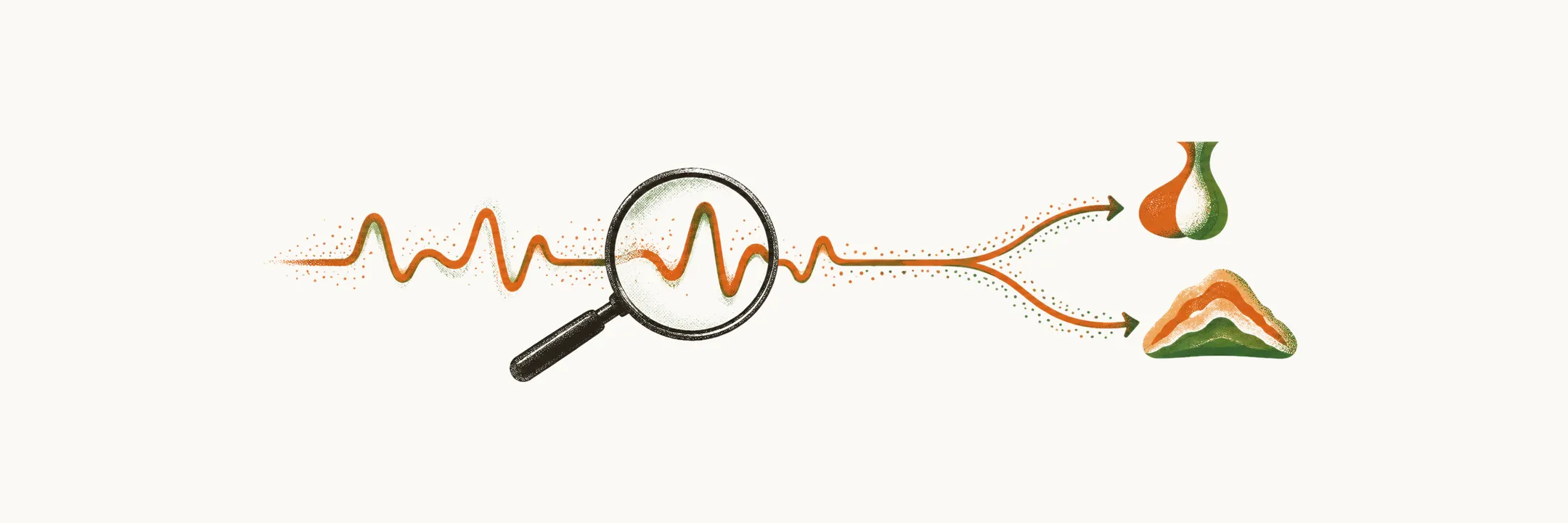
Cortisol is not a fixed number. It is released in pulses, it peaks in the early morning and it falls to its lowest level at night. Normal cortisol also switches off its own drive through negative feedback on the pituitary and hypothalamus, as the Causes and Forms of Cushing’s Syndrome note showed. Dexamethasone, a synthetic glucocorticoid, acts on that same loop, so a normal gland should respond to it by shutting cortisol down. Each test below reads a different part of this pattern: the total over a day, the night-time fall, or the response to dexamethasone.
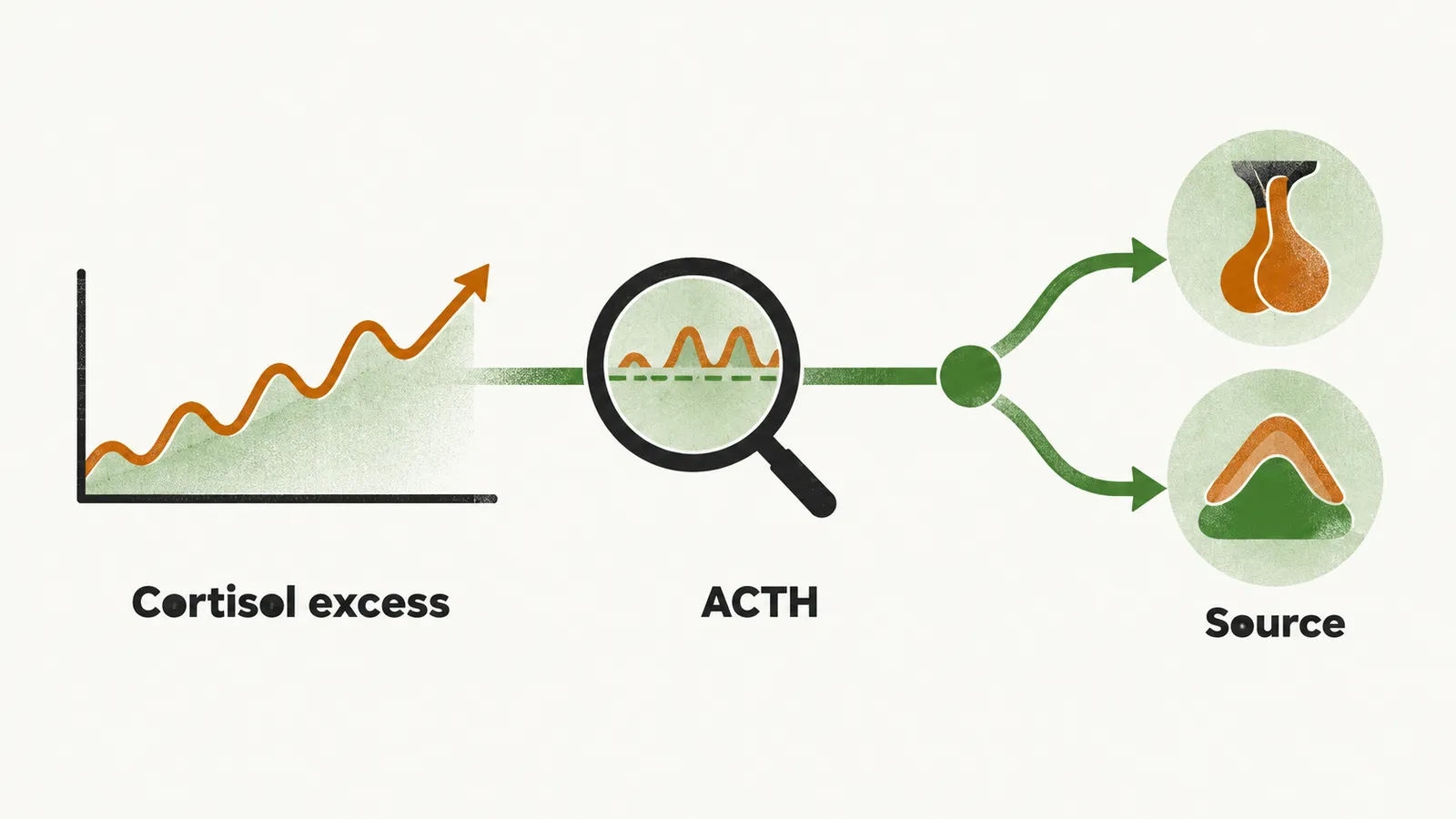
Cushing’s syndrome is a state of chronic glucocorticoid excess. Diagnosis is made in two stages: first confirm that cortisol excess is present, then find its cause.
What should make you think of it?
Cushing’s syndrome is easy to miss when the signs are mild. Obesity, depression, diabetes, hypertension and menstrual irregularity are all common in the general population.
So the question is not whether a feature is present, but whether it fits. Consider Cushing’s syndrome when:
- a patient has features that cannot be explained in another way;
- several features cluster in a pattern that does not fit a single diagnosis;
- features appear at a much earlier age than expected, for example osteoporosis, fractures or hypertension in a young adult;
- features accumulate over a period of time.
Also consider it as a secondary cause in a patient with obesity, depression, diabetes, hypertension or menstrual irregularity who has additional features those conditions do not explain, such as wide purple striae or proximal muscle weakness.
A clue like this raises the question. It does not say where the cortisol comes from.
Could a drug explain it?
The first thing to rule out is whether the cortisol comes from a drug. Exogenous glucocorticoids are glucocorticoids taken as medication. Iatrogenic treatment is the most common cause of Cushing’s syndrome, as the causes note set out.
They are easy to overlook. They are prescribed by oral, topical, rectal and inhaled routes. They are also present in some injections, in non-prescription topical medicines, in skin-lightening creams and in traditional herbal preparations.
A glucocorticoid taken as medicine acts through the same feedback loop as cortisol and can suppress the body’s own ACTH and cortisol. That is why a Cushingoid patient who may have used any of these is assessed for exogenous exposure before an endogenous cause is pursued.
Is cortisol excess present at all?
Once the drug is set aside, the first job is to confirm that cortisol excess exists at all. The question of the source makes sense after that is answered.
Morning cortisol on its own is not a good screening test. Cortisol peaks in the early morning, so a single morning value sits high on a normal rhythm and cannot separate normal from excess.
Initial screening instead uses a test with high diagnostic accuracy. The choices are:
- 24-hour urinary free cortisol (UFC);
- late-night salivary cortisol;
- the 1-mg overnight dexamethasone suppression test.
The 2-mg 2-day dexamethasone suppression test is an alternative screening test.
These tests read different parts of one pattern, and no single test is perfect. They complement each other, so more than one is usually measured.
Why can one cortisol value mislead?
A test that shows one moment cannot settle the question, because cortisol itself moves through the day and in pulses. Cortisol secretion varies over time.
Each screening test reflects a different abnormality:
- UFC reflects high integrated daily cortisol production. A 24-hour collection gathers the output of the whole day, pulses and rhythm included.
- Late-night salivary cortisol reflects loss of the late-night nadir. Cortisol normally falls to its lowest at night, so an excess that keeps the night-time level up shows at that time.
- The dexamethasone suppression test reflects impaired negative feedback. Dexamethasone normally suppresses cortisol through the feedback loop, so the test asks whether the loop still switches cortisol off.
Because a single sample can fall on a pulse or on a low point, at least two measurements are needed for UFC and at least two for late-night salivary cortisol.
What does the overnight dexamethasone result show?
The suppression result is read against the morning value a normal loop should produce. Cortisol normally peaks in the morning, and after dexamethasone taken at midnight a normal loop should shut that rise down. So after 1 mg taken at midnight, a normal cortisol at 9 a.m. is below 1.8 µg/dL (50 nmol/L).
Higher 9 a.m. values indicate autonomous secretion. The source is not being switched off by feedback, so the morning value stays high.
The result depends on the assay used. It must be interpreted against that assay’s own reference range.
When is a high result only pseudo-Cushing’s?
A high result can come from the body’s own stress response rather than from a tumour. Mildly abnormal results also occur in conditions that raise cortisol without true Cushing’s syndrome. Examples are pseudo-Cushing’s states driven by stress, depression or anorexia nervosa. As the causes note described, these act on the CRH-producing neurons.
Activation of the hypothalamic-pituitary-adrenal axis, whether by these conditions or by alcohol or inflammatory disease, is sustained or intermittent and reversible. It is driven by the underlying condition. That is why pseudo-Cushing’s states are usually separated by observing the patient over time and treating the underlying condition.
Which family is it?
Once cortisol excess is confirmed, ACTH decides the family, as the causes note set out. ACTH is measured as the first step.
A low or undetectable ACTH identifies an ACTH-independent cause, because the excess cortisol has already switched off the pituitary. The adrenal glands are then imaged with CT or MRI. The imaging looks for a unilateral mass with atrophy of the opposite gland, or for bilateral disease.
A normal or elevated ACTH identifies an ACTH-dependent cause. That cause is investigated further to separate a pituitary source from an ectopic one.
How is an ACTH-dependent source told apart?
When ACTH is normal or high, the next step separates the pituitary from an ectopic source. The investigations are:
- the high-dose (8 mg) dexamethasone suppression test, used when low-dose results are equivocal;
- the CRH stimulation test;
- pituitary MRI;
- inferior petrosal sinus sampling.
Imaging alone is unreliable here. In Cushing’s disease the adenoma is usually a microadenoma, and it is visible on pituitary MRI in only about 60% of adults. A pituitary lesion is also not proof of Cushing’s disease: about 10% of healthy adults have small pituitary lesions visible on MRI, and about 12% of patients with ectopic ACTH secretion also have an abnormal pituitary MRI.
So when imaging is negative or ambiguous, inferior petrosal sinus sampling is used to distinguish a pituitary from a non-pituitary source. The cavernous sinuses drain into the inferior petrosal sinuses, which drain into the internal jugular vein. Sampling there reads the blood draining the pituitary, so it can test the pituitary as the source even when no lesion is visible. It does not reliably predict the side of the tumour.
For a suspected ectopic source, imaging of the chest and abdomen is guided by the likely tumour.
Once the source is named, can the excess be removed, and what must be watched afterwards?