What is different in pregnancy?
The thyroid runs on the same loop as before: TSH from the pituitary drives the gland, and the hormone the gland makes restrains TSH by feedback, as the structure note showed. Pregnancy changes that loop in several ways at once, so the gland does not work exactly as it did before.
Five factors act together:
- hCG from the placenta, which is close enough to TSH to reach the gland’s own receptor.
- Estrogen, which raises the binding protein, so more hormone is held in bound form.
- Placental type III deiodinase, which clears hormone from the mother’s supply.
- Higher iodine loss in the urine.
- Changes in the immune system.
Together these raise the demand for hormone and for iodine. That is why normal thyroid ranges and the thyroid hormone requirement differ from the non-pregnant state.
The first of these changes comes from the placenta, and it is hCG.
How can hCG move the gland?
hCG rises transiently in the first trimester. It peaks near the end of that trimester and then drops to a plateau for the rest of pregnancy.
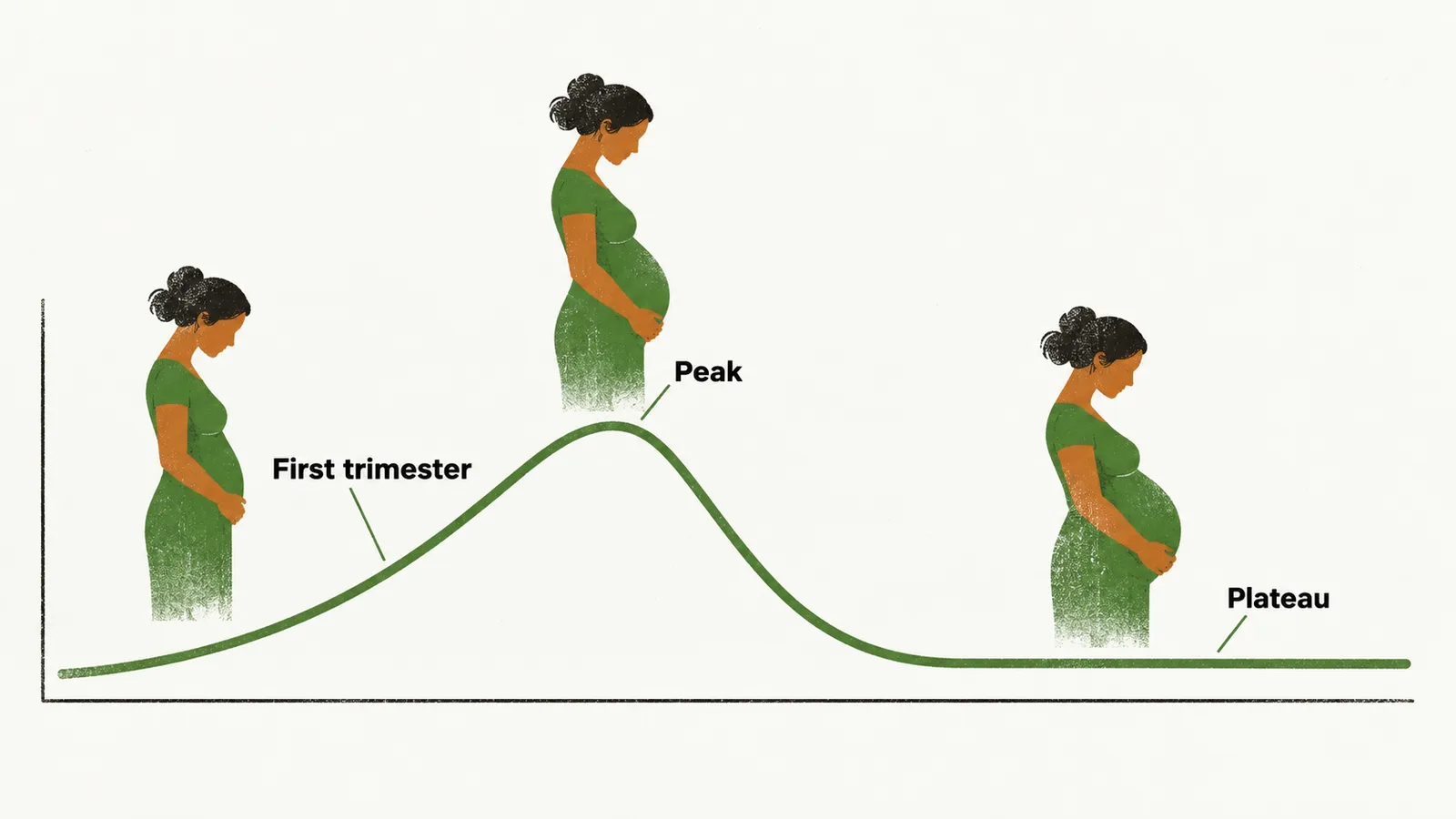
Why would a pregnancy hormone act on the thyroid? Because hCG and TSH share structure: they share an alpha subunit, from the structure note. So hCG is similar enough to TSH that it slightly activates the TSH receptor. The TSH receptor raises cAMP inside the follicular cell, from the metabolism note, so when hCG switches it on, the gland is stimulated a little and makes a little more hormone.
What does that small push do to the hormone and to TSH?
What does the push do to hormone and TSH?
A small push lifts the hormone, and the pituitary feels the lift. T4 during the first trimester is normal or even higher. The hormone restrains TSH by feedback, so the effect of hCG on TSH secretion in the first trimester is inhibitory to some extent. That is why TSH decreases during the first trimester.
Can the push go too far?
Why can the push go too far?
The same push, if strong enough, drives the gland past normal. In some women hCG leads to transient gestational hyperthyroidism; this mechanism is attributed to hCG. The state is time-limited because hCG falls after the first trimester. It is characterised by hyperemesis gravidarum, and its nausea and vomiting are severe, with a high risk of volume depletion.
Why does the push stop?
Why does the push fade, and what does it do to the values?
After the first trimester, hCG levels off, so its push ends. From mid-gestation TSH returns to the normal non-pregnant level. The hCG push also fades later in pregnancy, so T4 decreases toward the normal lower cut-off at the end of the third trimester.
So the values move through pregnancy. Normal ranges differ between trimesters of gestation, and one range cannot cover them all. A test value means something against its own range.
Why do the total levels rise even when the free level does not?
Why do the total levels rise while the free level holds?
Estrogen is the second change, and it acts on the binding protein. During the first trimester estrogen raises thyroxine-binding globulin (TBG). A proposed mechanism is that estrogen increases the sialylation of TBG. Increased sialylation of TBG lengthens its half-life in the blood.
TBG carries most of the hormone in blood, and the unbound part is sensed, from the metabolism note. Total T3 and T4 include the bound fraction, so with more TBG they are 1.5 times normal values during pregnancy, while the free fraction can stay near normal.
Where else does the mother lose hormone and iodine?
Why does the mother need more hormone and iodine?
The binding protein holds more, the placenta clears hormone, and the kidney loses iodine. The placenta’s type III deiodinase inactivates T4 and T3, from the metabolism note, and it increases thyroid hormone metabolism. As a consequence, hormone is removed from the mother’s supply and more is needed. Iodine excretion in the urine also increases; the usual explanation is that renal blood flow and filtration rise, so more iodide is cleared from plasma and lost.
The gland builds hormone from the iodine it takes up, from the metabolism note. Together these changes raise demand for hormone and for iodine, so the gland must make more hormone and take up more iodine. The fetus also needs iodine, and its requirements add to this.
WHO suggests that all pregnant women, and women during the breastfeeding period, have 250 micrograms per day of iodine in the supplemental diet.
Is the immune system part of this?
Why does the immune system matter?
Not every change is in the blood; the immune system changes too. An alteration in the immune system can lead to exacerbation or formation of autoimmune thyroid diseases. The year after delivery is a period when autoimmune thyroid disease can begin or flare, and a rebound of the immune system after pregnancy is proposed as a possible cause.
What does this mean for a woman already on levothyroxine?
What does this mean for a woman on levothyroxine?
The thyroid hormone requirement for hypothyroid patients using levothyroxine during pregnancy increases by up to 45% of the normal dosage.
So what happens when the gland cannot keep up with that demand?