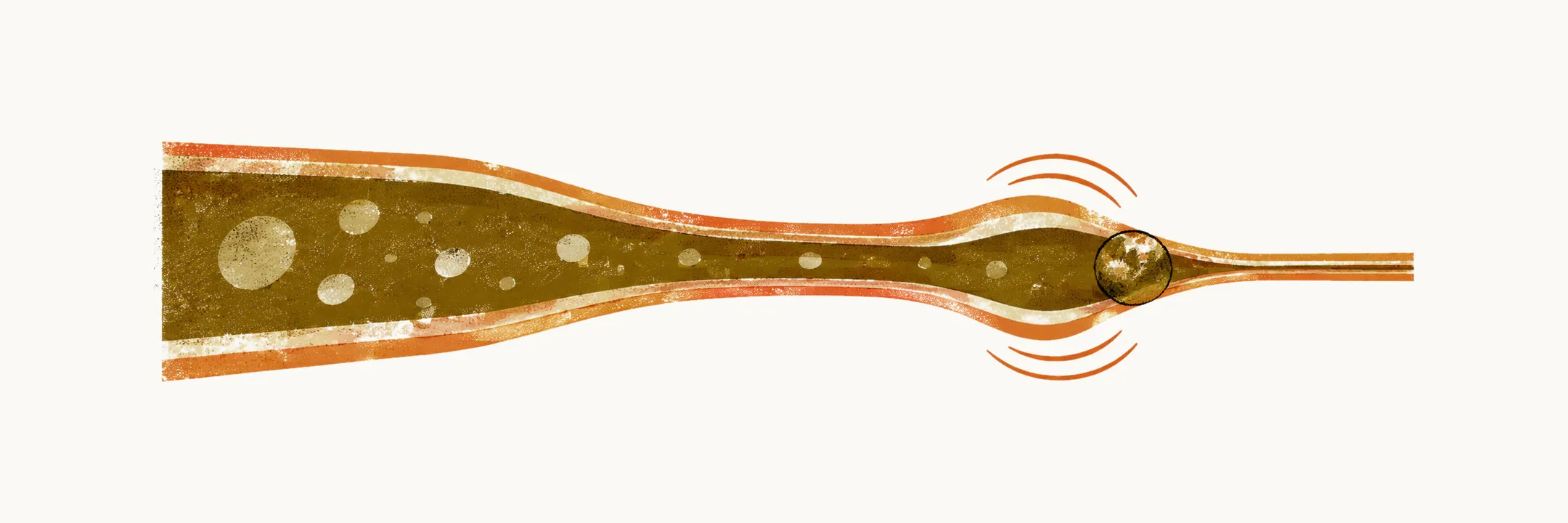
Several different conditions predispose to acute pancreatitis, but two dominate: gallstones and alcohol together account for most cases. The rest are less common, including hypertriglyceridaemia, drugs, hypercalcaemia, infection, trauma, and the settings after endoscopic procedures on the bile and pancreatic ducts or after surgery. In a substantial number of episodes no predisposing condition is found, and the episode is then called idiopathic acute pancreatitis; how often that label is needed is a measure of how much is still unknown about what triggers the disease.
Gallstones and other obstruction
Gallstones are the single most common cause of acute pancreatitis, accounting for about 40–60% of cases among all factors and among the obstructive causes, although only 3–7% of patients with gallstones ever develop the disease. For a stone to pass the cystic duct, reach the ampulla and obstruct it, its diameter must be less than 5 mm.
Biliary sludge is a viscous suspension in the gallbladder formed mainly from thick bile with calcium bilirubinate and other bile salts, together with small stones of less than 3 mm in diameter, which is why it is sometimes called biliary sludge with microlithiasis. It is found in patients who fast for a long time or lose weight very rapidly, and on ultrasound it appears as a low-amplitude echo without a shadow, with a fluid-fluid level. Some studies find biliary sludge in about 70% of patients labelled by other diagnostic tools as idiopathic.
Tumours can also obstruct the duct, most often intraductal pancreatic mucinous neoplasms; the relationship can run in both directions, because chronic pancreatitis significantly increases the risk of pancreatic cancer. Less common obstructive causes include duodenal diverticula, parasitic diseases such as ascariasis, and annular pancreas.
Alcohol
Alcohol use is the second most common cause, accounting for at least 30% of all cases, and is the most common cause of chronic pancreatitis in developed countries. To carry a risk of acute pancreatitis a drinker has to fit the definition of prolonged alcohol consumption — 4–5 drinks per day for at least 5 years — and even then the lifetime risk of acute pancreatitis is only 2–5%.
As the evidence stands, studies are better at showing alcohol as a cause of chronic rather than acute pancreatitis. Some studies and autopsy series describe an indolent chronic pancreatitis that becomes apparent with an episode of acute pancreatitis, while others describe acute pancreatitis arising directly from alcohol use; most favour the former, in which chronic involvement is present before the first attack. The chronology is still uncertain because there is evidence for both directions, but the most convincing account is that some chronic involvement of the pancreas precedes the first episode of acute pancreatitis.
Telling gallstones from alcohol
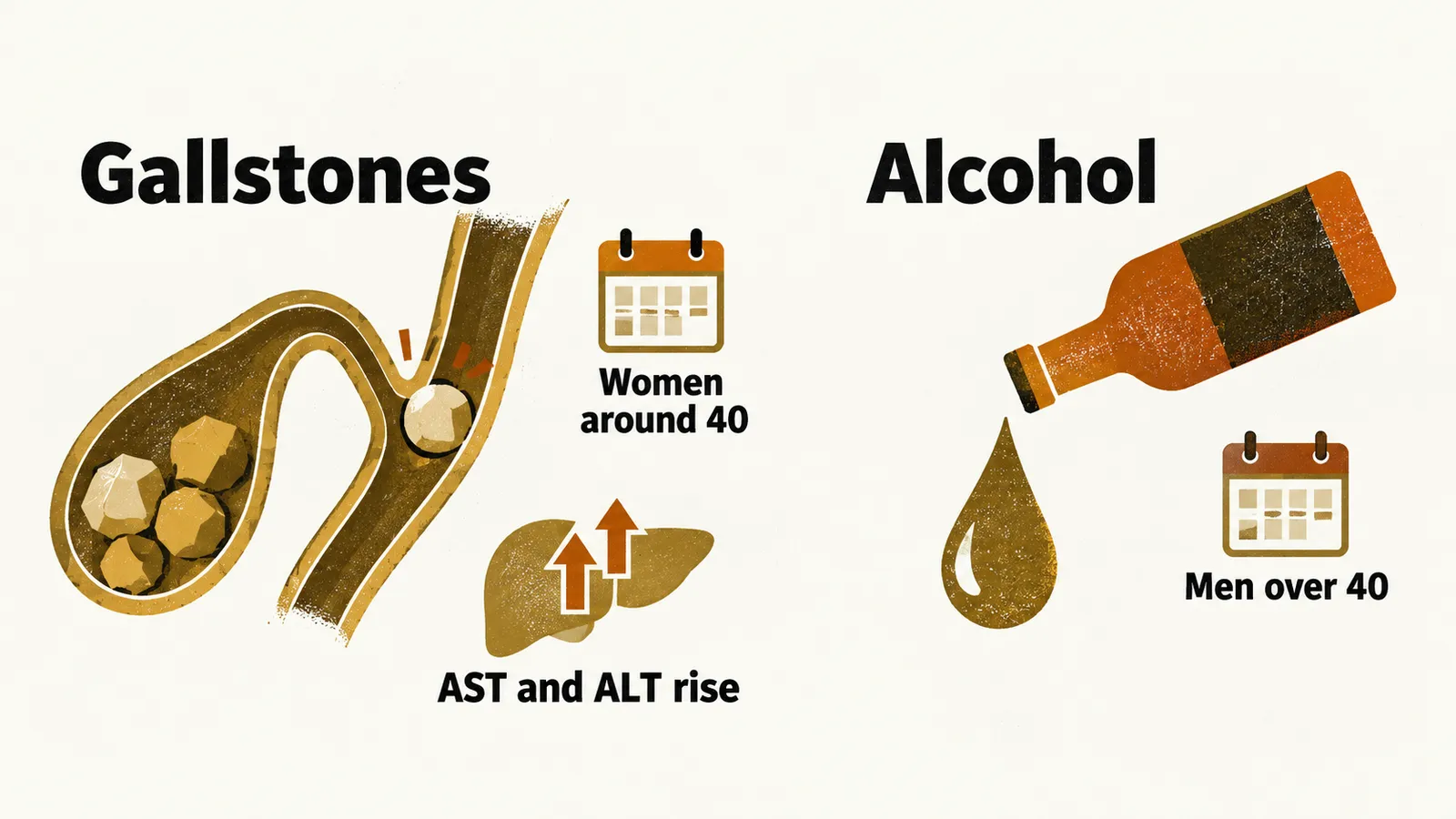
The two commonest causes can often be told apart clinically. Alcohol-induced acute pancreatitis mostly happens in men older than 40 years of age with at least 5–10 years of heavy alcohol use, while gallstone-induced acute pancreatitis mostly happens in women around 40 years old. An increase of AST and ALT over 3-fold above the upper limit of normal (ULN) suggests biliary acute pancreatitis, whereas bilirubin and alkaline phosphatase levels are not useful for this distinction.
Metabolic causes
Hypertriglyceridaemia is perhaps the third most common cause after gallstones and alcohol, accounting for 5–20% of cases, and carries a worse prognosis than the other causes. Patients with hypertriglyceridaemia-induced acute pancreatitis fall into three groups: diabetic patients with poorly controlled diabetes and hypertriglyceridaemia; alcoholic patients with hypertriglyceridaemia; and non-diabetic, non-alcoholic, non-obese patients whose hypertriglyceridaemia is induced by diet or drugs. Diabetes mellitus raises the risk of acute pancreatitis, possibly because of a higher risk of gallstone formation and hypertriglyceridaemia.
Hypercalcaemia of any cause can be associated with acute pancreatitis, because a sudden increase of calcium activates trypsinogen and its conversion to trypsin; primary hyperparathyroidism can cause it less commonly, while the more common causes of an acute rise in plasma calcium are metastatic bone disease, vitamin D toxicity and sarcoidosis.
Drugs
Drug-induced pancreatitis is rare, under 1% of cases, and is mostly mild and self-limiting, with onset about 4–8 weeks after the drug is started. The most common mechanism is a hypersensitivity reaction; less common mechanisms are accumulation of drug metabolites, drugs that induce hypertriglyceridaemia, and direct toxicity to pancreatic cells.
Procedures, surgery and other causes
The remaining groups are less common: infections, vascular diseases, trauma and inherited forms. Post-ERCP pancreatitis is the most feared complication of ERCP (endoscopic retrograde cholangiopancreatography, an endoscopic procedure on the bile and pancreatic ducts): an asymptomatic increase of amylase in the plasma occurs in 35–70% of procedures, and acute pancreatitis follows about 5% of them. A serum lipase of more than 1000 together with a serum amylase of 276 two hours after completion of the procedure is reported to have a 100% positive predictive value for post-ERCP pancreatitis. Pancreatitis can also follow thoracic and abdominal surgery, and about 5% of cases of cardiopulmonary bypass surgery are complicated by acute pancreatitis.