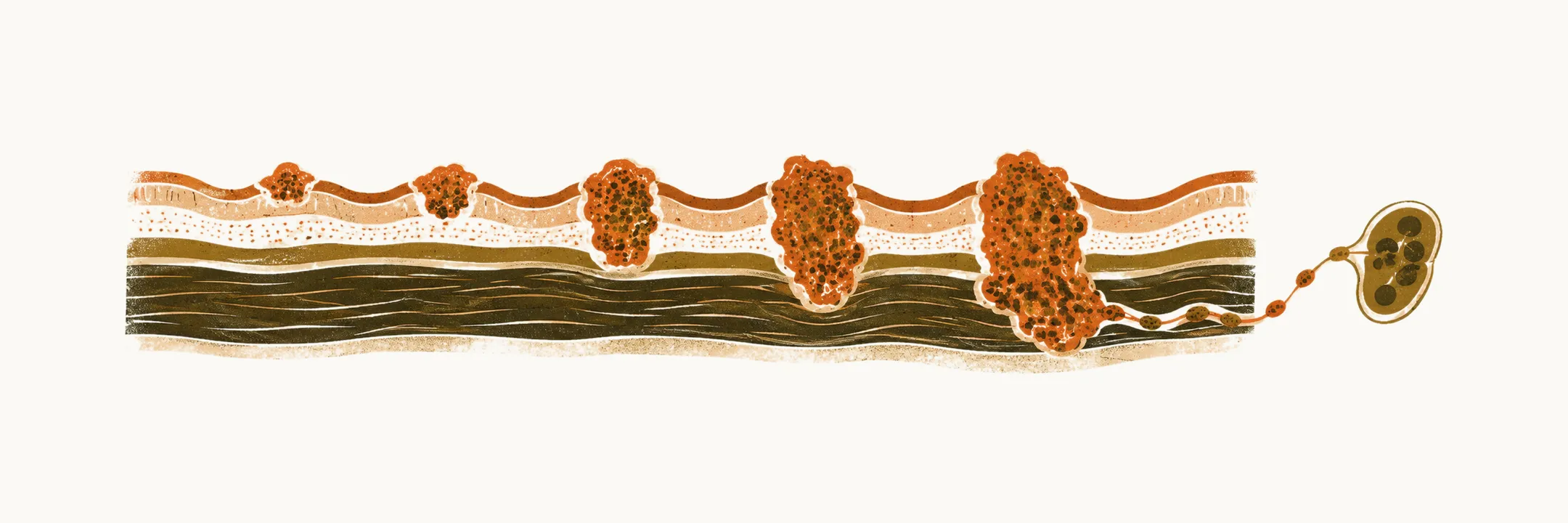
Esophageal cancer is staged with the TNM system, and the depth of tumor invasion and nodal spread are also the strongest predictors of survival, so staging and prognosis are closely tied.
Staging
Esophageal cancers are staged with three systems, depending on how the information was obtained:
- pathological staging (pTNM), from the resected specimen
- post-neoadjuvant pathologic staging (ypTNM), after preoperative treatment
- clinical staging (cTNM), from tests done before treatment
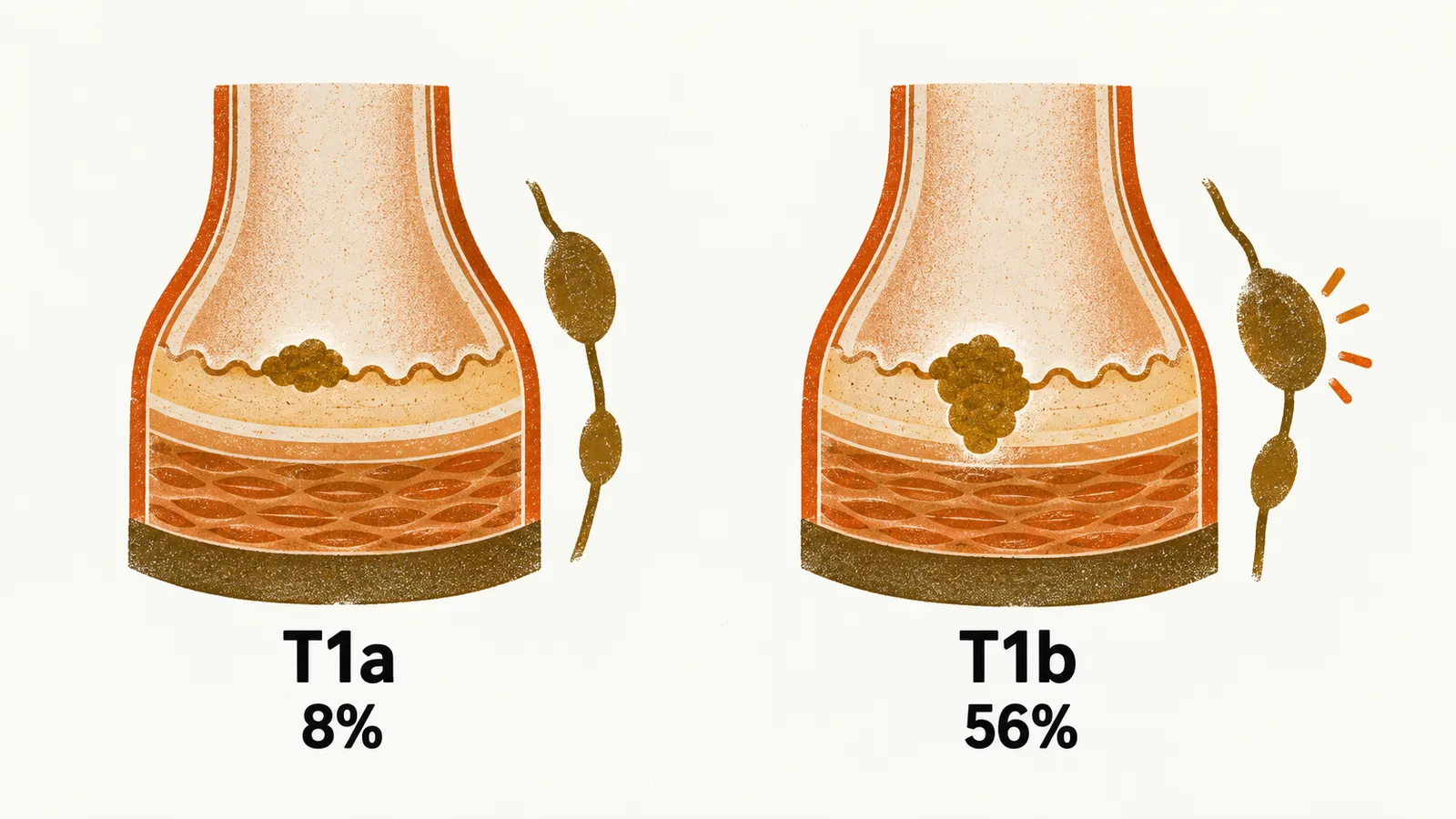
Whichever of the three systems is used, the T category records the depth of tumor invasion. Tis (tumor in situ) involves the epithelium only. T1 is divided by depth: T1a involves the mucosa over the basement membrane, without reaching the submucosa, and is subdivided as M1 (intraepithelial), M2 (to the lamina propria) and M3 (to the muscularis mucosae). T1b involves the submucosa, and is subdivided as SM1 (upper third), SM2 (middle third) and SM3 (lower third). The distinction matters because the two groups have very different chances of nodal spread: Tis and T1a lesions have a predictive rate of lymph node involvement of 8%, while T1b lesions have a 56% chance.
Tumors at the junction of the esophagus and stomach need a separate rule. Based on the latest staging, a tumor that involves the gastric cardia (the part of the stomach next to the esophagus) by less than 2 cm is considered EAC, while involvement by more than 2 cm makes it gastric cancer.
Prognosis
The best predictors of esophageal cancer survival are:
- the depth of cancer involvement (T stage): cancer in situ or T1a has a 5-year survival of at least 90%
- lymph node invasion (N stage): 5-year survival is 41% for local lymph node involvement, 23% for regional involvement and 5% for distal involvement
Other than the depth of invasion and lymph node involvement, other factors also affect the prognosis of EAC and ESCC: the histological type, the degree of differentiation, and the location of the tumor.
Unfortunately, despite all the recent advances, the overall 5-year survival of esophageal cancer is reported to be around 19%.