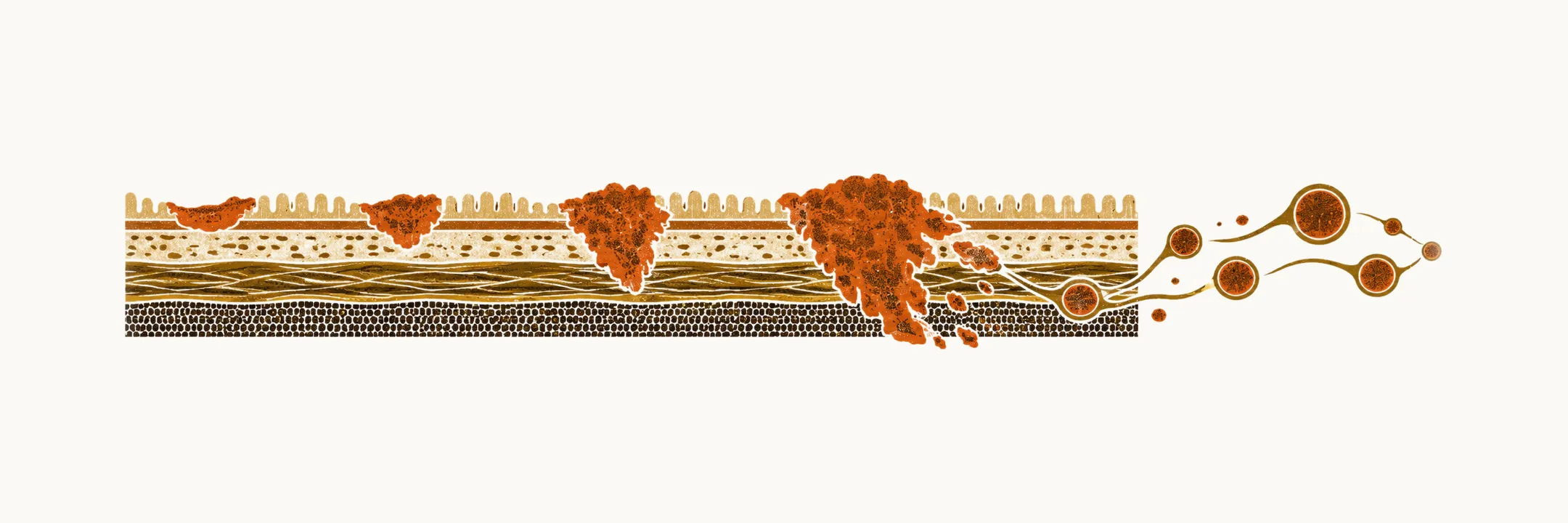
Early and advanced gastric cancer
Early gastric cancer is defined as a cancer that has not passed the submucosa, the layer of the stomach wall beneath the mucosa, regardless of lymph node involvement. Early gastric cancers are very common in the Far East and have a very good prognosis, reported to have a 5-year survival of more than 90%. Cancers that have grown deeper than the submucosa are advanced. The TNM system describes the same depth of invasion in finer steps and adds nodal and distant spread.
The TNM system
Gastric cancer is staged with the TNM system, which records the depth of invasion (T), the number of involved regional lymph nodes (N) and distant metastasis (M).
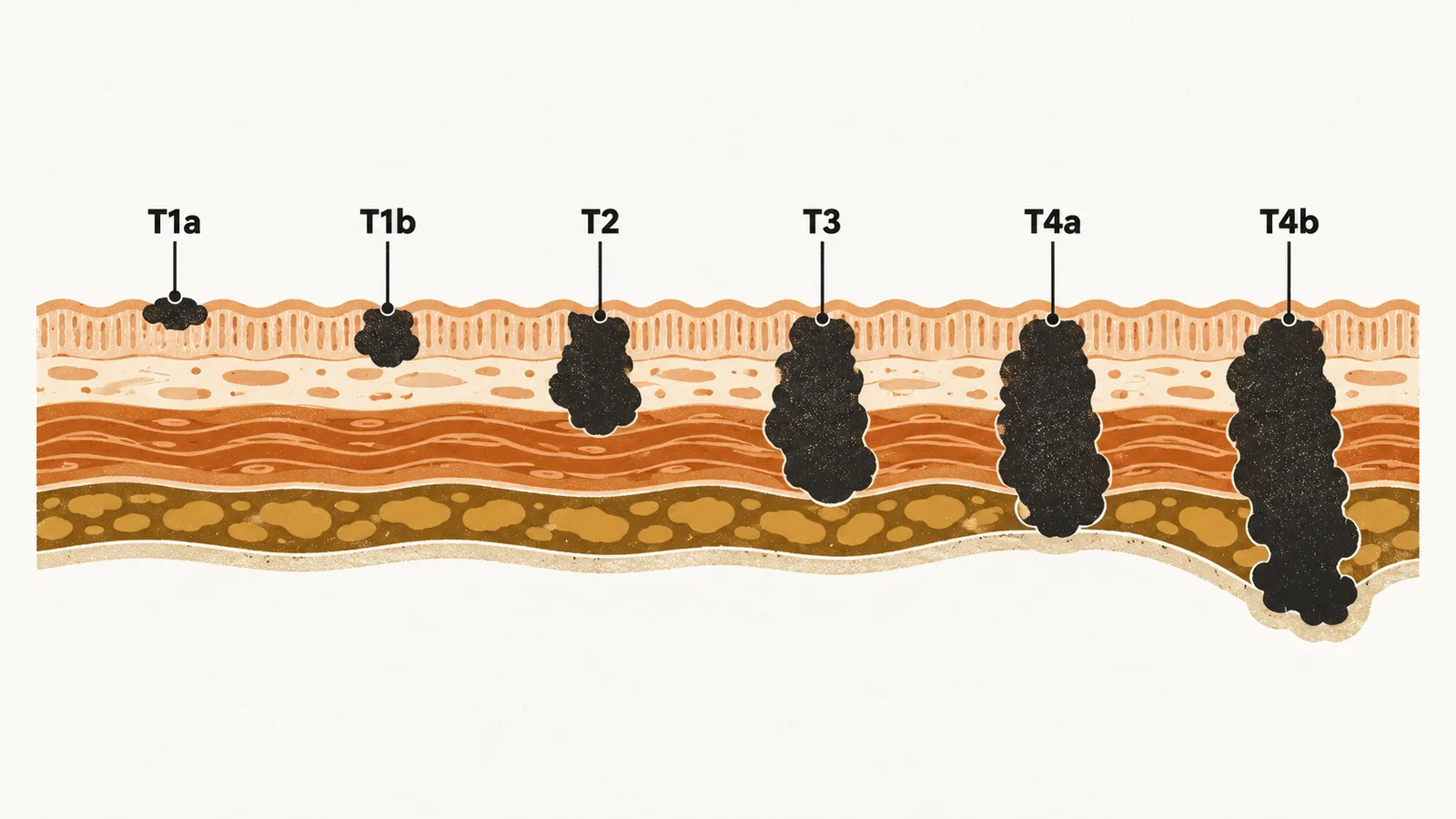
T, or tumour, indicates the depth of invasion:
- T1a, invades the lamina propria or muscularis mucosae
- T1b, invades the submucosa
- T2, invades the muscularis propria
- T3, invades the subserosal connective tissue
- T4a, invasion of the visceral peritoneum
- T4b, invasion of the adjacent organs
N, or node, indicates the number of involved lymph nodes:
- N0, no lymph node involvement
- N1, 1 to 2 lymph nodes
- N2, 3 to 6 lymph nodes
- N3a, 7 to 15 lymph nodes
- N3b, 16 or more lymph nodes
M, or metastasis, indicates the state of metastasis:
- M0, no metastasis
- M1, presence of distant metastasis; positive peritoneal cytology also places the disease in this category
Together the T, N and M categories give the stage, which is what the choice of treatment is built on.