
Most people who acquire hepatitis B do not know it at the time. Infants and children younger than 5 years usually have no symptoms, and even among people aged 5 years and older only about 30-50% become symptomatic; symptoms are more likely in people aged 30 and older than in younger adults. Because the clinical picture is indistinguishable from other causes of acute viral hepatitis, the diagnosis is made by serology, the testing of blood for viral antigens and antibodies, rather than from the symptoms themselves.
The acute illness
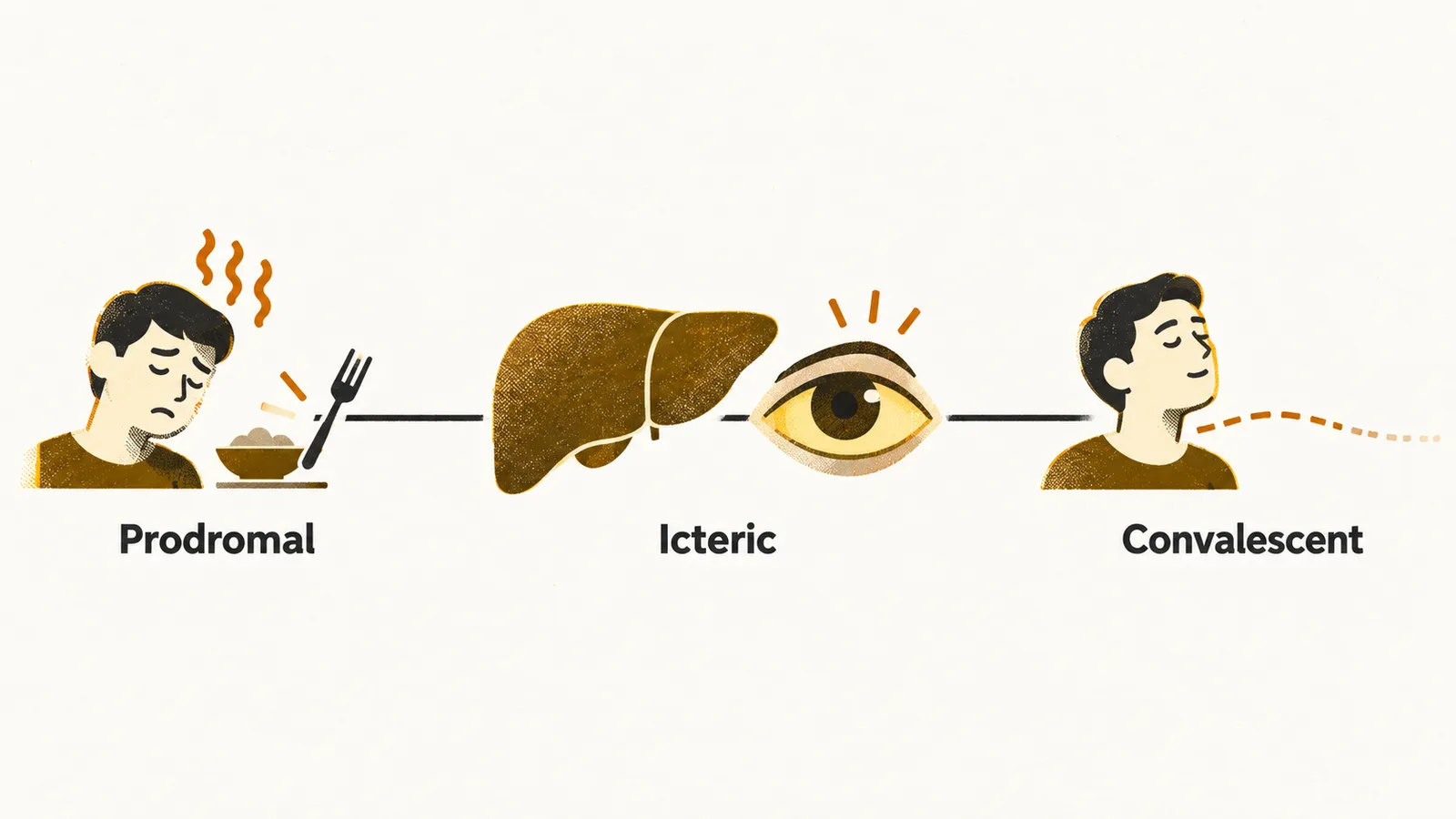
Acute hepatitis B is the illness of the first 6 months after exposure. When it is symptomatic, it follows an incubation period and then runs through three phases. The incubation from exposure to the first abnormal ALT (alanine aminotransferase, a liver enzyme released when liver cells are injured) is about 60 to 90 days, and from exposure to the first symptoms it averages about 90 days, with a range of 60 to 150 days.
Prodromal (pre-icteric) phase. This is the early phase before jaundice, lasting about 3 to 10 days, and is nonspecific: abrupt fever, malaise, loss of appetite, nausea and vomiting, abdominal discomfort, and dark urine beginning a day or two before jaundice appears. In a minority of patients a serum sickness-like illness — fever with joint pain, rash or angioedema (swelling of deeper layers of the skin) — precedes the icteric phase (see Complications of Hepatitis B).
Icteric phase. This is the phase of jaundice (yellowing of the skin and eyes), usually lasting 1 to 3 weeks. Jaundice appears, stools become pale or clay-colored, and the liver becomes tender and enlarged; an enlarged spleen is less common.
Convalescent phase. Jaundice, anorexia and the other symptoms disappear, while malaise and fatigue may persist for weeks to months.
Fulminant hepatitis
Rarely, acute hepatitis B is severe. Fulminant hepatitis, in which the liver fails, develops in about 1 to 2% of acutely infected adults and can be fatal.
Chronic infection
Chronic hepatitis B is defined by HBsAg, the hepatitis B surface antigen, persisting in the blood for more than 6 months. Most people with chronic infection are asymptomatic and have no evidence of liver disease or injury, so the infection is often found only when it is screened for. Some develop chronic hepatitis (ongoing liver inflammation) with raised aminotransferases, and a minority progress to cirrhosis or hepatocellular carcinoma (see Complications of Hepatitis B).