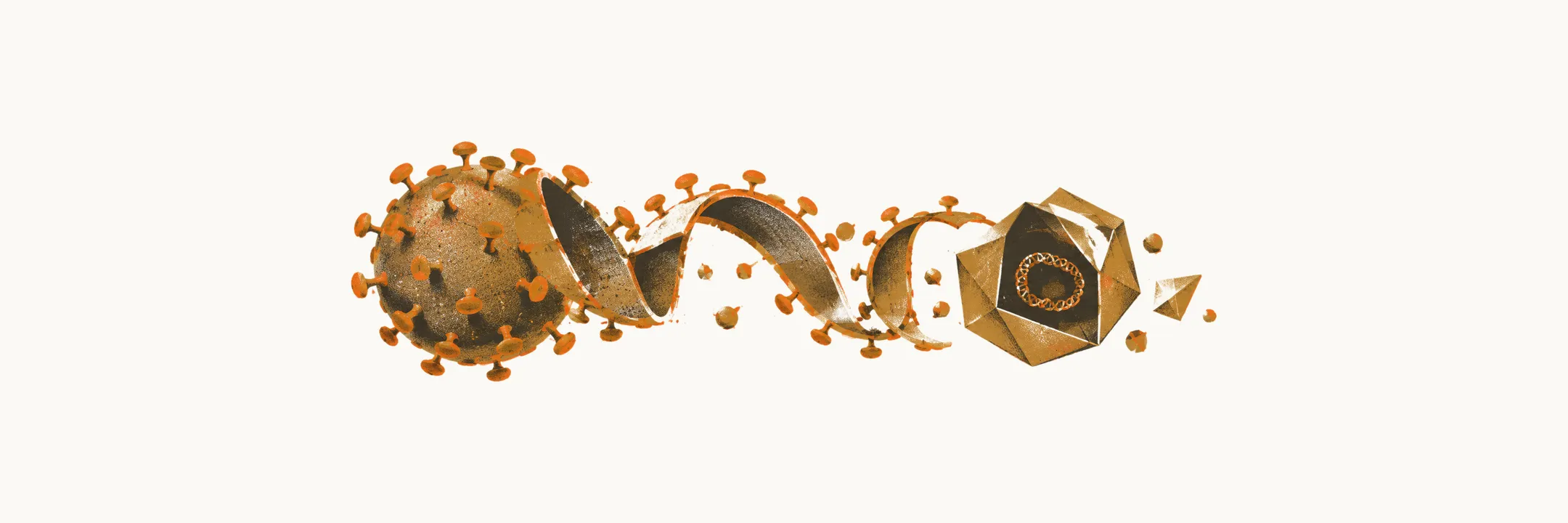
The hepatitis B virus (HBV) belongs to the Hepadnavirus family. Its members are strongly species-specific and tissue-specific, a property called tropism, so each virus infects only a narrow range of hosts and tissues. The only human-related member is HBV, which mainly infects the human liver and, to a lesser extent, the pancreas and kidney.
The Dane particle
The complete, infectious virion is very small, about 42 nm across, and is called the Dane particle. It is stable to freezing, mild heat, ether and low pH, and this stability is one reason person-to-person transmission is so efficient.
The Dane particle has an outer envelope and inner contents. The envelope forms the surface of the particle and contains glycoproteins called surface antigens, or HBsAg (an antigen is a molecule that the immune system recognises and can make antibodies against). These occur in three forms, large (L), medium (M) and small (S). They are all encoded by the same gene and translated from different AUG start codons, the points on the messenger RNA where protein synthesis begins, and they all share the same C-terminal end, the end of the protein chain that is made last. Together the three HBsAg proteins make up the outer layer that holds the particle together.
Inside the envelope lies the icosahedral capsid, a regular many-sided protein shell built from repeating units of the core antigen HBcAg. Inside the capsid sit a protein kinase and the polymerase, which carries reverse transcriptase activity (copying RNA into DNA) and ribonuclease H activity.
Particles in the blood
HBV particles reach very high concentrations in the blood: including the non-infective excess 22 nm particles and the complete 42 nm virion, they can reach 10 trillion in each millilitre. Some of these particles are secreted into the serum of the infected patient during replication rather than staying in the cell:
- HBsAg-containing particles, which are immunogenic and became the first commercial vaccine against HBV.
- HBeAg, which is very similar to HBcAg in protein structure but is mainly secreted into the serum, where it carries several different antigenic parts.