
Hepatitis B is diagnosed and staged from a sequence of serologic markers: viral antigens in the blood and the antibodies the body makes against them. The order in which they appear is what separates acute from chronic infection.
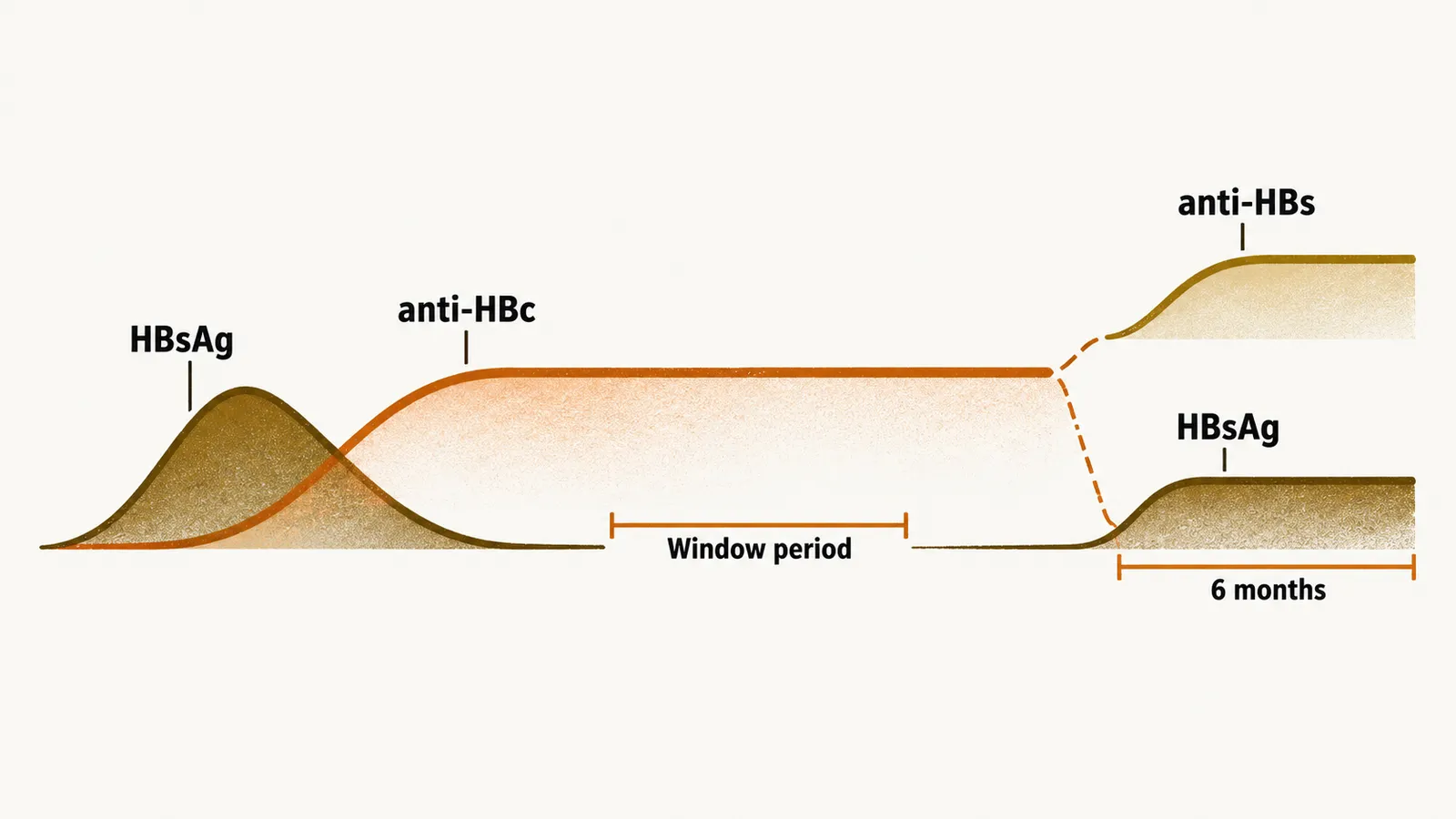
The first virologic marker to become positive, even before hepatitis presents, is HBsAg (hepatitis B surface antigen, the protein of the viral envelope). It can be detected as early as 1 to 2 weeks and as late as 11 to 12 weeks after exposure. Its appearance in serum precedes the rise in ALT (a liver enzyme that reflects liver-cell injury) and the icteric symptoms (jaundice) by 2 to 6 weeks, and it then persists for about 1 to 2 months after jaundice appears. The whole sequence is therefore: HBsAg appears first, jaundice follows 2 to 6 weeks later, and HBsAg usually disappears about 2 months after the jaundice.
After HBsAg disappears, anti-HBs antibodies (against the surface antigen) become detectable, but there is a variable gap between the two events. Anti-HBc antibodies (against the core antigen) are produced about 1 to 2 weeks after HBsAg appears, which makes anti-HBc the first antibody that can be detected.
Because of that variable gap between the disappearance of HBsAg and the formation of anti-HBs, a patient sampled during this window has neither the surface antigen nor the surface antibody. In this situation the most reliable indicator of a recent infection is anti-HBc IgM, the early-appearing class of anti-HBc antibody, which is present from 2 weeks after HBsAg appears.
In acute hepatitis B, HBsAg disappears within 6 months of exposure to the virus. In chronic hepatitis B, by contrast, HBsAg persists in serum beyond 6 months. The anti-HBc found in chronic infection is of the IgG type, the later class of antibody, and a very low level of anti-HBs can also be detected. It is possible to enter a non-replicative phase during chronic infection and then to have reactivation of replication and liver injury, and differentiating the IgM and IgG subtypes of anti-HBc helps to tell an acute exacerbation from stable chronic infection.
All of the serologic changes described so far apply to wild-type HBV, the unmutated virus. Mutations can change the serologic picture, and two mutant forms are especially important.
The pre-core mutant carries a single nucleotide change in the pre-core region of the C gene that suppresses expression of that region, so these patients do not produce HBeAg (the secreted core-related protein that marks replication); their pattern is called HBe-negative. Pre-core mutant HBV is a cause of fulminant hepatitis and of chronic infection, and it now accounts for almost all cases of chronic HBV infection in the Mediterranean and western Europe.
The escape mutant carries a single nucleotide change in the S gene that alters the conformation of HBsAg so that it no longer binds anti-HBs. The antibody these patients make is therefore not functional against the antigen, and the virus escapes the immune response. People who have been vaccinated and carry a good level of anti-HBs can be infected by an escape mutant and go on to develop chronic infection.