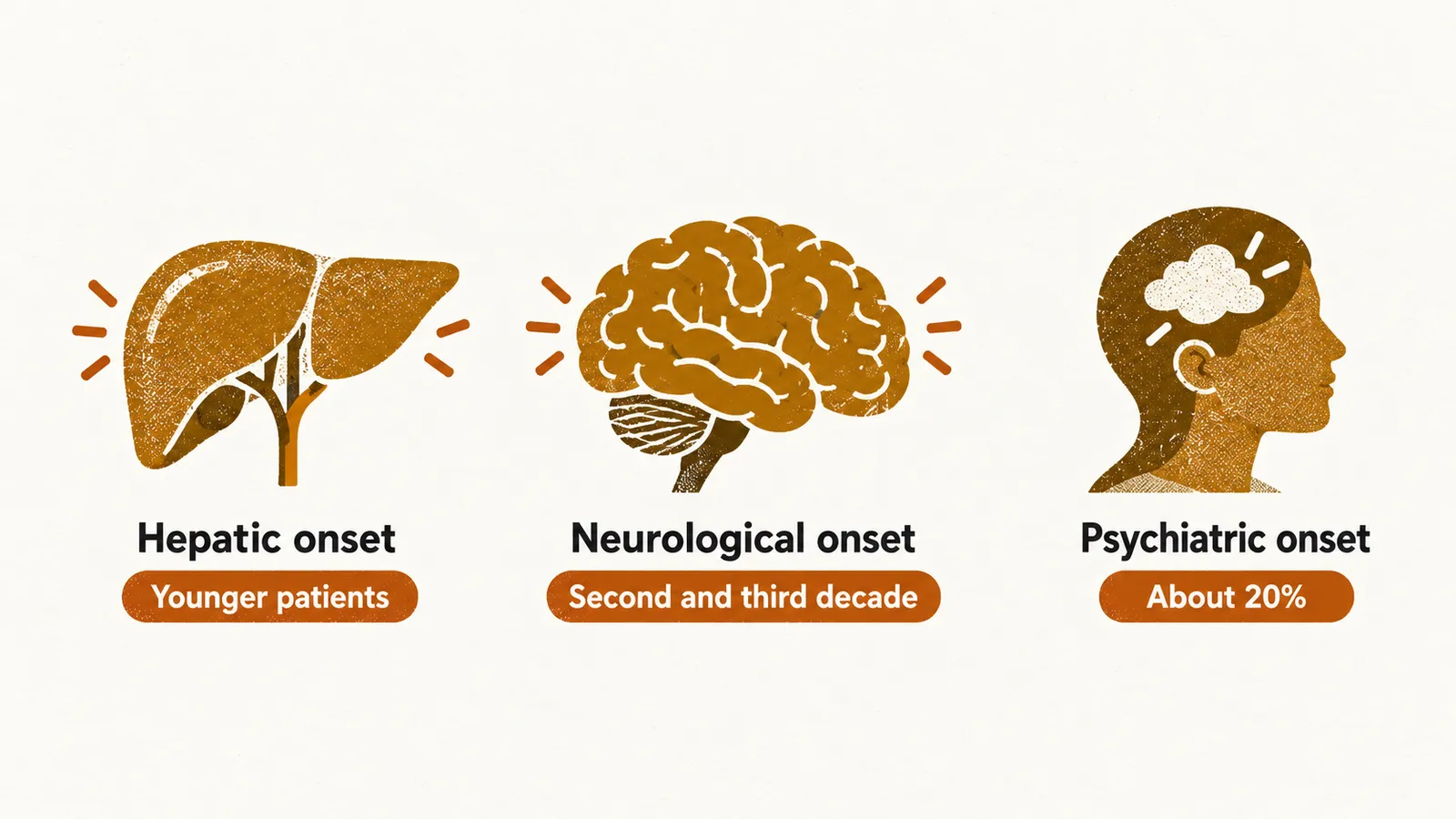
Wilson disease can begin at any age and from almost any organ, so it is the pattern of organ involvement, rather than a single pathognomonic sign (one specific to a single disease), that makes the presentation recognisable. Most patients are between the ages of 3 and 55 years, and the first manifestation can be hepatic, neurological without any hepatic insufficiency, or psychiatric. The course can be chronic, or even very acute with a rapid onset.
Hepatic involvement
Hepatic involvement is more likely to be the primary manifestation in younger patients. Wilson disease should be considered in the differential diagnosis of any child with unexplained steatosis (fat in the liver), persistently high liver enzymes or hepatomegaly (an enlarged liver), because these common findings may be its first sign. Patients who present this way usually have non-specific hepatic symptoms — anorexia, malaise, nausea, jaundice and abnormal coagulation tests — rather than a distinctive picture.
Even when the liver is the obvious organ, neurological and psychiatric manifestations are common in children with hepatic involvement. Low performance at school, clumsiness and hypophonia (a soft voice, often whispery) are early clues.
Two less common patterns are worth separating. Some patients have episodic, self-limiting jaundice, possibly due to hemolysis caused by the direct toxicity of copper on erythrocytes. Others present with severe hepatic involvement, with hepatosplenomegaly (an enlarged liver and spleen), a low serum albumin level, persistently abnormal coagulation tests and, rarely, isolated splenomegaly from the portal hypertension that Wilson disease produces.
At the severe end, Wilson disease can present as acute liver failure (ALF), with severe coagulopathy and encephalopathy. Its classical laboratory presentation is distinctive:
- Coombs-negative hemolysis (hemolysis not caused by antibodies on the red cells), with extremely high unconjugated bilirubin and a low haptoglobin.
- Renal failure from the extensive hemolysis.
- A normal or even low alkaline phosphatase.
- Serum aminotransferases that are disproportionately low, mostly less than 2000 U/L, which does not reflect the severity of the liver disease.
Urinary copper excretion is increased.
Because the disease mimics commoner conditions, two differential diagnoses matter most: fatty liver disease, because of the steatosis, and autoimmune hepatitis, because of the positive antinuclear antibody (ANA) and the increase in immunoglobulin G (IgG), especially in younger patients. In children and young adults the picture can be indistinguishable from autoimmune hepatitis, with interface hepatitis (inflammation at the border between portal tracts and liver cells), a raised serum IgG and a positive ANA — a resemblance that delays the diagnosis because the two conditions look the same on serology.
Neurological involvement
Neurological involvement is the second main way the disease can begin, as the primary manifestation tends to appear in the second and third decades of life, though it has also been reported in patients as young as 7 years. It is mainly motor, and takes one of two patterns depending on how far the disease has progressed. An earlier movement disorder produces tremor, poor coordination and loss of fine movement control. A later rigid dystonia (sustained abnormal muscle contraction) produces mainly spastic movements, with a mask-like face, rigidity and pseudobulbar features such as drooling and dysphagia (difficulty swallowing).
Psychiatric involvement
Behaviour and mood can be the first manifestation instead. In about 20% of cases there is a pure psychiatric presentation, and its features are variable: depression, antisocial behaviour, aggressiveness and phobias.
Ocular involvement
Copper deposition can also be seen directly at the eye, where it is deposited in the peripheral region of the cornea and produces the Kayser-Fleischer ring, a sign that tracks with how the disease declares itself. More than 95% of patients with neurological or psychiatric involvement have a Kayser-Fleischer ring, whereas about 40–50% of patients with exclusive hepatic involvement do not have one. The ring is easier to see when copper deposition is heavy and iris pigmentation is light. It is not specific to Wilson disease; it can also be seen in other liver disorders, such as primary biliary cirrhosis and chronic active hepatitis.
Other organs
Beyond the liver, brain and cornea, copper deposited elsewhere produces further problems. Copper toxicity to red cells causes episodic hemolytic anemia. In the kidney it produces Fanconi syndrome (a disorder of kidney tubular function), and in the joints arthritis. In the heart it produces cardiomyopathy and arrhythmia, which are rare but can lead to sudden death. Amenorrhea and infertility also occur.