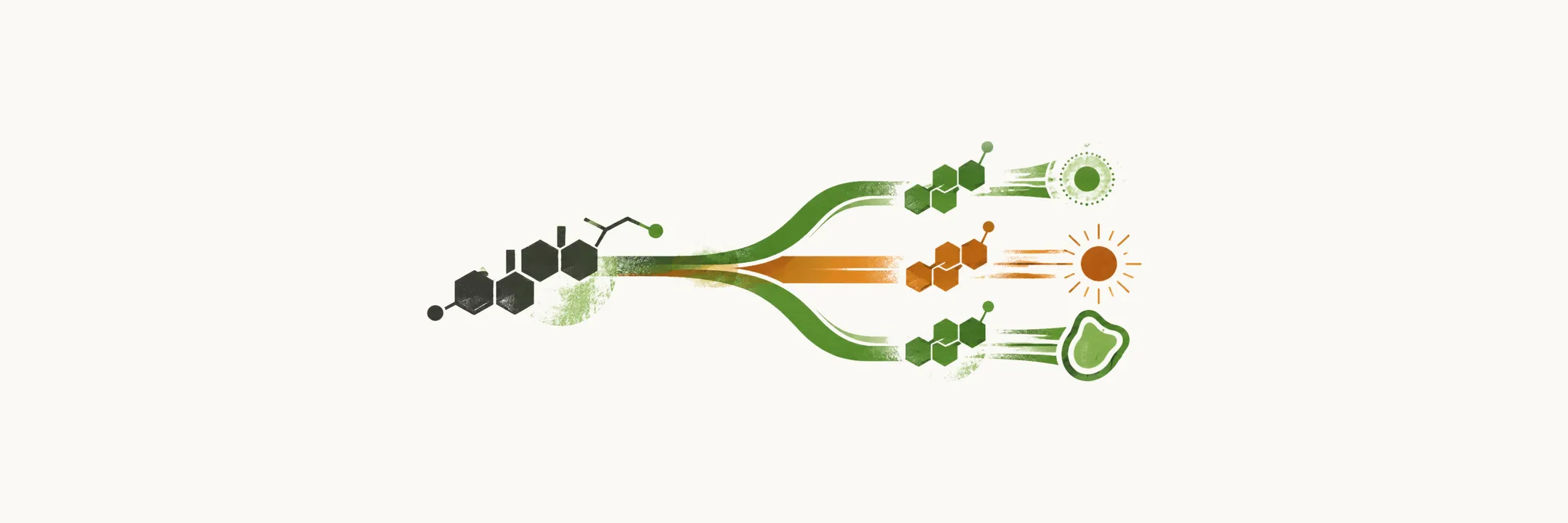
The adrenal cortex does not keep hormone in stock. It builds steroid when it is told to, starting from cholesterol, the single precursor of every product. A useful picture is one assembly line: cholesterol is brought into the mitochondrion, trimmed to pregnenolone, and then passed along a short series of enzymes. Each enzyme makes one change, usually a hydroxyl group added at a particular carbon, and the enzymes a cell carries decide where on the line it stops. The end products are cortisol, mineralocorticoids and adrenal androgen precursors.
Why must the cortex build steroid when it is asked to?
Adrenal cortex steroidogenesis starts with ACTH acting on the glucocorticoid-producing cells. ACTH is the pituitary signal that drives cortisol production, and steroidogenesis needs it. Because the cortex holds no pre-made hormone, output depends on how hard ACTH drives the line.
The routes that follow are overlapping enzymatic routes. Because they share early steps, one enzyme defect can affect more than one product.
How does ACTH switch the cell on?
ACTH has to reach the cell before anything else happens. It stimulates the glucocorticoid-producing cells of the adrenal gland by attaching to the melanocortin 2 receptor (MC2R), a G protein-coupled receptor (GPCR). MC2R produces cAMP and finally activates PKA inside these cells.
PKA then changes the cell in two ways at once.
- More substrate. PKA increases the import of cholesterol ester into the cell and increases hormone-sensitive lipase. The cell keeps cholesterol esters in storage, and hormone-sensitive lipase releases free cholesterol from them, so more substrate is available to start steroidogenesis.
- More enzyme. PKA phosphorylates and so makes available CREB, a transcription factor. CREB drives the production of CYP11A1, the enzyme crucial for steroidogenesis. CYP11A1 catalyses the first and rate-limiting step, so making more of it raises the capacity of the whole line.
The two branches work on different timescales. ACTH acts immediately, by increasing the supply of cholesterol, and it also acts over hours, by increasing the amount of enzyme the cell carries.
How does cholesterol reach the first enzyme?
More cholesterol is no use until it gets into the mitochondria. The first step of steroid hormone biosynthesis is the transfer of cholesterol into the mitochondria, and it happens by a shuttle, the steroidogenic acute regulatory protein (StAR). StAR moves cholesterol from the outer to the inner mitochondrial membrane. The first enzyme sits on the inner membrane, so cholesterol must be carried across to reach it.
There the cholesterol side chain cleavage enzyme, CYP11A1, removes the side chain to produce pregnenolone. This is the first step of every pathway, so everything downstream depends on it, and pregnenolone is the precursor from which all adrenal steroids are made.
Where does the road branch?
Pregnenolone is the start, and the next question is where it goes. The reactions that build steroids from pregnenolone are catalysed mainly by CYP proteins, which are coupled with an oxidase-reductase system. These reactions are located mainly in mitochondria or endoplasmic reticulum.
Pregnenolone can also be converted to progesterone by 3β-hydroxysteroid dehydrogenase (HSD3B2). This step changes the 3-hydroxyl group to a keto group and shifts the double bond, and both the cortisol and aldosterone routes need it. Progesterone is therefore a precursor for the production of mineralocorticoids and also of glucocorticoids.
The androgen and cortisol routes share their early enzymes. Both use CYP11A1, HSD3B2 and the 17-hydroxylation by CYP17A1. The mineralocorticoid route leaves the cortisol route after progesterone, and the next enzyme decides the branch: 17-hydroxylation leads toward cortisol, whereas 21-hydroxylation without it leads to deoxycorticosterone.
How is cortisol built?
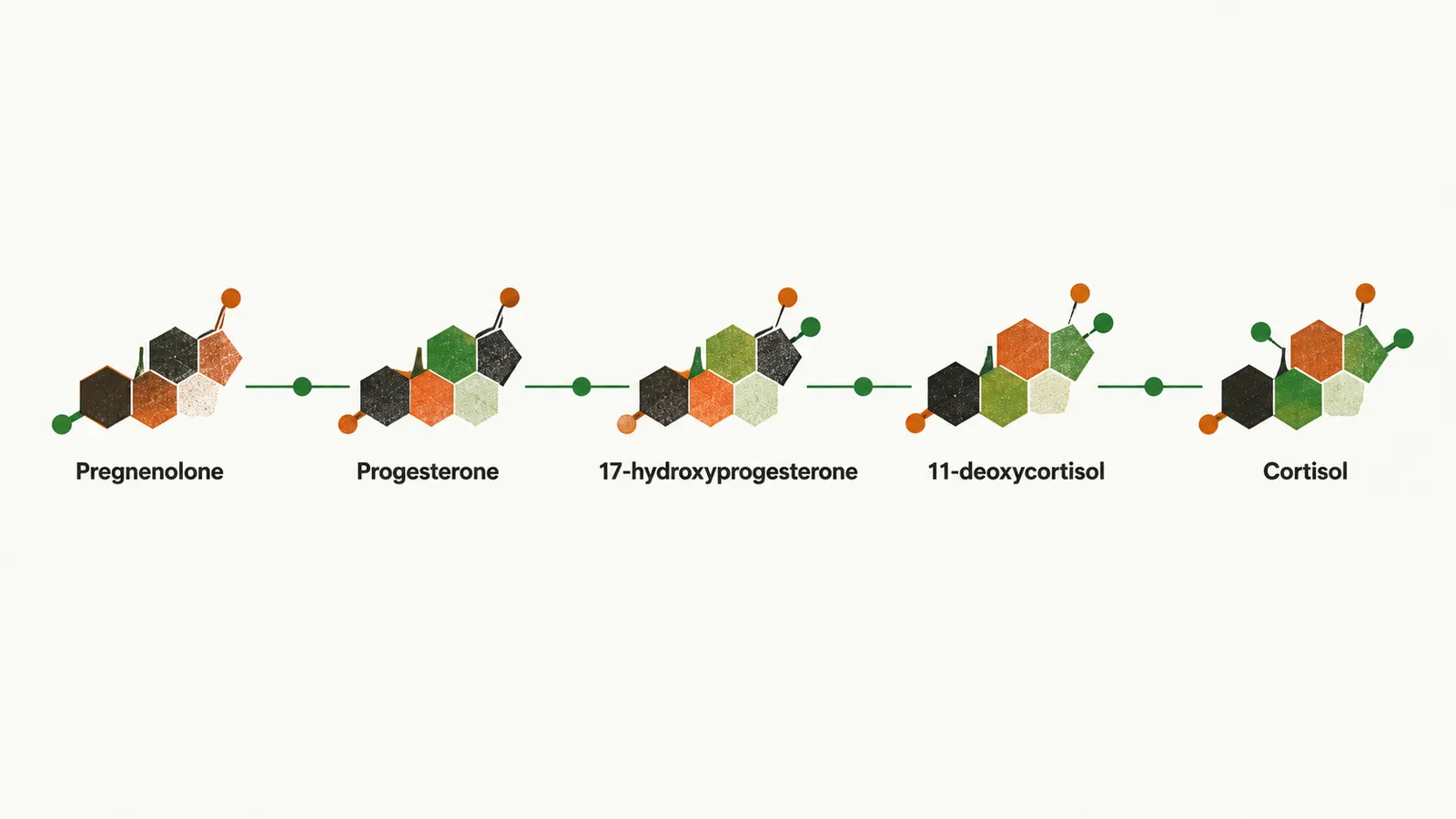
Making cortisol from pregnenolone takes a sequence of four steps. CYP17A1 hydroxylating carbon 17 is what directs steroid toward cortisol, and in cortisol production carbon 17 is hydroxylated once progesterone is formed.
- HSD3B2 converts pregnenolone to progesterone.
- CYP17A1 hydroxylates progesterone at carbon 17 to give 17-hydroxyprogesterone.
- CYP21A2 hydroxylates carbon 21 to give 11-deoxycortisol.
- CYP11B1 hydroxylates carbon 11 to give cortisol.
How is aldosterone built, and how does it differ?
The mineralocorticoid route likewise takes four steps. Here carbon 17 is skipped, so 21-hydroxylation acts directly on progesterone.
- HSD3B2 converts pregnenolone to progesterone.
- CYP21A2 hydroxylates progesterone at carbon 21 to give deoxycorticosterone.
- CYP11B1 hydroxylates carbon 11 to give corticosterone.
- Aldosterone synthase (CYP11B2) hydroxylates and then oxidises carbon 18 to give aldosterone.
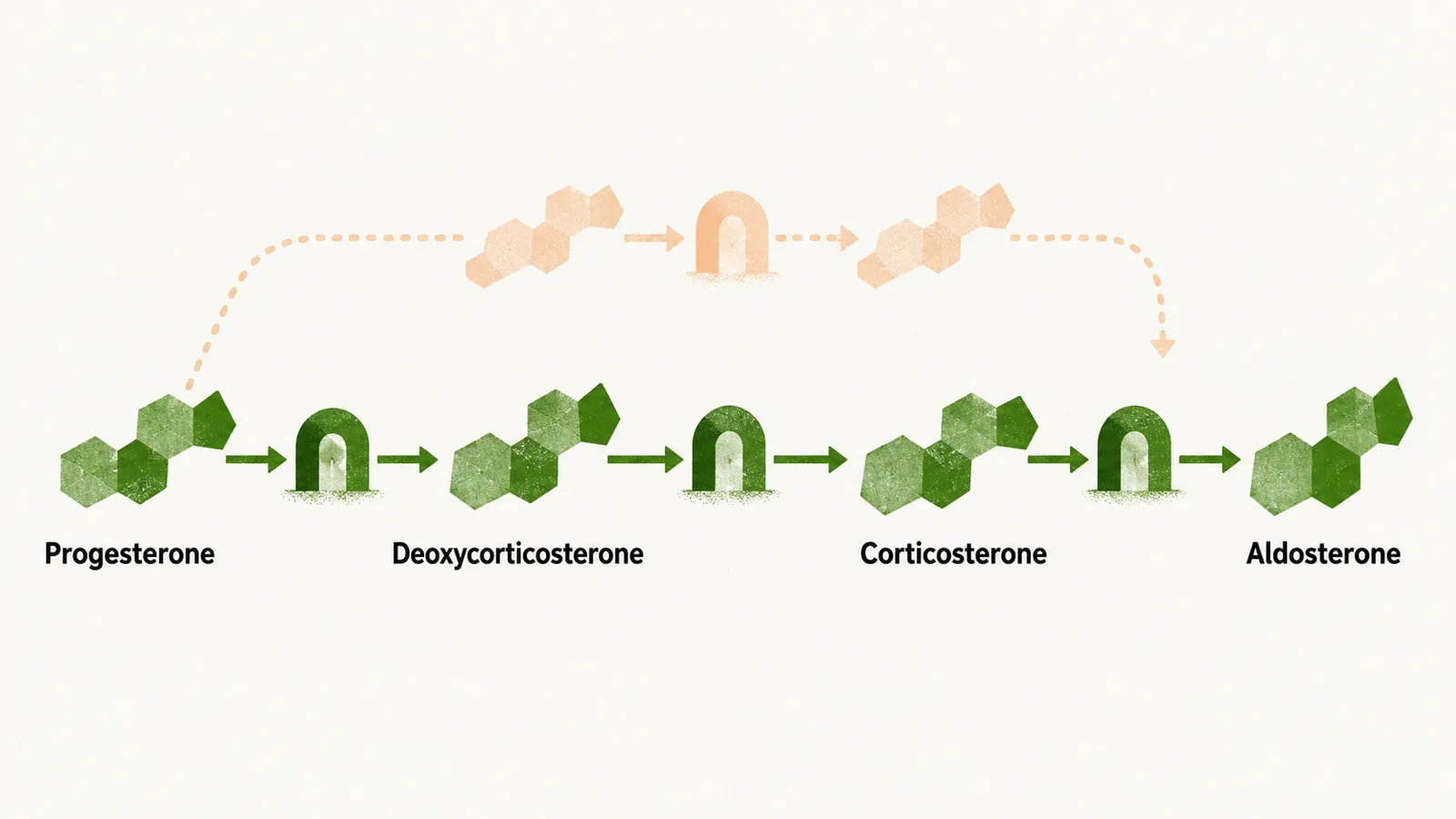
Aldosterone and cortisol production therefore differ in two steps. First, in aldosterone synthesis carbon 17 is not hydroxylated, because the zona glomerulosa does not express CYP17A1. Second, the final step of aldosterone needs CYP11B2 in addition to CYP11B1. The reason is that only aldosterone synthase carries the 18-hydroxylase and 18-oxidase activities that complete the molecule. CYP11B1 can add the hydroxyl at carbon 11, which is how cortisol is finished, but it cannot make these carbon 18 changes.
Aldosterone synthesis depends on CYP11B2, and CYP11B2 is driven by angiotensin II and potassium rather than mainly by ACTH. Angiotensin II attaches to the AT1 receptors of the zona glomerulosa and increases the synthesis of CYP11B2.
How are the adrenal androgens built?
The adrenal androgen route depends on a single enzyme with two catalytic activities, CYP17A1. Its 17-hydroxylase activity converts pregnenolone to 17-hydroxypregnenolone. Its 20-lyase activity then converts 17-hydroxypregnenolone to DHEA. The same enzyme that starts the cortisol route therefore also makes the androgen precursor.
The majority of DHEA is secreted in its sulfated form, DHEAS. A portion of DHEA enters the pathway of androstenedione, which can produce testosterone at the end.
Adrenal androgens are made in the inner zones. Because of this, they are the products that disappear first when the inner cortex is lost. The glomerulosa can keep making aldosterone in that situation, since its CYP11B2 depends on angiotensin II and potassium and not mainly on ACTH.
That raises the next question: if the glomerulosa listens to angiotensin II and potassium rather than ACTH, what actually controls how much aldosterone it secretes?