
Why can glucose rise in pregnancy?
Gestational diabetes mellitus (GDM) is diabetes first recognized in the second or third trimester of pregnancy, in someone who did not clearly have diabetes before. Pregnancy is a state of built-in insulin resistance. The placenta releases hormones that make maternal tissues respond less to insulin, so more glucose stays in the blood for the growing fetus, and a healthy mother’s pancreas answers by making more insulin. GDM appears when that compensation falls short.
The placental hormones and the insulin resistance rise as pregnancy advances. This is why testing is done in the second and third trimesters, and the recommended test is performed at 24-28 weeks of gestation.
Why are the thresholds lower than outside pregnancy?
The diagnostic thresholds for GDM are lower than those used for other types of diabetes mellitus. The lower numbers do not describe a milder diabetes. They reflect a different target: the test is aimed at the pregnancy, not at the mother’s own diabetes.
Maternal glucose crosses the placenta, so the fetus meets the mother’s glucose level. Excess glucose stimulates the fetal pancreas to make more insulin, and insulin drives fetal tissues to grow, which is how a large baby results. The other adverse outcomes are preeclampsia, a hypertensive disorder of pregnancy, and birth complications. The GDM values were chosen from the glucose levels at which the risk of these adverse pregnancy outcomes starts to rise. They were not chosen from the mother’s later risk of diabetes.
How is the one-step test done and read?
The recommended test is the 2-hour 75-gram oral glucose tolerance test (OGTT), the one-step test. It measures plasma glucose while fasting and again at set times after a glucose drink. It is performed in the morning after an overnight fast of at least 8 hours. The diagnosis is made when any one of these plasma glucose values is met or exceeded:
| Time | Threshold |
|---|---|
| Fasting | 92 mg/dl (5.1 mmol/L) |
| 1 hour | 180 mg/dl (10.0 mmol/L) |
| 2 hours | 153 mg/dl (8.5 mmol/L) |
A single abnormal value is enough, because the one-step test was built around the glucose level at which pregnancy risk begins to rise. Already one value at that level carries meaning. Outside pregnancy the criteria need confirmation, so the contrast is clear. Since one abnormal value settles it, the one-step test makes the diagnosis in a single sitting.
What is the alternative, and how does it differ?
The one-step test needs a fasting visit, so the alternative begins with a screen that does not. The two-step pathway is also accepted. It is more common in the United States.
- Step 1: a screening test. 50 g of glucose is given regardless of fasting state, so it can fit into a routine visit. The screen is positive if plasma glucose 1 hour later reaches 130 mg/dl (7.2 mmol/L). Some protocols use 135 or 140 mg/dl.
- Step 2: a screen is not a diagnosis, so after a positive screen a confirmation test must be performed. This is a 100-gram OGTT after a night of fasting. GDM is confirmed if at least two values are met or exceeded.
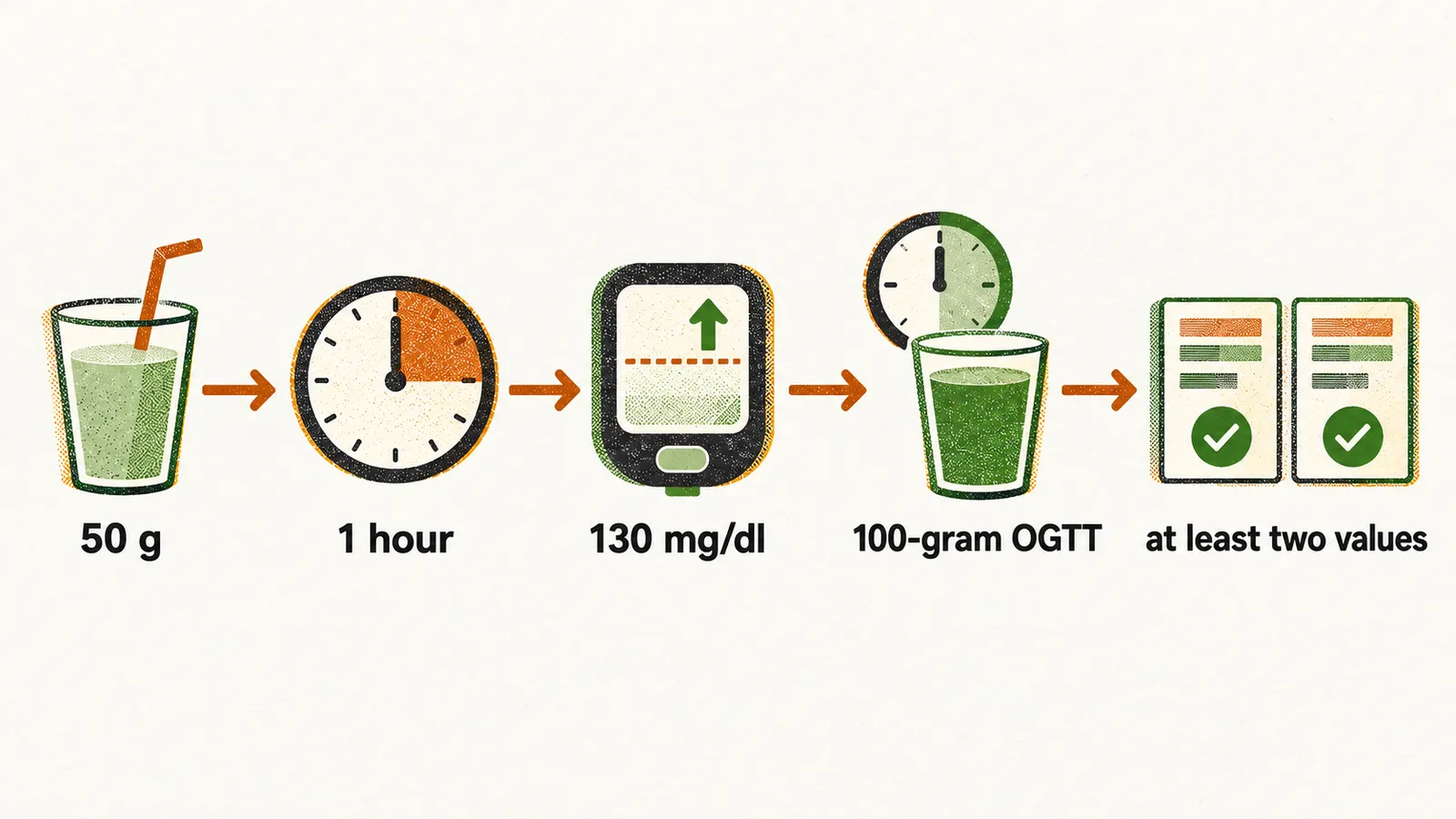
Here two abnormal values are needed, where the one-step test needs one.
Which thresholds apply to the 100-gram test?
Two sets of thresholds exist for the 100-gram OGTT, and they differ. The National Diabetes Data Group thresholds are the higher ones. The American Diabetes Association (ADA) now prefers the lower Carpenter-Coustan thresholds.
| Time | National Diabetes Data Group | Carpenter-Coustan |
|---|---|---|
| Fasting | ≥ 105 mg/dl (5.8 mmol/L) | ≥ 95 mg/dl (5.3 mmol/L) |
| 1 hour | ≥ 190 mg/dl (10.5 mmol/L) | ≥ 180 mg/dl (10.0 mmol/L) |
| 2 hours | ≥ 165 mg/dl (9.2 mmol/L) | ≥ 155 mg/dl (8.6 mmol/L) |
| 3 hours | ≥ 145 mg/dl (8.0 mmol/L) | ≥ 140 mg/dl (7.8 mmol/L) |
Once the placenta is delivered and its hormones are gone, what does a diagnosis of gestational diabetes say about the mother’s glucose levels afterwards?