Why test people who feel well?
Type 2 diabetes does not begin with a symptom. Screening means looking for diabetes and prediabetes before symptoms appear, and prediabetes is raised glucose that is still below the threshold for diabetes.
Screening matters because type 2 diabetes develops gradually. Insulin sensitivity falls slowly and a functional deficit of insulin builds up, so nothing announces the change. Hyperglycemia can therefore be present for years without classic symptoms.
Silent does not mean harmless. Raised glucose is thought to glycate proteins and lipids, which damages small vessels in the retina, kidney and nerves, and it already raises the risk of the acute and chronic complications of diabetes mellitus. Finding it earlier allows treatment to begin earlier. But what if the glucose has already climbed high enough to be felt?
What does high glucose feel like, and who is tested because of it?
Any individual with signs and symptoms suggestive of hyperglycemia should be tested for diabetes mellitus, whatever their other risk factors. Once symptoms are present the glucose is already high, so risk factors are no longer the question. The main symptoms are:
- polyphagia (increase in appetite)
- polydipsia (increase in thirst)
- polyuria (increase in urination)
- unexplained weight loss
- blurred vision
- infections or wounds that heal poorly
- excessive fatigue
Several of these follow from the glucose level itself, through the kidney. The kidney filters glucose and reabsorbs nearly all of it in the proximal tubule, but only up to a maximum capacity. When plasma glucose rises beyond the amount the kidney can reabsorb, glucose passes into the urine. Glucose in the urine obliges water to follow it. This process is osmotic diuresis, and it results in polyuria. The fluid lost then drives polydipsia. If the fluid loss continues, dehydration and unexplained weight loss follow. Weight loss also fits glucose, and the calories it carries, leaving in the urine instead of being used.
Polyphagia, blurred vision, poorly healing wounds and fatigue are listed as symptoms of hyperglycemia, but this account does not explain them. And when there are no symptoms at all, who is still tested?
Who is screened when nothing is wrong yet?
The ADA recommends routine screening for type 2 diabetes mellitus in all adults from age 35, repeated at a minimum of every 3 years. Insulin resistance commonly develops with obesity and ageing, so an older adult and an overweight person sit nearer the slow drift in glucose handling. That is why the ADA also screens people who are overweight at any age: BMI ≥ 25, or ≥ 23 in those of Asian ancestry.
Pregnancy has its own timing:
- Women planning a pregnancy are screened.
- All pregnant women are screened between the 24th and 28th week of gestation.
- Before 15 weeks of gestation, pregnant women with risk factors are tested at the first prenatal visit. Gestational diabetes is diabetes first recognized in the second or third trimester, so a test this early looks for diabetes already present before the pregnancy, and it uses the standard non-pregnancy criteria.
- Testing all pregnant women at that visit may also be considered.
Women with a history of gestational diabetes mellitus (GDM) are at higher risk of developing diabetes later. The ADA recommends a 2-hour 75-gram OGTT (oral glucose tolerance test) 4-12 weeks after delivery in women with a GDM history. If that result is normal, screening should continue every 1-3 years.
How are children and adolescents screened?
The same logic of insulin resistance reaches younger people, and obesity in adolescents has raised the number of younger people with type 2 diabetes. Overweight and obese youth are screened at least every 3 years, beginning at age 10 or at the onset of puberty, whichever comes first. Screening is more frequent if BMI is rising and at least one risk factor is present.
The risk factors for type 2 diabetes in children and adolescents are:
- Family history: type 2 diabetes in first- and second-degree relatives. Type 2 diabetes has a strong hereditary component.
- Race and ethnicity: Native American, African American, Latino, Asian American, Pacific Islander. Ethnic differences in risk are real, and environment also contributes, so these groups are associated with higher risk without a single cause being named.
- Signs of insulin resistance: acanthosis nigricans (a skin sign of insulin resistance), hypertension, dyslipidemia, large- or small-for-gestational-age birth weight, and polycystic ovary syndrome.
- Maternal history: diabetes or gestational diabetes during the child’s gestation.
Everyone so far is tested the usual way. But what if the usual test misleads in a particular group?
Why do cystic fibrosis and HIV change the test?
Some groups have their own recommendations, because their risk is particular or because the usual test is unreliable in them.
Cystic fibrosis. Patients over 10 years of age should be screened annually, with a 2-hour 75-gram OGTT. In cystic fibrosis, thick secretions block the pancreatic ducts, and the inflammation and fibrosis that follow damage the islets, so insulin falls short. This is the commonly held view; insulin resistance from lung disease and inflammation is also proposed to contribute. A 2-hour glucose-load test exposes insulin secretion that is inadequate under load. Insulin secretion is reduced in cystic fibrosis patients during an OGTT regardless of exocrine pancreatic status, which fits annual screening of all patients. HbA1c (hemoglobin A1c) should not be used in cystic fibrosis because it is insensitive in this group.
HIV. Screening is recommended before starting antiretroviral therapy (ART), when ART is switched, and 3-6 months after starting or switching ART. The test of choice is fasting plasma glucose (FPG), and HbA1c should not be used. HbA1c depends on red cells, and in HIV it can underestimate glycemia. This underestimation has been associated with the use of nucleoside reverse-transcriptase inhibitors and with larger red cells (a higher mean corpuscular volume). The mechanism is not settled: hemolysis was suggested but did not hold up as an independent predictor. Fasting plasma glucose does not depend on red cells, so it is the test of choice.
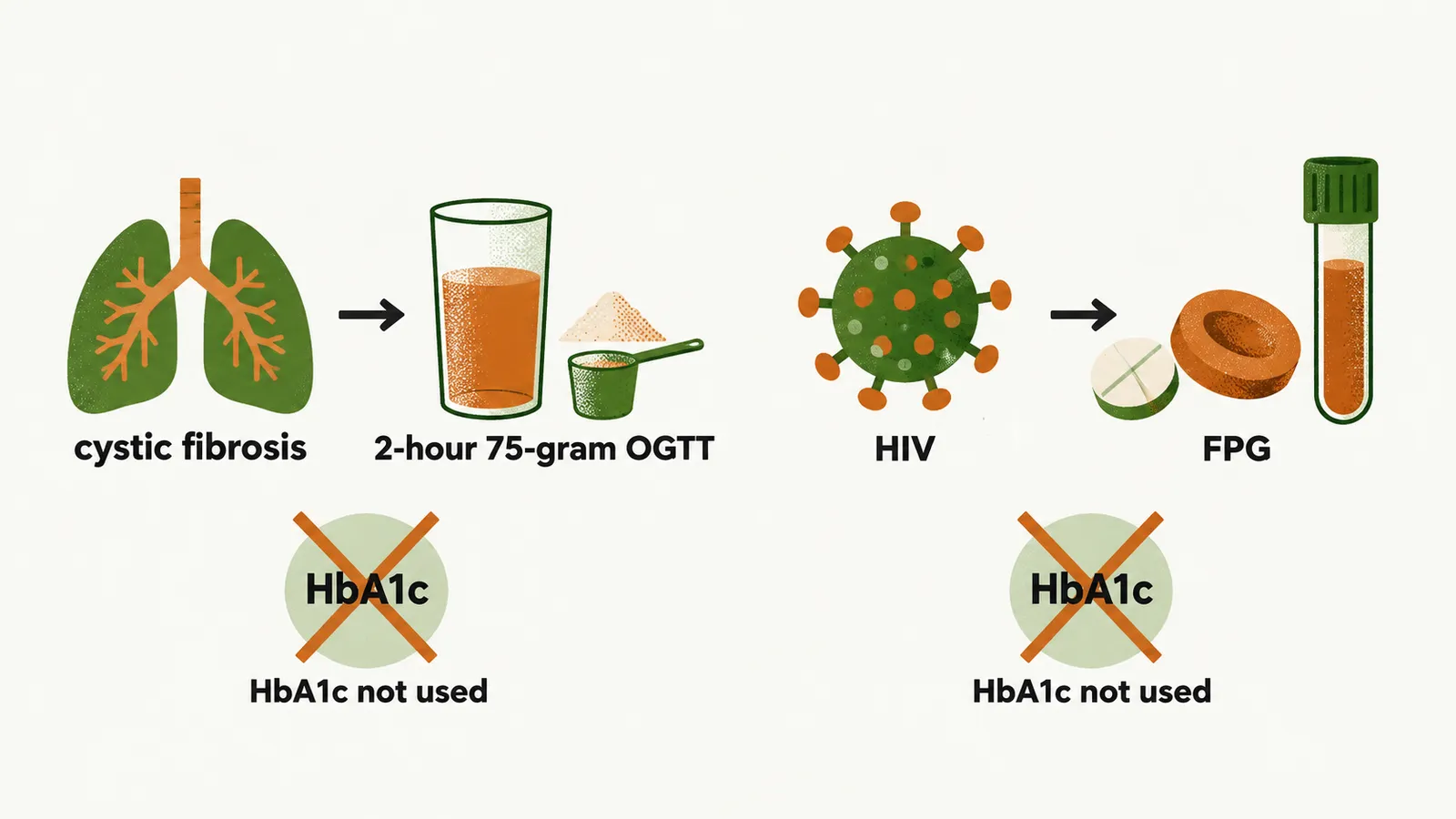
In both cystic fibrosis and HIV, the choice of test is part of the recommendation, because a test that works in the general population can mislead in a particular group. Once a person is tested, which result counts as abnormal, and how many results does it take?