
Puberty is a relay along one chain. The hypothalamus signals the pituitary, the pituitary releases gonadotropins, the gonads answer by making sex steroids, and the steroids act on breast, hair, uterus and bone. The adrenal glands add androgens from the side. Abnormal puberty is a problem of timing along this chain, and the first task is to say what counts as abnormal.
What makes timing abnormal?
“Abnormal” here is a statistical idea. The classical definition of abnormal pubertal timing, precocious or delayed, is a deviation of more than 2.5 SD from the population mean. A deviation of that size marks the rare ends of the distribution, so the definition is not a disease threshold.
The population mean varies with ethnicity. Because of that, the definition is not a single fixed age: the same number of SD lands at a different age when the mean is different, and the practical cutoffs that follow differ between populations. The 2.5 SD rule gives a distance from a mean; it becomes a practical age only once a reference population is chosen, and the cutoffs are therefore stated for specific groups.
Abnormal timing goes in one of two directions, precocious or delayed. These are the two tails of the same distribution.
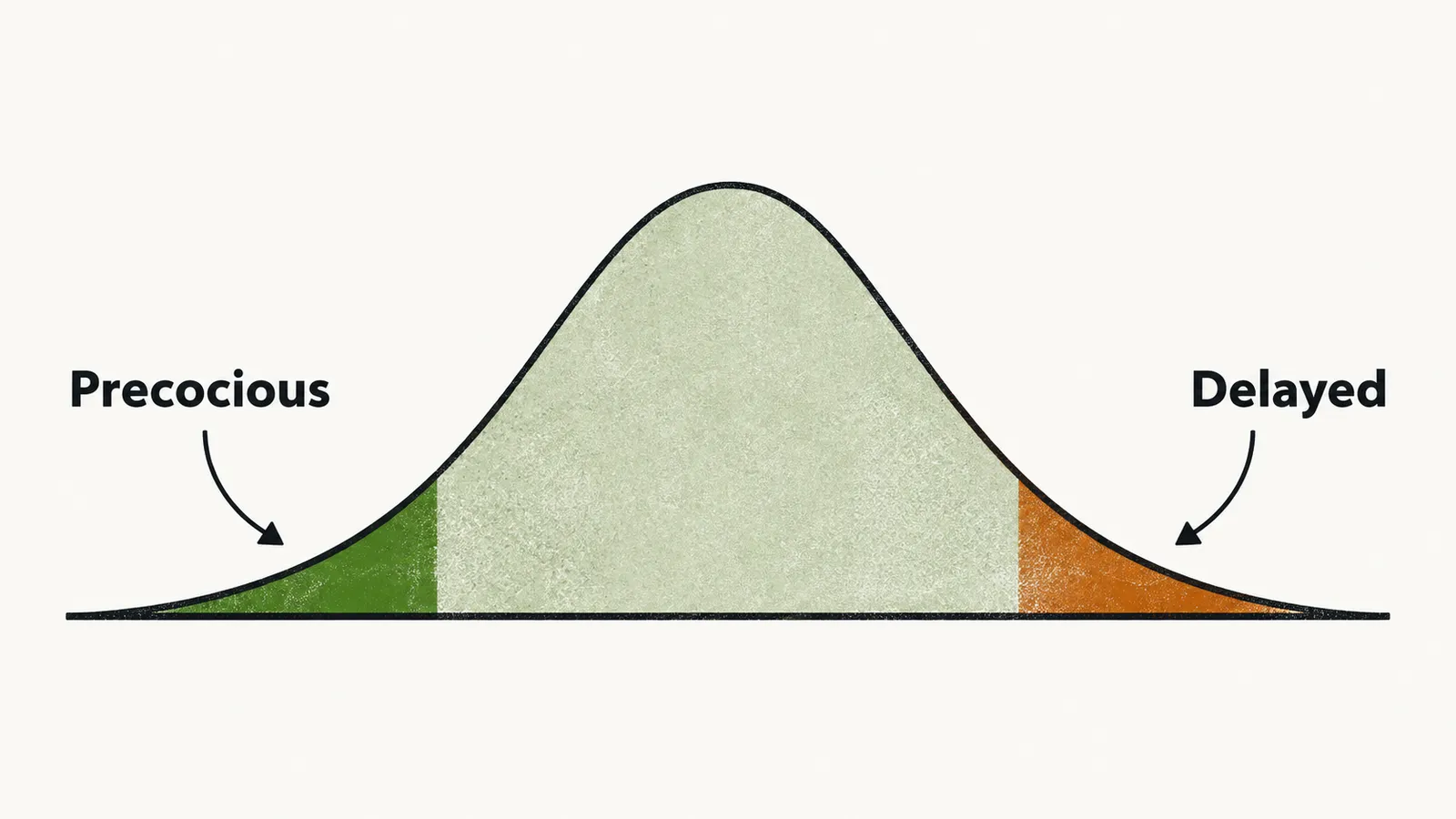
At what age is puberty too early?
A rule in standard deviations only becomes useful once someone picks a reference population. On the classical definition and on new epidemiological findings, precocious puberty is defined as puberty before age 6 in African-American girls and before age 7 in Caucasian girls. These are the same rule applied to different reference means. This definition rests on the PROS (Pediatric Research in Office Settings) guideline.
Some experts do not agree with the PROS guideline. One concern is that the studies judged puberty by inspection alone, and that lowering the threshold risks calling a girl precocious when a curable underlying factor is the real issue. Many endocrinologists still evaluate a girl with secondary sexual traits before age 8, so clinical practice keeps an older cutoff alongside the newer definition.
At what age is puberty too late?
The same rule applies at the late end of the distribution. Delayed puberty is the absence of thelarche after age 13 in girls. Thelarche, the start of breast development, is the marker because it is normally the first sign of puberty in girls.
A second marker comes later in the sequence. Delayed menarche is the absence of menarche, the first menstruation, by age 15 or 16, so a girl can be flagged by either marker.
Menarche normally follows thelarche after about 3 years. For this reason, a guideline suggests starting the diagnostic procedure for delayed puberty if there is no menarche 3 years after thelarche. A longer gap suggests the sequence is stalling even when the age cutoff has not been reached.
Where can the chain fail?
Behind either cutoff is the same chain of signals, and the pattern of failure differs for early and late.
In precocious puberty, the secondary sexual traits appear because sex steroids increase. Steroids are made in the gonads and adrenal glands, and the hypothalamus is the start of the chain, so the increase can arise at any of these points:
- a central disorder of the hypothalamus
- a disorder of the gonads
- a disorder of the adrenal glands
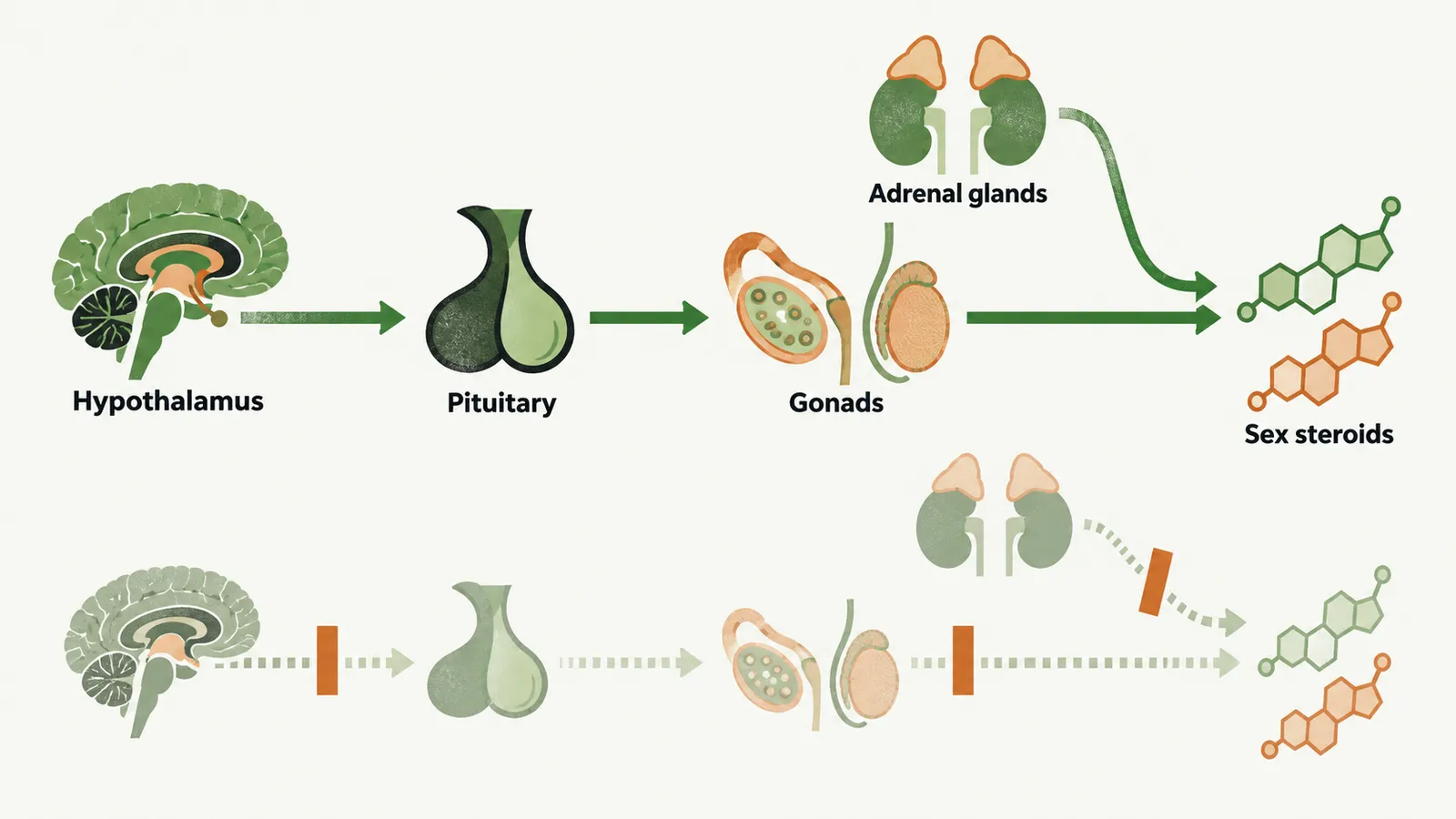
In delayed puberty, the events are late or absent because the relay fails to start or to arrive. A weak start gives too little drive, and failed gonads cannot answer the drive. A working axis can also leave a girl without menstruation if flow is blocked. So puberty is delayed when:
- the reproductive axis is not driven hard enough
- the gonads cannot respond to that drive
- an anatomical block prevents menstruation even when the axis is working
Is the pituitary driving early puberty?
For early puberty, the first thing to settle is whether the pituitary is part of the cause. Gonadotropins are the pituitary hormones that command the gonads, and the gonads make steroids when they receive that command. The first question therefore asks whether gonadotropins are driving the process.
If they are, it is gonadotropin-dependent, or central, precocity: the axis itself has switched on early. If sex steroids are produced without gonadotropin drive, it is gonadotropin-independent, or peripheral, precocity: the steroids arise outside the control of the axis.
Do the signs match the child’s sex?
A second question applies whatever the answer to the first, and it concerns which steroid is acting. In isosexual precocity the child shows features of her own sex, for example feminization of a girl, the effect of oestrogen. In heterosexual precocity the child shows features of the opposite sex, for example virilization of a girl, the effect of androgen.
Central or peripheral, isosexual or heterosexual: these labels sort precocious puberty but do not yet say what causes each type. What lies behind each type, how is the diagnosis confirmed, and how can the axis be suppressed?