What does puberty change?
Puberty is the transition from childhood to adulthood. It is characterised by the maturation of several endocrine axes, not of one gland. An endocrine axis is a chain of glands that signal one another through hormones.
Two chains matter here. One is the hypothalamus, the pituitary gland and the ovaries, linked by their hormones: the HPO axis. The other is the adrenal gland, which makes androgens on its own schedule.
As these axes mature, puberty leads to three changes:
- Secondary sexual traits appear.
- Reproductive capacity is attained. The maturing ovary makes the sex steroids that act on breast, uterus and skeleton.
- A second, skeletomuscular phase of growth forms adult stature.
Because the chains start at different times, the visible events come in a recognisable order. Each event has a name, so what does the name tell us?
What do the -arche words name?
Pubertal events are named with the suffix -arche, from the ancient Greek for “beginning”. The prefix says what begins, and it also says which chain is involved:
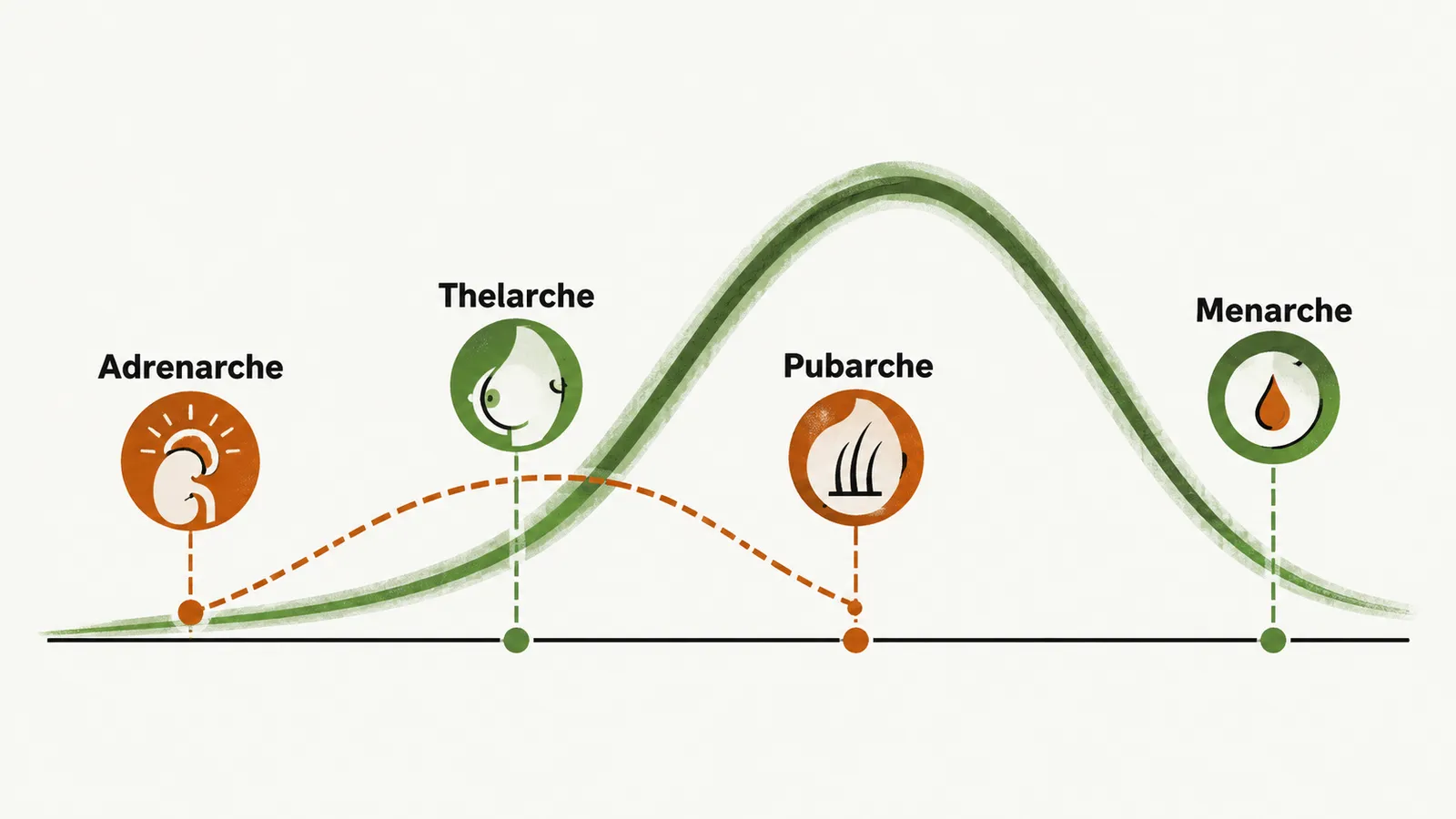
- Thelarche (thela- = nipple) is the beginning of nipple budding, the first sign of breast development. Breast development is an estrogen effect, so thelarche signals that the ovarian axis has started to make estrogen.
- Adrenarche (adren- = adrenal glands) is the beginning of adrenal androgen production, which gives the first male-like secondary features. It is an adrenal event, so its onset does not depend on the maturation of the HPO axis.
- Menarche (men- = month) is the beginning of the monthly period, the first menstruation. It is the visible result of estrogen having built up the uterine lining and then being withdrawn.
With the three events named, where do they fall in time?
In what order do the events appear?
The first somatic change of physiological puberty in girls is an increase in growth velocity, which peaks at 9 cm/year. This builds on Somatic Growth and Its Determinants in Puberty: the same sex steroids that start the spurt also advance maturation of the growth plates. After the peak, growth velocity diminishes as the epiphyses, the growing ends of long bones, begin to close.
Thelarche appears at about age 11 years, while growth velocity is still increasing. The breast signal therefore comes early, before the growth peak has been passed.
Pubarche, the growth of pubic and axillary hair, follows thelarche. Hair growth is an androgen effect, and the adrenal androgens contribute to it; the rise needed for visible hair comes after the breast signal.
Adrenarche is the underlying rise in adrenal androgen production, a hormonal change rather than a visible event. It begins in early childhood, years before thelarche. Its onset does not depend on the ovarian axis, so it runs on its own clock and can start earlier. The hair that follows thelarche is pubarche, the late visible sign of that rise, and not the start of adrenarche.
Menarche appears during the deceleration phase of growth, due to epiphyseal closure. The sex steroids that brought the spurt also advance closure, so the slowing side of the growth curve is where the first period falls. It mostly happens about 3 years after thelarche, as estrogen builds up over the intervening years.
These ages are quoted as if they applied to everyone. Do they?
Is the timing the same for everyone?
No. The timing and sequence of pubertal events are highly dependent on ethnicity.
The first normality range for girls was defined by British studies in the 1970s. In them, the mean age of the first sign of puberty, breast budding, was about 11 years. A norm is the average of the population measured at that time, and the population has changed. Later studies in the USA found that the age of onset has fallen across all ethnicities. The earliest stages of puberty can appear around 8 years in some groups, notably African-American girls.
Environmental and nutritional conditions may influence the timing and progress of puberty, and a higher gain in body mass index in childhood is linked with earlier onset. These are associations, not established causes.
Population norms are therefore a moving target: if the population changes, what counts as normal changes with it, and a norm taken from one place or decade can mislead. This matters when deciding whether an individual girl’s timing is normal, because the same age can be normal in one group and unusual in another.
Timing aside, does the first period mean the process is finished?
Is puberty finished at menarche?
No. Menarche is not the end of the process. The cycle has begun, but the machinery behind it is still maturing. The HPO axis is not completely mature at first menarche: the brain’s drive, the pituitary output and the ovarian response have to mature together, and in early postmenarchal girls studied, some components, such as gonadotropin levels and ovarian responsiveness, were still below adult levels.
That is why early cycles are often anovulatory, with no egg released. Bleeding can happen without ovulation: a period shows that estrogen has acted on the uterus, not that an egg was released.
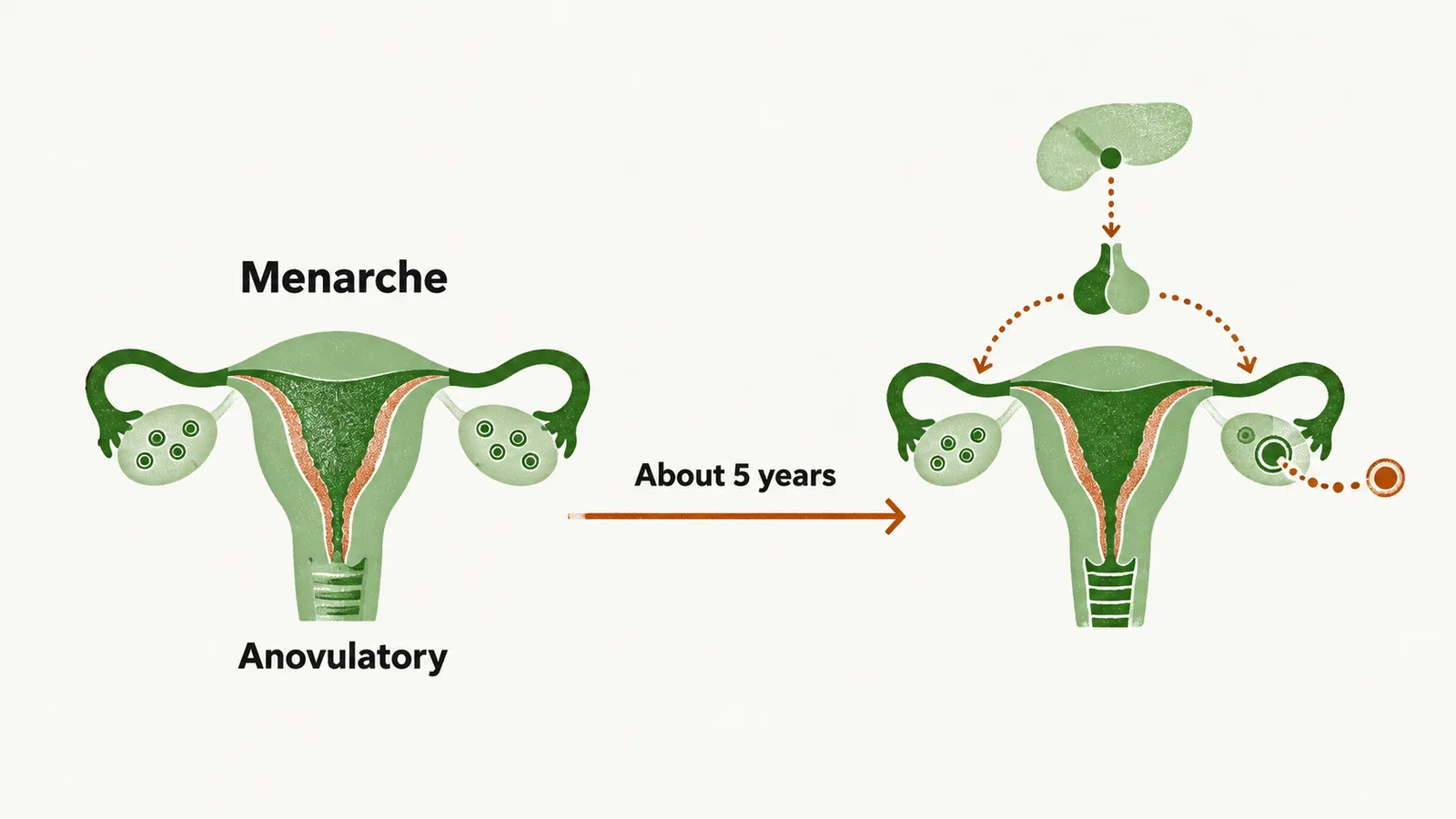
About 5 years after menarche, most menstrual cycles are ovulatory. At that point the HPO axis can be called mature and puberty considered complete, so puberty is complete when reproductive capacity is stable, not when the first period arrives.
If population timing keeps shifting, how far from the norm must a girl’s timing be before it counts as abnormal, and how do population differences change that cutoff?