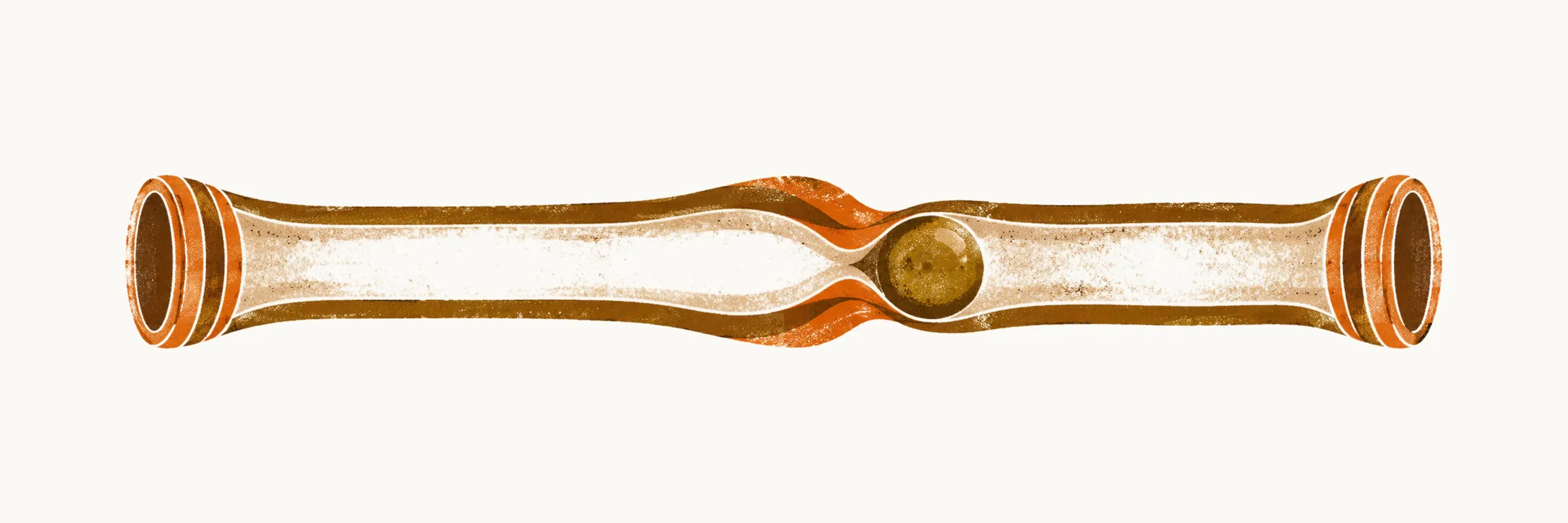
Esophageal motility is the sequence of contractions that carries food and fluid from the mouth to the stomach. Two muscular rings, the upper esophageal sphincter at the top and the lower esophageal sphincter at the bottom, open and close at the right moments: the upper one opens to let a swallow through, and the lower one stays closed between swallows to keep gastric contents out of the esophagus. Motility disorders arise when these contractions or sphincter pressures go wrong.
Peristalsis
The wall of the esophagus is muscular, and it moves a swallowed bolus (the mouthful of food or fluid) onward with peristalsis, a wave of contraction that travels down the tube ahead of the food. Three forms of contraction are recognized.
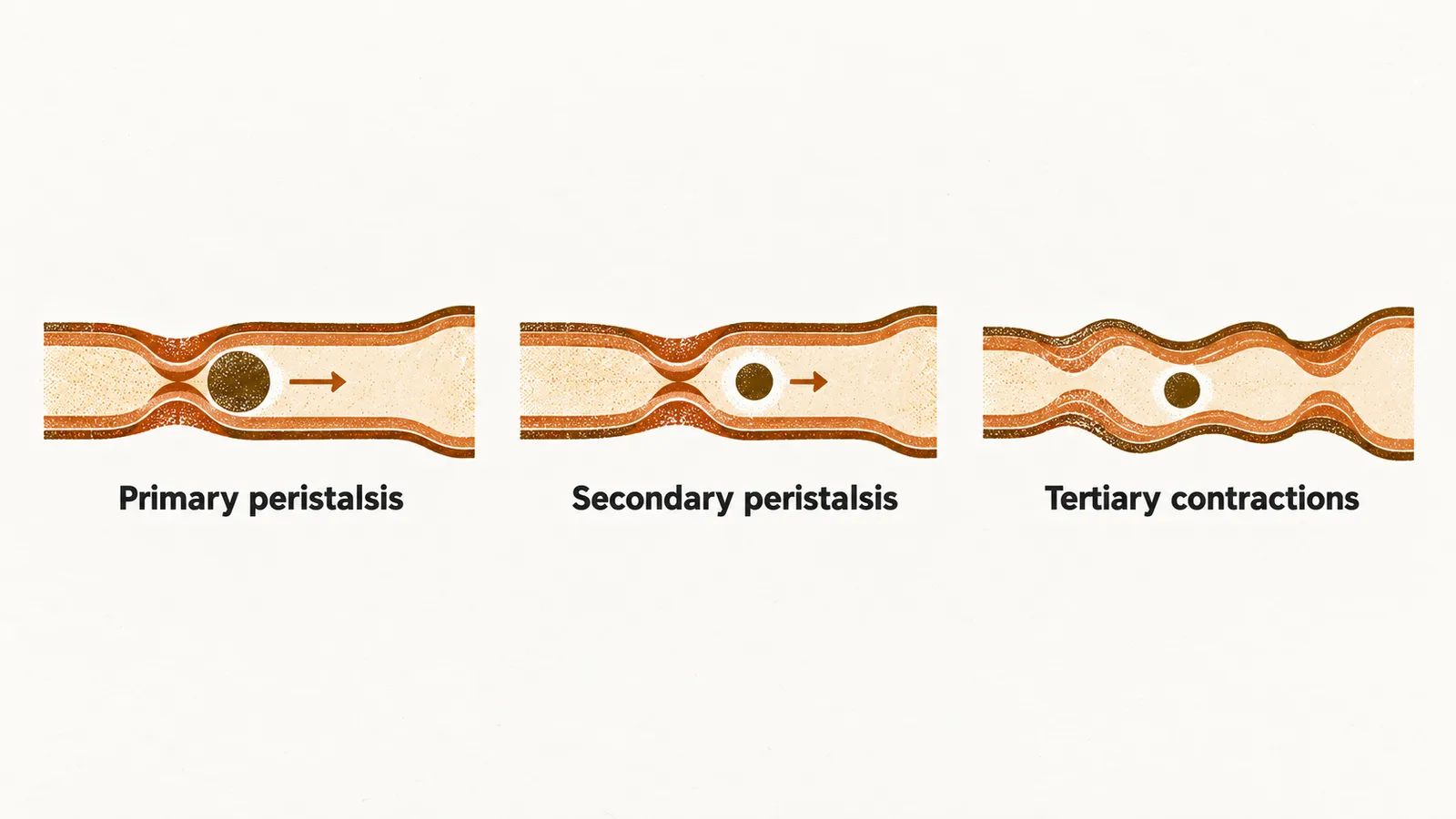
Primary peristalsis is the wave triggered by swallowing. It begins at the upper esophageal sphincter and sweeps downward to carry the food toward the stomach. The bolus moves because the muscle just above it contracts while the muscle just below it relaxes: excitatory neurons behind the bolus drive the contraction, while inhibitory neurons ahead of it open the segment the bolus is about to enter.
Secondary peristalsis is not triggered by swallowing. It is a contraction of the esophageal body set off by mechanoreceptor stretch, when food residue or refluxed gastric contents are left behind. It clears the esophagus, either pushing retained food downward or removing refluxed material before it can damage the mucosa, the inner lining.
Tertiary contractions are spastic, uncoordinated contractions that do not propel a bolus. They are pathologic and are a feature of some motility disorders.
When motility fails
Disordered motility usually takes one of two shapes. In the first, the lower esophageal sphincter does not relax when it should, so food is held up at the junction with the stomach; achalasia is the clearest example. In the second, the esophageal body contracts abnormally: too weakly to propel the bolus, as in ineffective esophageal motility, or with spastic, uncoordinated waves, as in diffuse esophageal spasm and hypercontractile esophagus.