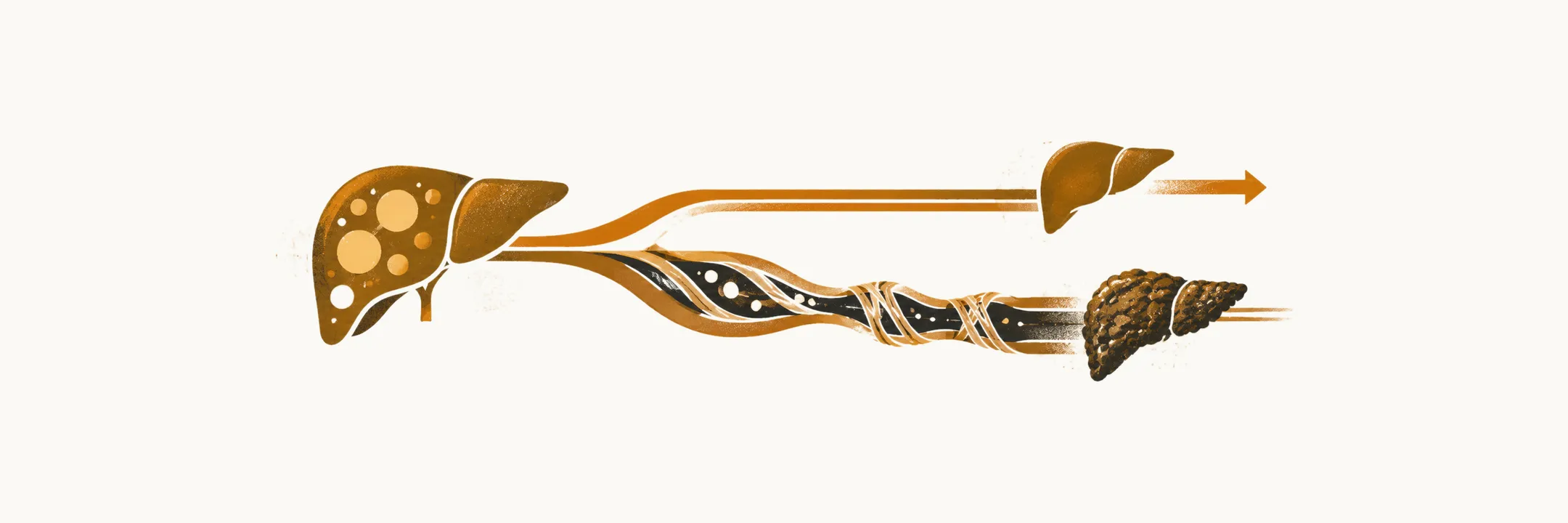
How NAFLD behaves over the years depends on which form is present, and the stage of fibrosis is the strongest predictor of survival. Fibrosis here means scarring of the liver, and cirrhosis is its advanced stage.
Course of the disease
Patients with NAFLD can have either IFL, isolated fatty liver (fat without significant inflammation or fibrosis), or NASH, non-alcoholic steatohepatitis (fat with inflammation and liver-cell injury). More than 80% of the cases of NAFLD are IFL, while less than 20% of them are NASH.
Virtually none of the IFL patients will progress to cirrhosis and end-stage liver disease, while in patients with NASH there is a higher rate of mortality due to liver-related complications.
Studies show that patients with proven NASH will progress to end-stage liver disease or cirrhosis in 15 years in about 11% of the cases. Beyond that, the general mortality of patients with NASH is also higher, due to other complications such as hepatocellular carcinoma (HCC), the primary liver cancer, and cardiovascular disorders.
Most patients with NAFLD who are in the early stages, such as IFL, will die from cardiovascular disorders, while most patients with end-stage conditions of NAFLD, such as NASH, will die from liver-related causes.
Progression to NASH is more common in patients who have more components of the metabolic syndrome, such as hypertension and diabetes mellitus. Metabolic syndrome components not only increase the rate of NASH, but also play a role in increasing the risk of HCC in patients with NAFLD.
NASH can be compared with alcohol-associated steatohepatitis. For patients with NASH there is significantly better long-term survival compared with patients with alcohol-associated steatohepatitis. The 5-year survival of alcohol-associated steatohepatitis is 50–75%, due to its higher rate of cirrhosis development.
Fibrosis and survival
The most important predictive factor for the survival rate of patients with NAFLD is the stage of fibrosis. Studies show that the higher the stage of the fibrosis in NAFLD, the worse the survival rate. Mortality is also raised more generally: all patients with NAFLD, after 5 years, face increasing mortality compared with the control group, and even a small steatosis is related to a higher mortality rate compared with the control group.
Hepatocellular carcinoma
HCC is a recognised complication of NAFLD, and a substantial minority of NAFLD-related HCCs arise before cirrhosis is established. Non-cirrhotic HCC has historically accounted for only about 10% of HCC cases in the Western world, but up to about 30% of NAFLD-related HCC develops in the absence of cirrhosis. Surveillance is recommended in NAFLD-related cirrhosis, while current guidance does not recommend routine surveillance in NAFLD with advanced fibrosis but without cirrhosis.
Liver transplantation
When cirrhosis decompensates or HCC develops, liver transplantation becomes the option. Liver transplantation has increasingly been performed in cases of NAFLD in recent years, especially in NASH with decompensated liver function. NASH-related cirrhosis is now a leading indication for liver transplantation, on a par with alcohol-related liver disease, and it is the leading indication in women and in people over 65.
In an important proportion of the patients who are liver transplanted for NASH, there is recurrence of the metabolic syndrome, which again predisposes to NAFLD or NASH. The incidence of NAFLD/NASH after liver transplantation is steatosis in 60% at one year, steatohepatitis in 60% at two years and cirrhosis in 5% at 10 years.