
Hepatitis A is caused by the hepatitis A virus (HAV), which spreads mainly by the fecal-oral route: the virus is shed in the feces of an infected person and swallowed by another, usually in contaminated food or water. How widely it circulates therefore depends on sanitation and on the age at which people are first exposed.
Epidemiology
Sanitation, age and immunity
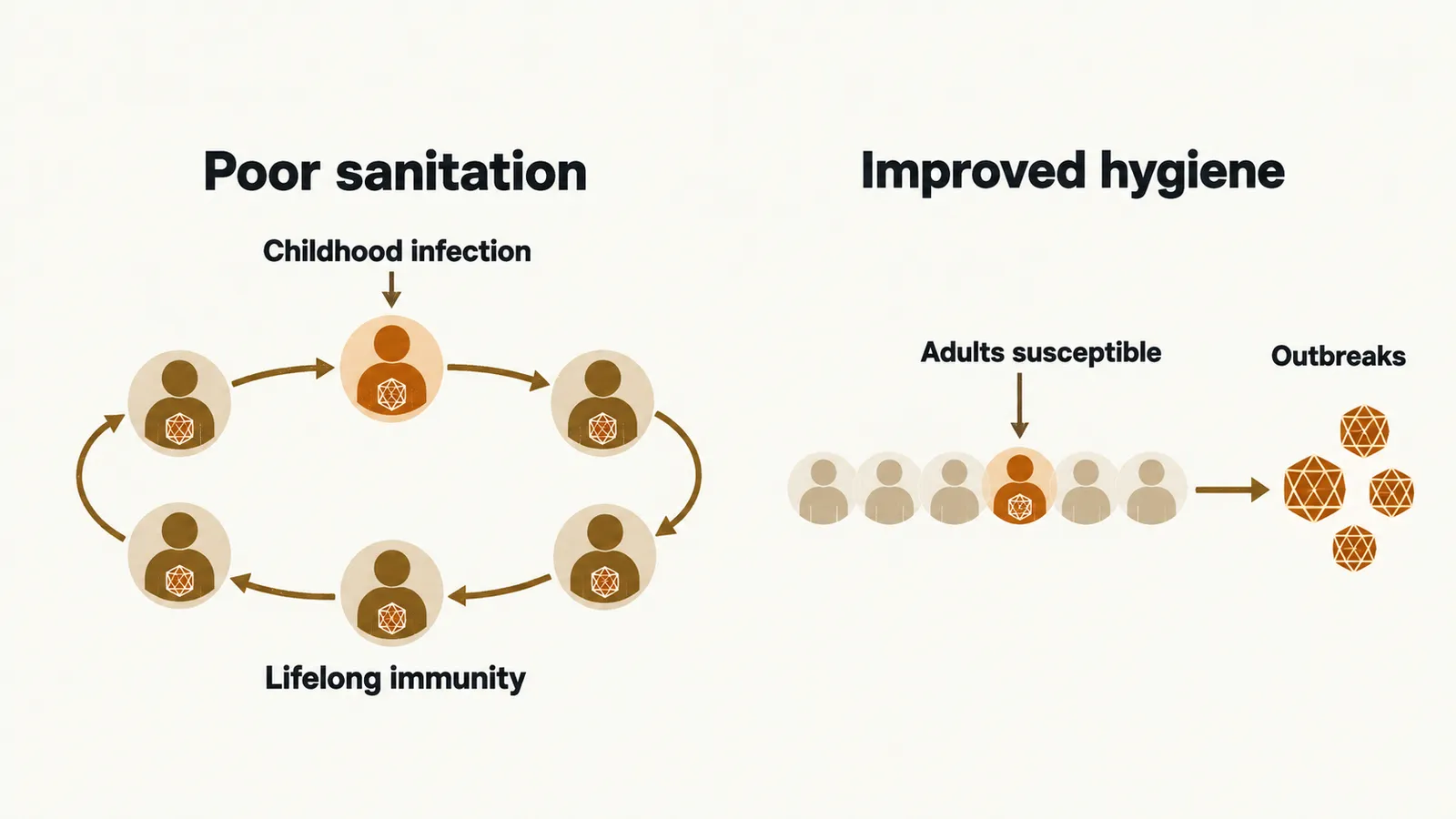
In communities with poor sanitation, HAV circulates continuously and almost everyone is infected in childhood. Because early infection leaves lifelong immunity, the virus then persists quietly in young children, whose infections are usually asymptomatic (they cause no symptoms), and adults are already protected. As sanitation and hygiene improve, children are no longer exposed early, so a growing proportion of adults remains susceptible; the virus can then produce large outbreaks instead of silent childhood infection. This is why, in developing countries, HAV epidemics occur cyclically, every 5 to 20 years, as a new segment of the non-immunised population arrives, whereas in developed countries, with improving hygiene, they no longer occur cyclically.
How the virus is perpetuated
No HAV carrier state (a person who keeps carrying the virus after the illness) has been identified after acute hepatitis A. Instead, the virus is perpetuated in populations mainly by subclinical infections, meaning infections too mild to be recognised, and by food and water consumed from, or imported from, endemic areas. Where HAV is still common the usual vehicle is contaminated water; in developed countries, seafood such as shellfish and fish, which can concentrate the virus, is a frequent source, and travelling to an endemic area is a common way for a non-endemic region to see a case.
Groups where infection clusters
The epidemiological foci of HAV infection that matter for prevention and control are:
- men who have sex with men (MSM), a clustered population in which HAV can spread very significantly
- childcare centres
- neonatal intensive care units
- people who inject drugs
- unvaccinated close contacts
- adopted children from endemic areas
Shift towards adults
Recent vaccination of children, especially those coming from high-incidence countries, has shifted the total incidence of HAV from children to adults, who are mostly in the 4th to 5th decades of life.