
What does a sore throat in a child usually mean?
The pharynx is the shared passage behind the mouth and nose, so anything inhaled or swallowed passes through it. That is why many different agents can inflame it. Pharyngitis is inflammation of the pharynx. When the tonsils are visibly involved, the same illness is called tonsillitis or pharyngotonsillitis. The tonsils are lymphoid tissue in the pharyngeal wall, so the same infection often reaches them. The name changes with what the examiner sees, not with the cause. This distinction is anatomical, not diagnostic. It matters less than the real question: is there a bacterium that needs an antibiotic, and which one?
Most acute pharyngitis in children is viral. This matters because antibiotics do not act on viruses. As a teaching shorthand, about two-thirds of cases are viral and about one-third are bacterial. The exact proportions vary with age, season, epidemic activity and how hard the laboratory looks. So the numbers are a starting point for the differential, not a fixed law.
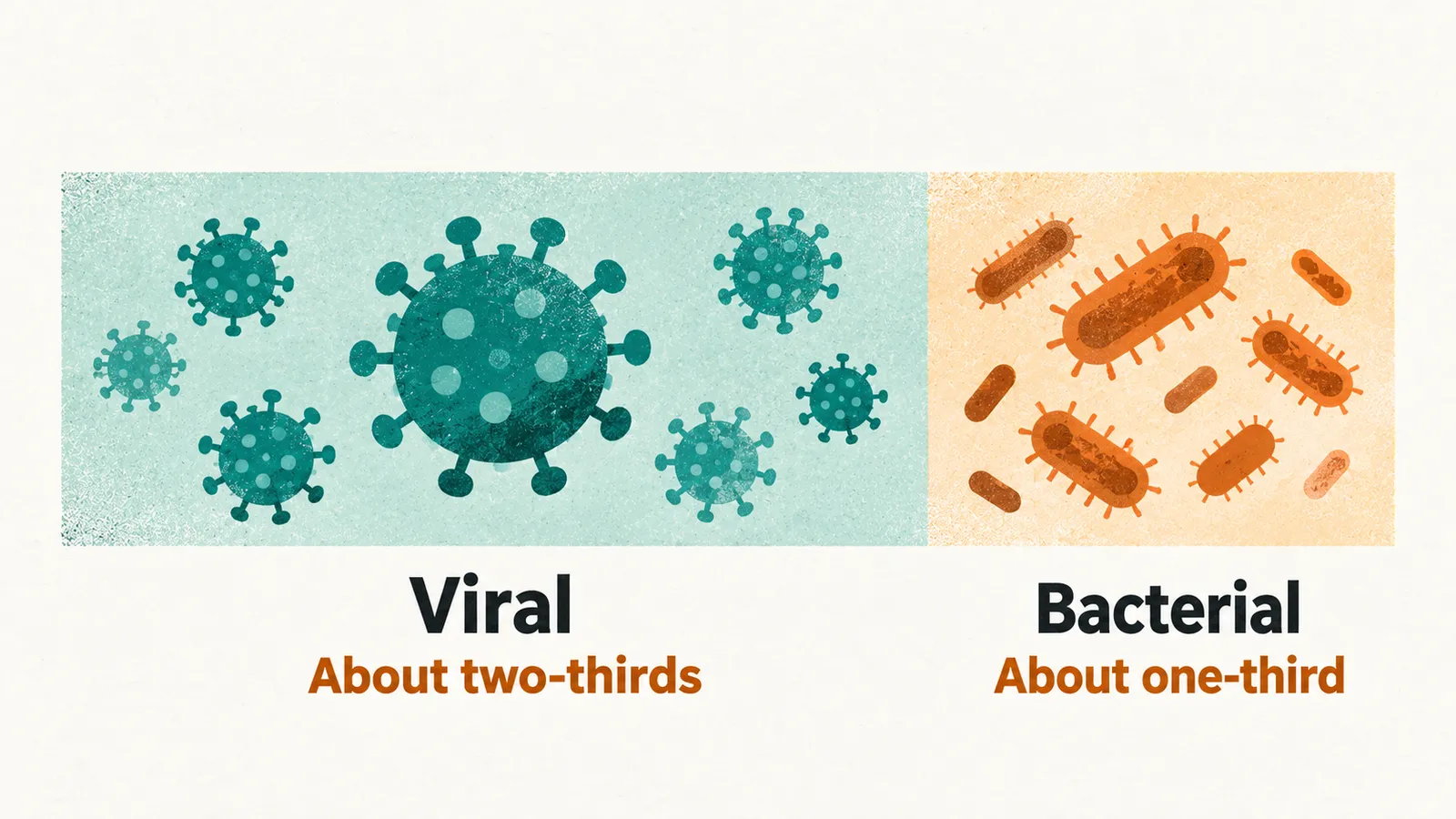
All of these agents can inflame the pharynx, and their appearance overlaps a great deal. They are best read as two parallel lists.
The viruses, roughly two-thirds of cases, include:
- adenovirus, the commonest single viral cause
- influenza A and B
- parainfluenza 1–4
- Epstein–Barr virus (EBV)
- enteroviruses
- herpes simplex virus
- respiratory syncytial virus
- rhinoviruses
The bacteria, roughly one-third of cases, include:
- Streptococcus pyogenes (group A Streptococcus, GAS)
- other β-haemolytic streptococci (groups B, C and G)
- Mycoplasma pneumoniae
- Haemophilus influenzae
- Neisseria meningitidis
- Neisseria gonorrhoeae
Pediatric tonsillitis caused by SARS-CoV-2 is uncommon, and it does not belong near the top of the differential.
Which bacterium matters, and how common is it?
If most cases are viral, where does the bacterium fit? Among the bacteria, GAS is responsible for roughly 90% of cases. It is found in roughly 1 in 4 children presenting with acute pharyngitis. Pooled estimates across diagnostic studies give 20% to 40%. Globally, streptococcal pharyngitis is estimated at 288.6 million episodes a year in children aged 5–14 years.
These counts are complicated by carriage. Between 10% and 21% of children with microbiological evidence of GAS are asymptomatic carriers. In a carrier, GAS lives in the throat without causing acute illness. So a positive result does not always mean that GAS is the cause of this child’s sore throat.
Group B Streptococcus appears among the other streptococci, but it causes neonatal sepsis acquired from the mother during delivery. It does not cause pharyngitis in the school-age child. It is therefore not the target of the swab-and-treat logic.
GAS is a Gram-positive coccus that grows in chains. Its consequences are out of proportion to its share of cases. It is the reason a sore throat is investigated at all rather than simply treated. GAS causes complications of two kinds. One comes from direct spread from the throat. The other comes from an immune response that appears weeks later.
Who should be suspected: how does age change the picture?
Finding GAS means deciding which children to test. The first thing that shapes that decision is the child’s age. Age does more work in the differential than any individual sign. Age sets the pre-test probability: how likely GAS is before any test.
The presentation also changes with age. Young children may not be able to localise a sore throat, and a proposed explanation for the differences is that infants and toddlers do not have a clearly defined case of pharyngitis. The classic picture of streptococcal tonsillitis is therefore a poor guide in the youngest children.
- Under 12 months. Pharyngitis is almost always viral, of the order of 99% of cases. The child often shows non-specific fussiness, poor feeding and low-grade fever. The pre-test probability of GAS is low, so a swab is rarely informative. Management is usually supportive.
- 1–3 years. The presentation is often non-specific: protracted rhinitis and nasal discharge, low-grade fever, irritability, poor appetite and tender anterior cervical nodes, rather than classic exudative tonsillitis. This picture is sometimes called streptococcosis. GAS still occurs at this age and is missed if it is not tested for.
- 3 years and older. The picture is abrupt sore throat, fever, exudative tonsillitis and tender anterior cervical lymphadenopathy. Headache, vomiting and abdominal pain are common in children. This is the age band in which the familiar score-and-swab reasoning applies.
The old rule that children under 3 years are viral by default is no longer used. The only age band with a pre-test probability low enough to justify not testing is the first year of life. From the second year onwards, the question becomes whether examination can identify GAS without a test.
Can the tonsils tell viral from bacterial?
The assumption that exudate, the coating of inflammatory material over the tonsils, means bacteria does not survive inspection. Inflammation can produce exudate whatever the trigger, so its presence does not point to the cause. Studies in the early 1980s showed that adenovirus produces as much tonsillar exudate as GAS. At the bedside the two are indistinguishable.
EBV produces the heaviest exudate of the three. The virus infects the pharyngeal epithelium and B cells in lymphoid tissue, and the resulting lymphoid proliferation enlarges the tonsils and nodes. The membranes can coalesce over both tonsils and the illness is prolonged. Enlargement can obstruct the upper airway, which explains why airway compromise is possible.
What does peeling the membrane show?
Two causes leave a membrane, and one sign separates them: what happens when the membrane is peeled away.
A grey-white pseudo-membrane that stays in place is EBV infectious mononucleosis. It does not bleed when removed.
An adherent, grey, necrotic membrane with underlying mucosal bleeding is diphtheria (Corynebacterium diphtheriae). The toxin kills the cells it enters, and the membrane is made of dead epithelium, fibrin and inflammatory cells stuck to the dead tissue beneath. It bleeds when removed because the tissue beneath is necrotic.
The distinction changes management.
- A child with EBV is uncomfortable and may need airway support, because of the tonsillar and nodal enlargement. EBV has no specific antiviral therapy, and the illness is expected to resolve.
- A child with diphtheria is systemically unwell, because the toxin travels from the throat into the blood and can cause myocarditis. Diphtheria kills 5% to 10% of patients even with treatment. Treatment is time-critical because the antitoxin neutralises only toxin that is still unbound. Once the toxin has entered cells, the antitoxin cannot reach it.
Diphtheria remains rare in Western Europe. It is re-emerging where vaccination coverage has fallen, and cases have been imported into countries with disrupted immunisation programmes. Where immunisation lapses, a disease kept rare by vaccination can return.
If the signs cannot decide, what justifies finding the organism?
Guidelines state that because the signs and symptoms of streptococcal pharyngitis overlap extensively with other infections, the diagnosis should not be made on clinical grounds alone. The sore throat itself does not justify establishing the organism. What justifies it is what GAS does afterwards. So what does GAS do once it reaches the throat that makes finding it worth the effort? That is the subject of Pediatric Group A Streptococcus: Virulence and Complications.