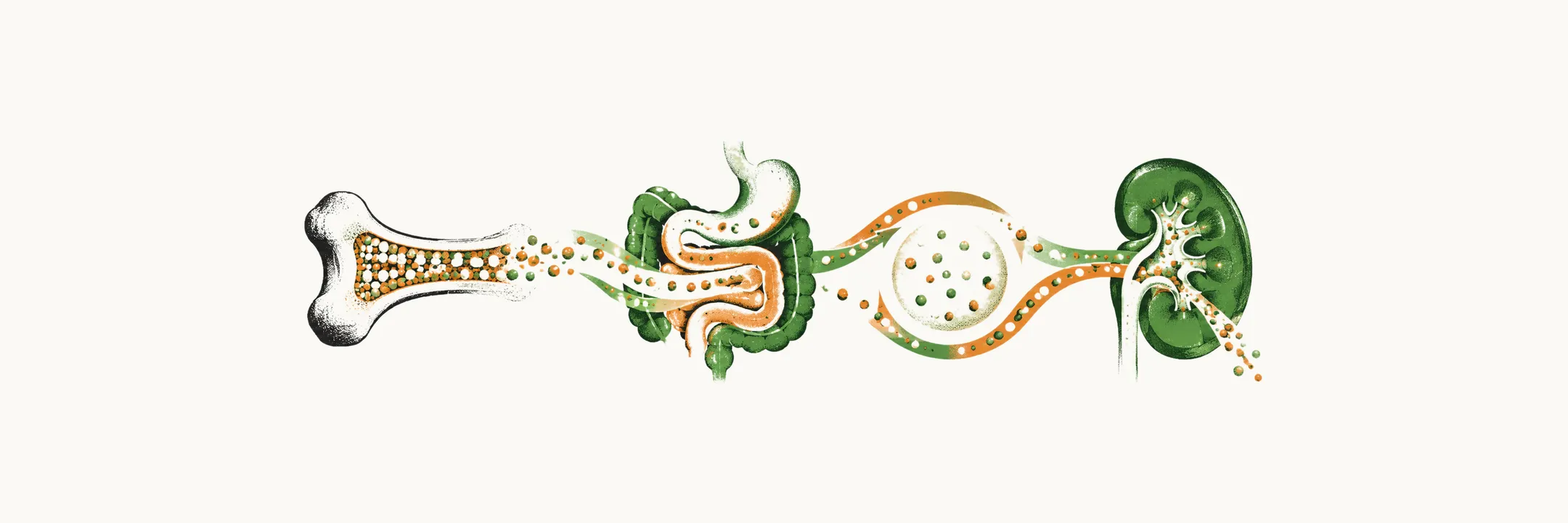
Calcium balance means how much calcium the body holds, where it is held, and how it is taken in and lost.
Where is the body’s calcium?
The total calcium pool differs between healthy adult men and women: about 1300 g in men and about 1000 g in women. More than 99% of it is in bones and teeth, where calcium is held as mineral bound with phosphate. Bone is therefore the reserve behind the daily traffic of calcium in and out of the body.
The small remainder is in cells and the extracellular fluid. It is the pool that works moment to moment: it carries the signal and sets the plasma level, so even small shifts in it matter.
Why do cells keep calcium so low?
The small working pool is split between the inside and the outside of cells, and the two are very different. Intracellular calcium is kept far below the extracellular concentration. Inside the cell it stays between 100 nM and 1 microM, while extracellular fluid calcium is in the millimolar range. Buffering proteins help hold the cytosolic level down.
This steep gradient is the point of the arrangement, because calcium is used as a signal. When the cytosol is nearly empty of calcium, a small entry is a large relative change there, and that change can trigger processes such as muscle contraction and secretion. Calcium exerts most of its effects inside the cell through calmodulin, a calcium-binding protein expressed throughout the body.
What does the plasma calcium number show?
Outside the cell, calcium is kept in a narrow range: 8.5-10.4 mg/dl, or 2.1 to 2.6 mM. But this calcium is not all in the same state, and three fractions make up the total. Only some of it is the active part, so the total can mislead.
- Free ionised calcium is 50% of the 2.5 mM. This is the fraction tissues respond to.
- Complexed calcium is 10% of the 2.5 mM. It is bound to anions, mostly citrate or phosphate ions.
- Protein-bound calcium is 40% of the 2.5 mM. It is attached to plasma proteins.
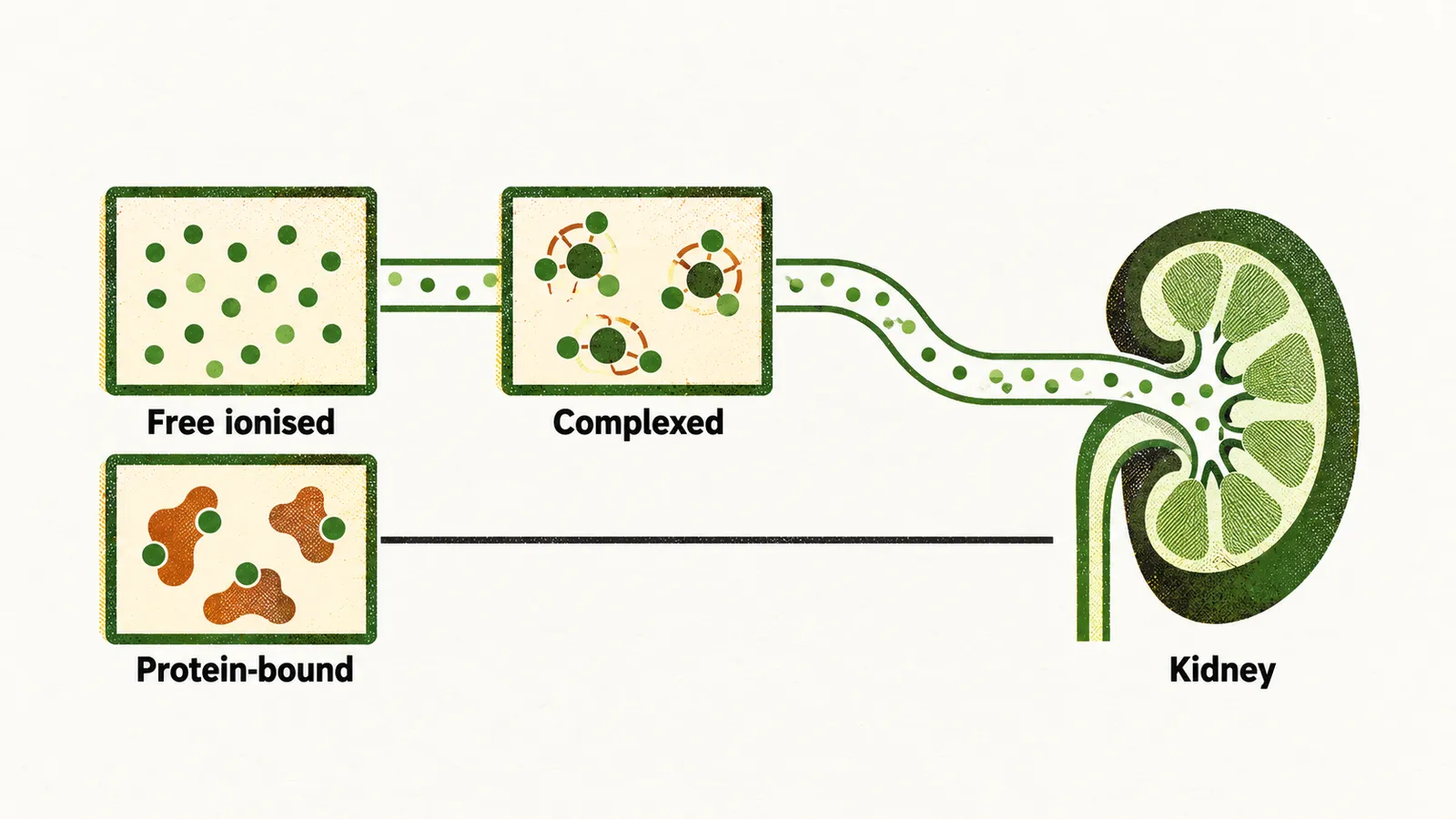
Free ionised plus complexed calcium make up the diffusible calcium, 1.5 mM. Both fractions are small enough to be filtered at the kidney, which matters further on.
Calcium is a cation, so it sticks to negatively charged protein. About 90% of the protein-attached calcium is attached to albumin. Because most of the protein-bound share travels on albumin, a fall in albumin lowers the measured calcium without lowering the ionised fraction that tissues see: the bound part falls, the free part does not.
The size of the effect is set at physiological conditions, at a blood pH of 7.4: each 1 g/dl of albumin carries 0.8 mg/dl of calcium. So each 1 g/dl reduction in albumin reduces the extracellular fluid calcium concentration by 0.8 mg/dl. The adjusted formula turns this around, so that a low albumin is corrected up to the value expected at normal albumin:
adjusted calcium (mg/dl) = total calcium + 0.8 × (4.4 − serum albumin concentration)
With that number understood, the next question is how calcium reaches the plasma at all.
How does calcium get in?
The only route of calcium absorption in the body is the small intestine. It is the single door in, so intake and absorption set what enters.
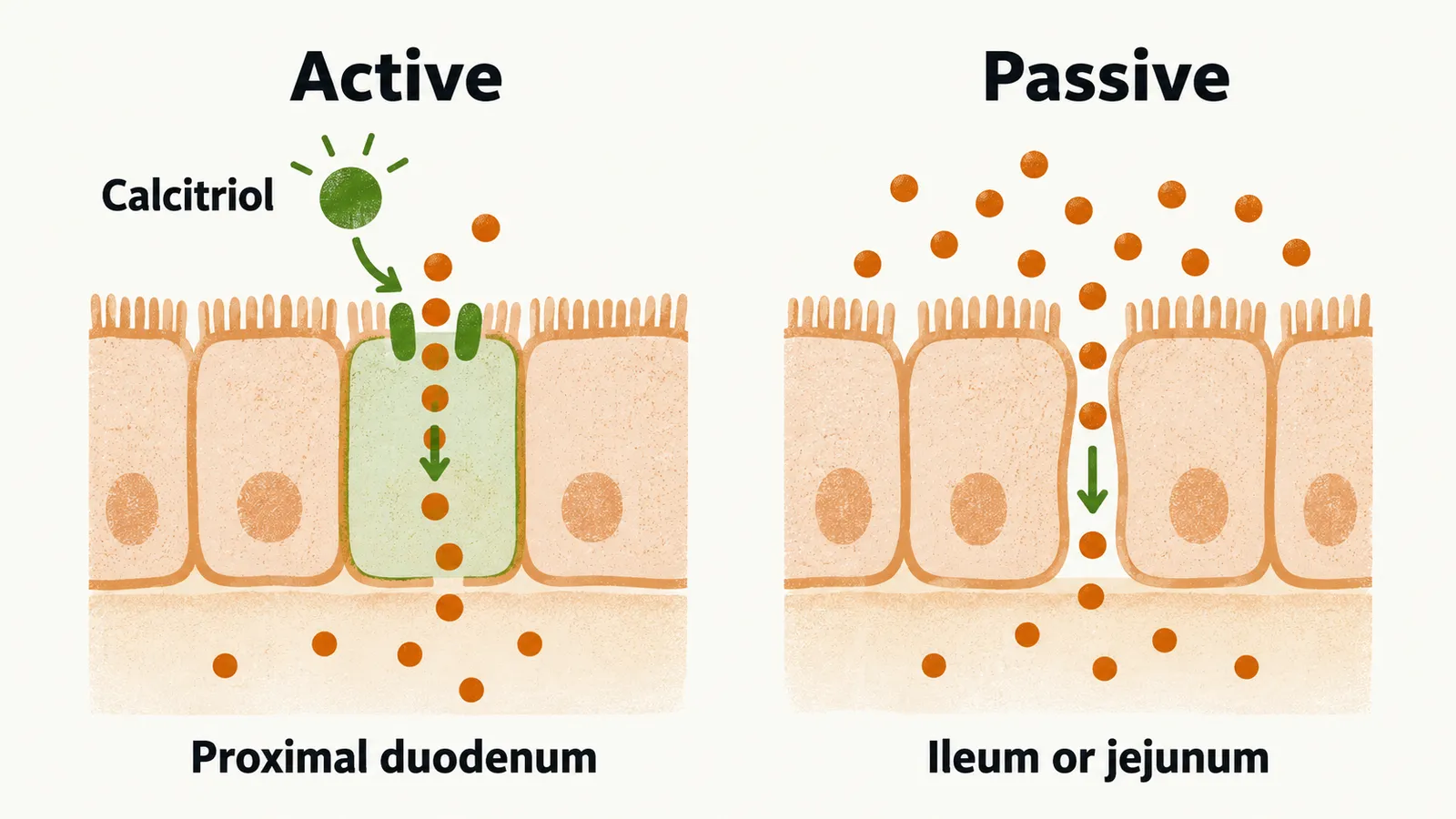
Absorption occurs in two forms, and each suits a different intake.
- Active, vitamin-D-dependent absorption relies on calcitriol, the active form of vitamin D. It takes place in the proximal duodenum. A cell-driven route can pull calcium in when the gut contents are poor in calcium, and active absorption prevails over passive when total calcium intake is not adequate.
- Passive absorption happens when total calcium intake is adequate or even high, in the ileum or jejunum. Calcium moves between the cells down its concentration gradient, so calcium-rich gut contents drive it across.
Intestinal calcium absorption is less efficient in some conditions, such as elderly people, and with some drugs, notably glucocorticoids and phenytoin.
Diet supplies the calcium: in the US, more than 75% of the daily calcium need is taken from milk and dairy products.
What does the daily ledger look like?
Intake is only half of the ledger. Normally, absorbed calcium equals the calcium lost from the gastrointestinal tract (GIT) and the kidney, so the body stays level. This amount is mostly equal to 300 mg/day.
Most adults take about 800 mg/day of calcium, and of this 300 mg is absorbed. The remaining 500 mg is unabsorbed and leaves in the stool. Fecal calcium loss is 650 mg in all: 500 mg from the diet and 150 mg from physiological GIT calcium loss, calcium that the gut itself secretes. So the 300 mg absorbed is matched by 150 mg returned in the gut and 150 mg lost in the urine, which brings us to the kidney.
How does the kidney let calcium go?
The kidney is the other route of calcium loss, a second door mirroring the gut. About 9 g of calcium is filtered by the kidneys every day, and more than 98% of it is reabsorbed. About 150 mg/day is lost in urine. Because nearly all of the filtered load is taken back, a small change in the reabsorbed share changes the urinary loss a lot.
Two kidney parts reabsorb calcium:
- The loop of Henle reabsorbs calcium by a passive mechanism that carries calcium along with sodium. In the thick ascending limb, sodium-potassium-chloride transport leaves the lumen electrically positive, and that voltage pushes calcium out between the cells.
- The distal convoluted tubule (DCT) reabsorbs calcium by an active mechanism governed by PTH, calcitonin and vitamin D. This is the fine-tuning step, a cell-driven transport that hormones can turn up or down.
Because the passive step in the loop of Henle follows sodium, daily calcium loss depends on sodium and water as well as on hormones. The hormone side is that the PTH level raises reabsorption in the distal tubule. Several modifiers follow:
- Sodium: the higher the daily sodium intake, the higher the calcium excretion. The link is thought to be that more sodium moving through the nephron takes calcium with it.
- Protein: calcium reabsorption by the renal tubules depends heavily on proteins containing sulfur-containing amino acids, that is, on dietary protein intake.
- Loop diuretics increase daily calcium loss. They block the sodium-potassium-chloride transporter that builds the lumen-positive voltage, so calcium loses its driving force in the loop.
- Thiazide diuretics decrease daily calcium loss. They act on the distal segment, where calcium is reabsorbed actively.
What does this leave open?
The gut and kidney set how much calcium enters and leaves the body, and hormones adjust both steps. Phosphate moves through the same organs, is stored in the same bone, and is under some of the same hormonal controls. So how does the body handle phosphate alongside calcium?