
The calcium-regulating signals met so far came from the parathyroid, the thyroid and vitamin D. A peptide made elsewhere can use the PTH receptor too, and that is PTHrP, parathyroid hormone-related protein.
PTH is made by one organ and read by a receptor on bone and kidney cells, and that receptor does not check who is calling. PTHrP is a different peptide, made by many tissues. It shares the N-terminal part of its sequence with PTH, and because of this shared sequence it activates the same receptor, the type 1 PTH receptor (PTH1R), described in the PTH note. PTHrP is not a second parathyroid hormone: it does not come from the parathyroid, so it is not under the parathyroid’s feedback.
What does PTHrP do when it is made normally?
If many tissues make a PTH look-alike, what is it for when it is not raising plasma calcium? PTHrP generally acts locally, in the tissue that makes it, and not as a circulating regulator of plasma calcium. Under normal conditions it is made and used within the same tissue, so it does not reach the blood in amounts that move plasma calcium.
Its production follows a time course. PTHrP is physiologically secreted during fetal life and decreases after birth. It increases again during injury and malignancy.
What happens when PTHrP reaches bone and kidney?
Once PTHrP is in the blood, the receptor cannot tell it from PTH. A tissue releasing PTHrP can therefore reproduce PTH effects on calcium and phosphate even when the parathyroid glands are not secreting PTH. PTHrP acts through PTH1R in bone and kidney, the same way PTH does.
In bone, PTHrP stimulates resorption by osteoclasts. Like PTH, it is thought to act through the osteoblast, which signals the osteoclast, and it triggers RANKL expression in osteoblasts, which leads to further osteoclast generation and activation. In the kidney, PTHrP increases calcium reabsorption by the renal tubules, so less of the filtered calcium is lost, and it reduces phosphate reabsorption, so more phosphate is lost.
The result is the same pattern as PTH excess. Bone supplies calcium and the kidney keeps calcium, so plasma calcium rises. The kidney lets phosphate go, so phosphate falls.
Why can calcium be high while PTH is low?
The calcium rises, so what does the parathyroid do? The rising calcium feeds back on the parathyroid cell through the calcium-sensing receptor and suppresses PTH. The signal at the receptor is PTHrP’s, the calcium is high, and the parathyroid responds to the calcium as it should.
So plasma calcium can be high while PTH is low. This is why calcium rises without a rise in PTH: the cause is a hormone that is not PTH, so the parathyroid has nothing to do with it and is switched off by the calcium. Elevated PTHrP with depressed or low-normal PTH suggests this kind of hypercalcaemia.
How do tumours raise calcium?
That is the pattern a PTH-silent tumour produces. PTHrP is a major humoral mediator of hypercalcemia of malignancy, humoral meaning a factor carried in the blood that acts at a distance.
A tumour can raise plasma calcium in two main ways:
- Local: the tumour can metastasize to bone and destroy it locally. Current understanding suggests that tumour cells in the marrow are not enough by themselves, and the proposed route is excessive osteoclast activation through RANKL and RANK, together with tumour cytokines.
- Distant: the tumour can secrete a humoral factor that acts on bone and kidney at a distance. The reasoning is that a single metastasis cannot explain the rise in calcium, so a circulating factor must be responsible.
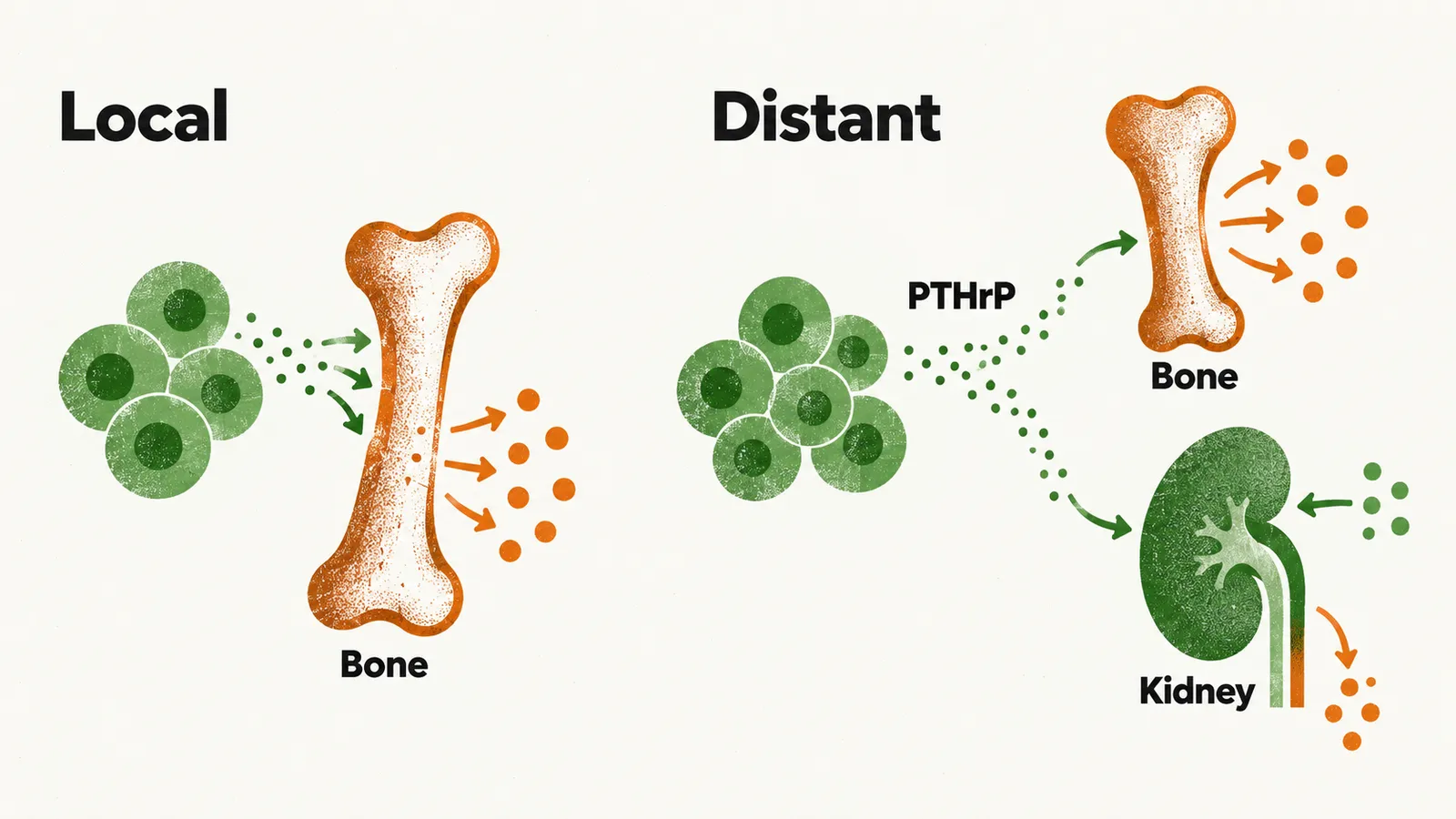
Humoral hypercalcemia of malignancy is mediated mainly by tumour-produced PTHrP acting through PTH/PTHrP receptors in bone and kidney.
Several different forms of cancer secrete PTHrP, mainly breast, prostate and lung cancer. In more than half of breast cancers and prostate cancer there is secretion of PTHrP.
If the parathyroid, the bone, the gut and a distant tumour can all push calcium and phosphate, how do the separate controls fit into one picture?