
Galactorrhea and amenorrhea are the hormone-induced features of a raised prolactin level.
Why does the breast leak milk when no baby is feeding?
The discharge is called galactorrhea when it persists 6 months after breastfeeding or childbirth has stopped. The fluid can vary in form: transparent, milky or bloody, in men and in women. It can come from one breast or from both.
Prolactin is the signal that drives milk production. But the signal needs the tissue to be ready to answer it, and that is the first thing to understand about this feature.
Why does estrogen decide whether the breast responds?
Milk needs several things at the breast. Estrogen primes the breast tissue, and prolactin drives the milk. Prolactin and the ovarian steroids work together to build the breast and make milk, so prolactin alone is not enough.
This explains a requirement: galactorrhea happens in hyperprolactinemia only if some estrogen is present in the body. In a patient with hyperprolactinemia and frank hypogonadism, the breast has not been primed, so galactorrhea is not seen.
The same excess prolactin also suppresses the gonadal axis, and that lowers estrogen. Galactorrhea and gonadal suppression therefore belong together. Because the fall in estrogen removes the priming, galactorrhea can probably fade even as the prolactin level keeps rising. The source only proposes this link, so it is the likely reason, not a proven one.
What happens to the breast when estrogen is low?
Low estrogen is what leaves the breast unprimed. Does it also mean the breast wastes away? In a woman with amenorrhea caused by hyperprolactinemia, it does not: she shows no breast atrophy.
Contrast women who are post-menopausal, women who are amenorrheic with gonadotropin defects, and women in primary ovarian failure. In them, estrogen is lost from other causes. Prolactin itself keeps breast tissue maintained, so it protects against atrophy following estrogen loss. A proposed explanation is that prolactin acts on the breast’s own epithelial cells and can influence them without much estrogen, so the tissue is kept.
Why is galactorrhea rare in men, and what is the exception?
The incidence of galactorrhea in men is very low compared with women. It occurs in less than 30% of men with hyperprolactinemia. The reason is probably the priming: galactorrhea needs estrogen, and men make far less estrogen than women, so the male breast is seldom primed. This brings the question back to estrogen.
There is one exception worth knowing. About one third of patients with acromegaly have galactorrhea. Some pituitary adenomas make GH and prolactin together, and it is common to have somatotroph adenomas secreting both. A tumour that raises GH can therefore raise prolactin too, and the prolactin produces the discharge.
How does prolactin suppress the gonadal axis?
A visible milk leak is one of prolactin’s effects. Another is on the gonads.
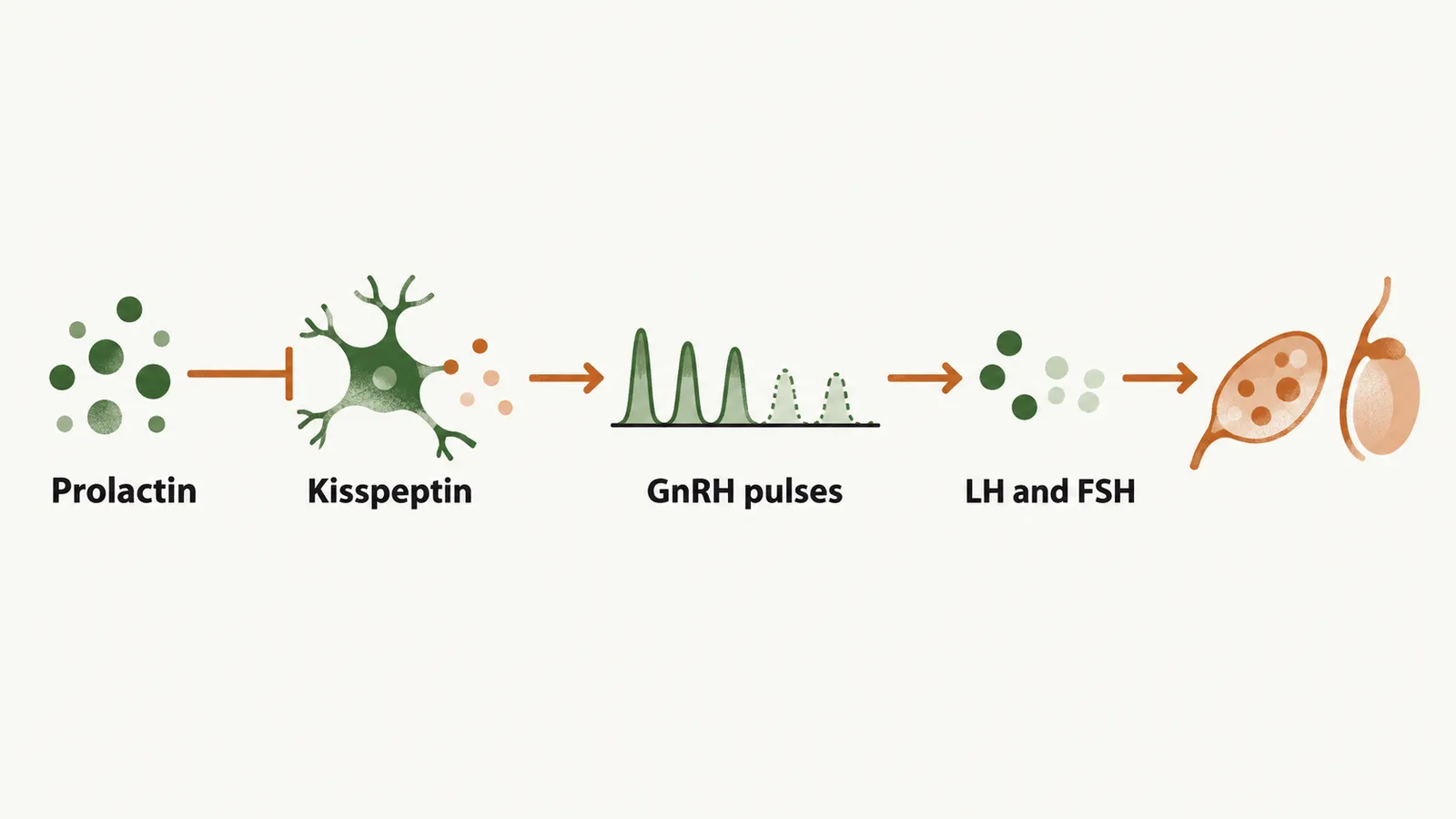
The pathophysiology of hypogonadism caused by hyperprolactinemia is not completely understood. Animal model studies suggest it could be due to an inhibitory effect of hyperprolactinemia on the release of kisspeptin. Kisspeptin is the upstream signal driving the GnRH pulse generator, and a subset of kisspeptin neurons is thought to act as that pulse generator for the GnRH neurons. GnRH has to be released in pulses, and the pulses matter.
Putting the steps in order: the excess prolactin suppresses kisspeptin, so the GnRH pulses fall. Gonadotropin secretion falls with them, because LH and FSH depend on those pulses. The gonads are then no longer properly stimulated.
What do the gonads make once the drive is gone?
Fewer GnRH pulses mean less LH and FSH to drive the gonads, so they make less of their hormones.
In women, LH stimulates the ovarian theca cells to make testosterone, and the granulosa cells turn it into estrogen. Less LH means less estrogen, so women with hyperprolactinemia and hypogonadism usually have a low estrogen level. That low estrogen is also what removes the priming for galactorrhea.
In men, LH drives the Leydig cells of the testis to make testosterone. Less LH means less testosterone, so a low level of sex hormones is mostly seen in men with hyperprolactinemia. A normal testosterone level is nevertheless possible.
Once a raised prolactin level has suppressed the gonadal axis, how do we tell which cause is behind it, and how do we confirm it?