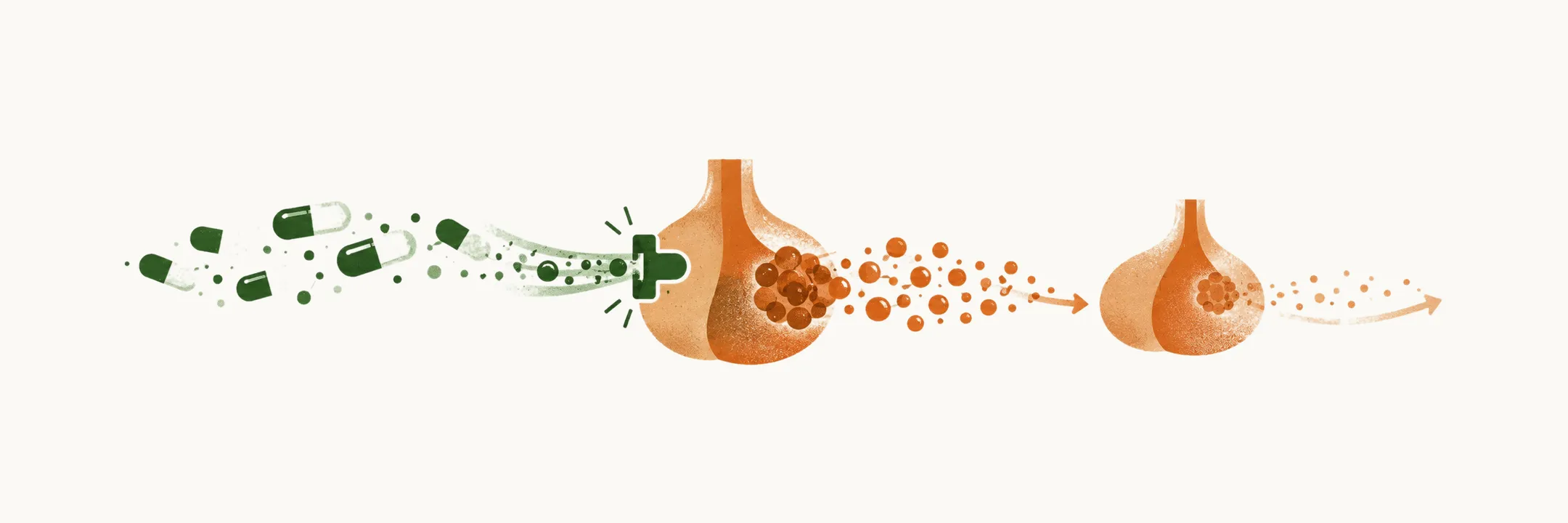
Treatment works on one hormone level and the effects it has. A raised prolactin level has three effects that treatment has to undo, and a tumour adds a fourth target. The cause then decides the route.
What does treatment have to fix?
Treating hyperprolactinemia means restoring the gonadal axis, stopping galactorrhea and preserving bone density. Each aim follows one effect of the raised level.
The first is the gonadal axis. Prolactin suppresses the GnRH pulses, so the gonadal hormones fall, which is the chain taught in Prolactinoma and the Clinical Features of Hyperprolactinemia. Treatment is therefore aimed at normalising the final effect of hyperprolactinemia on the gonadal system.
The second is the milk. Prolactin drives the milk, so the discharge stops when the level falls. Treatment is aimed at normalising the effect on galactorrhea too. The discharge can be absent even when prolactin is high, because galactorrhea needs estrogen to prime the breast as well as prolactin to drive the milk, as set out in Galactorrhea and Hypogonadism in Hyperprolactinemia.
The third is bone. Estrogen helps keep the bone, so low estrogen from hypogonadism costs bone density. Treatment is aimed at preserving it.
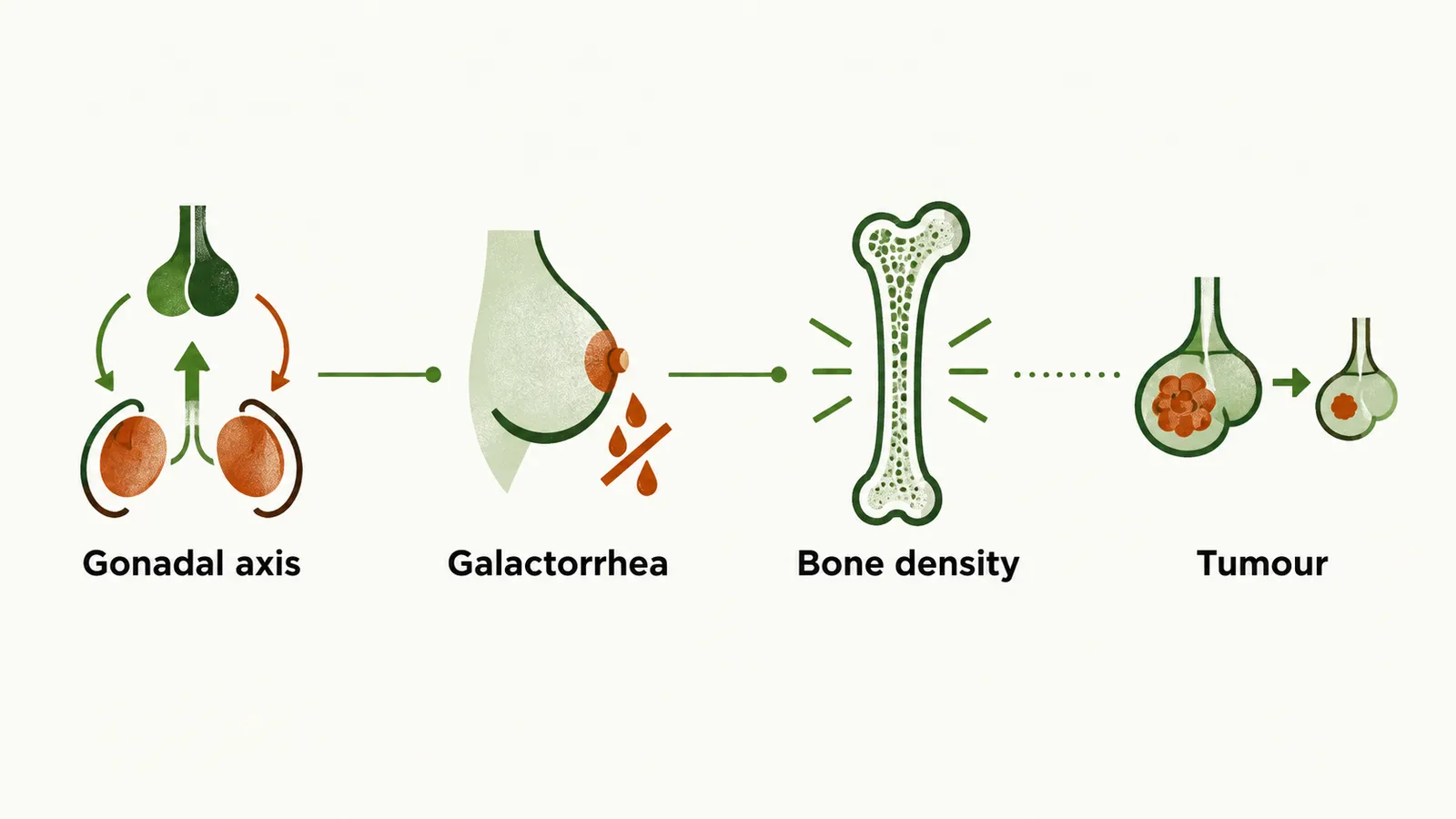
When a prolactinoma is present, treatment also includes shrinking the tumour. The tumour’s bulk presses on the structures beside it, which is how it can press on the optic pathways.
Does every raised level need treatment?
If treatment is aimed at effects, the next question is whether a given raised level has any effect to fix. Not every raised level needs treatment.
A patient with a microadenoma or idiopathic hyperprolactinemia, non-bothersome galactorrhea and normal estrogen or testosterone levels can be followed with periodic prolactin measurement. A similar patient with amenorrhea who is not interested in fertility can be managed with estrogen replacement rather than a prolactin-lowering drug.
Which cause, and which route?
Some raised levels have effects but no tumour, so the cause has to be found before the route is chosen. Cause changes what is done. That is why the first question after diagnosis is which cause is responsible. Not every raised level comes from a tumour.
When the drug itself is the cause
Sometimes the cause is a drug that blocks dopamine. Drugs that block dopamine receptors let prolactin rise, which is why a drug can be the cause. In a patient whose hyperprolactinemia is a drug side effect, changing the drug or titrating its dose can help reduce the hyperprolactinemia.
Switching to a drug in the same class that does not raise prolactin, and rechecking the prolactin, is a practical way to confirm that the drug is responsible. The level usually falls within a short time once the offending drug is withdrawn.
An antipsychotic cannot always be stopped. Then the partial dopamine agonist aripiprazole can be used to attenuate the antipsychotic-induced hyperprolactinemia. Aripiprazole is a partial dopamine D2 agonist, so it reduces the prolactin rise that antipsychotics cause.
How does a dopamine agonist lower the level?
When a prolactinoma is the cause, a dopamine agonist is the first-line drug, and the question is what it does. Dopamine from the hypothalamus holds lactotrophs down through D2 receptors, as taught in Prolactin Regulation and Causes of Hyperprolactinemia. A dopamine agonist acts on the same D2 receptor that normal dopamine uses at the lactotroph, so it lowers prolactin secretion. That is why, regardless of the etiological cause, a dopamine agonist will help reduce the level of hyperprolactinemia.
For prolactinomas specifically, dopamine agonists are first-line treatment. Prolactinoma cells express D2 receptors as well, so the agonist can act on the tumour itself, not only on normal lactotrophs. Dopamine agonists normalise prolactin. They reduce tumour size by more than 50% in 80-90% of patients. As the level falls, gonadal function is restored and the galactorrhea stops, by the same chains described earlier.
Which agonist, and why?
Knowing the drug works, the next question is which one to use. Cabergoline is the preferred dopamine agonist. It is more effective than bromocriptine and better tolerated. Its long half-life keeps the drug in the body for a long time, which is why once- or twice-weekly dosing works.
Bromocriptine and quinagolide are alternatives where cabergoline is unavailable. Cabergoline is usually started at 0.25-0.5 mg per week, and bromocriptine at 1.25 mg per day.
What else does the drug do?
Lowering the level is the aim, but a drug that acts on dopamine receptors also acts elsewhere in the body.
Nausea, dizziness and postural hypotension are the most common early adverse effects. Dopamine receptor stimulation can lower blood pressure, so the drop on standing is one of the early effects. Taking the dose at bedtime with food and increasing it slowly reduces all three.
Some adverse effects matter beyond early nausea and dizziness.
- Dopamine agonists can cause impulse control disorders: compulsive buying, gambling, hypersexuality and mood change. They are a well-known adverse effect of this drug class. They are uncommon, and they are a reason to stop or reduce the drug.
- Long-term or high-dose cabergoline (more than 2 mg per week) can cause cardiac valve changes. Baseline echocardiography is considered when such treatment is planned.
- In a large prolactinoma, rapid tumour shrinkage can open a path for cerebrospinal fluid and cause CSF rhinorrhea. CSF rhinorrhea needs surgical repair.
When can the drug be stopped?
A serious side effect is one reason to stop; the other is that long-term treatment is not always permanent. When prolactin has been normal for at least two years, the maintenance dose is low and the tumour has shrunk substantially, the agonist can be withdrawn and the prolactin rechecked. Roughly 20-30% of patients remain in remission after withdrawal. If hyperprolactinemia recurs, it usually responds to restarting the agonist.
When the drug is not enough: surgery and radiotherapy
If the drug is stopped, or does not work, the tumour and its effects have to be treated another way. In transsphenoidal surgery, the surgeon reaches the pituitary through the sphenoid sinus. The pituitary sits in the skull behind the nose, so the route runs through the nose.
This surgery is used mainly when the dopamine agonist is resisted or not tolerated.
Surgery is also the treatment of choice when the hyperprolactinemia comes from stalk compression by a tumour that does not itself secrete prolactin. In stalk compression, a mass on the pituitary stalk blocks dopamine on its way to the lactotrophs, so prolactin rises although the mass does not make prolactin. Removing the mass lifts the block. Such a tumour will not shrink with a dopamine agonist.
Surgery is also used for:
- rapidly progressive visual loss, because the bulk of the tumour presses on the optic pathways;
- pituitary apoplexy (sudden haemorrhage or infarction of pituitary);
- repair of CSF rhinorrhea.
In experienced hands, remission rates are high for microprolactinomas, up to about 90%. They are lower for macroprolactinomas.
Radiotherapy is reserved for the rare macroadenoma not controlled by medical or surgical treatment.
What happens in pregnancy?
Surgery and drugs both leave one case: a woman who becomes pregnant while on treatment. When a woman becomes pregnant while taking a dopamine agonist for a microprolactinoma or a small macroprolactinoma, the drug is usually stopped once pregnancy is confirmed. Dopamine agonists cross the placenta, which is why. Symptomatic tumour growth during pregnancy is uncommon in these groups.
A large macroprolactinoma carries a higher risk of growth during pregnancy. It may need shrinking with medical therapy or surgical debulking before conception.
That leaves one question: why does a single raised hormone cause so many different problems?