
A prolactinoma is a prolactin-secreting tumour of the anterior pituitary. It arises from the lactotrope cells of the gland. It is the most common pituitary adenoma and accounts for more than 50% of all pituitary adenomas. It also accounts for about half of all pituitary tumours that secrete a hormone.
Sometimes the tumour is mixed, and prolactin is made together with another hormone. The combinations seen are GH and prolactin, ACTH and prolactin, and TSH and prolactin.
The tumour makes a hormone, so what does that hormone do to the body?
Why does one tumour cause two kinds of trouble?
The pituitary sits in the sella, and the optic chiasm lies just above it. A prolactinoma can do harm in two ways, and they come from different sources. The first is the hormone: excess prolactin acts on the gonadal axis. The second is the mass: the tumour presses on the structures near the sella. Because the sources differ, the two kinds of effect do not depend on each other.
This is why the clinical manifestations of hyperprolactinemia are divided into hormone-induced and tumour-induced. Galactorrhea and amenorrhea are hormone-induced. Headache, visual disturbances and hypopituitarism are tumour-induced. This division shapes the presentation in women, in men, and before puberty.
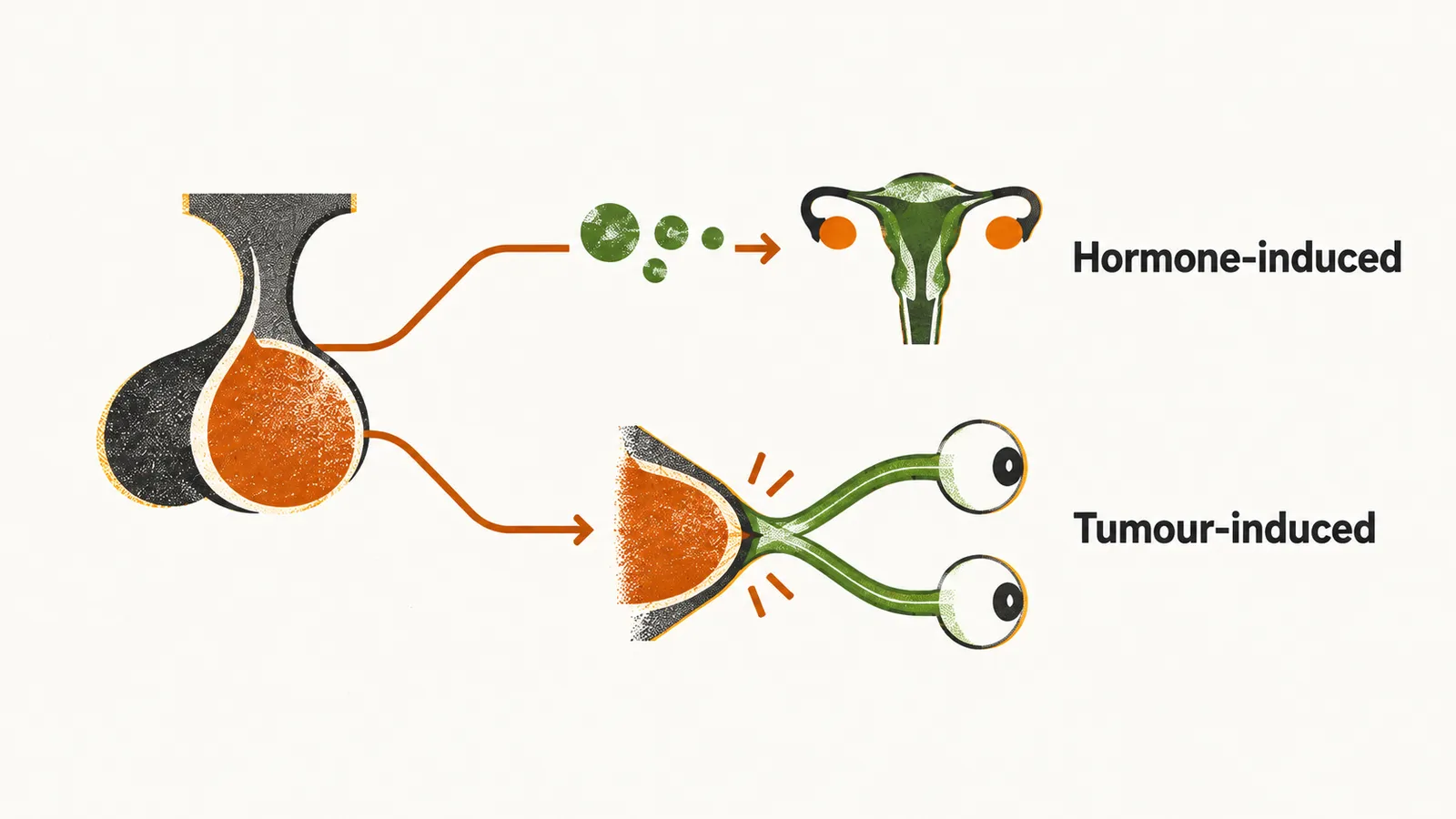
A prolactinoma is a tumour that makes prolactin directly, and its effects come from the two sources above.
The mass is the second source, so how big must a tumour be before it presses?
How are prolactinomas sized, and does size change what they do?
Prolactinomas are grouped by size, and the threshold is 1 cm in diameter. A microprolactinoma is smaller than that, and a macroprolactinoma is larger. The same two size classes are called microadenoma and macroadenoma.
Size at diagnosis matters for the presentation, and the reason is the mass effect. A tumour that grows out of the sella reaches the structures around it, so the tumour-induced features belong to the larger tumours.
Two of these features follow from where the tumour grows. The optic chiasm lies just above the gland, so a tumour growing upward presses on the crossing optic fibres, and that causes visual disturbances. The other pituitary hormones fall because the tumour takes room from the normal cells that make them. Headache is also a tumour-induced feature.
Does a bigger tumour also make more prolactin?
Does a bigger tumour make more prolactin?
Size is one question and hormone output is another. In GH-secreting tumours, the GH level does not correlate with tumour size. In prolactinoma, the level of prolactin secretion is always correlated with tumour size.
Who gets these tumours, and at what age?
Who gets prolactinomas?
Sex and age go with who is found and when. Among people with prolactinoma, microprolactinoma is 20 times more prevalent in women. The prevalence of macroprolactinoma is equal in men and women.
In women the mean age at diagnosis is about 30 years. In men, prolactinoma is mostly diagnosed after age 50. Microadenoma is more common in women, and men more often present with macroadenoma.
In women, what is the chain that links prolactin to the period?
How does prolactin stop the periods?
The main manifestations of hyperprolactinemia in women are amenorrhea, galactorrhea and infertility. Amenorrhea comes first in this section because it follows directly from what prolactin does to the hypothalamus.
GnRH is released in pulses, and each pulse drives the release of LH. Prolactin can block the activity of the pulse maker in the GnRH-releasing cells of the hypothalamus. This blockade disrupts the physiological pulsatility of GnRH release. The rhythm itself is lost, not only the amount of GnRH, so the LH pulses fall.
Ovulation needs those LH pulses, so fewer pulses mean fewer ovulations. That is why, after menarche, hyperprolactinemia first leads to oligomenorrhea and finally to amenorrhea: the cycle lengthens, and then it stops. Infertility is common, and it follows the same chain, because without ovulation there is no egg.
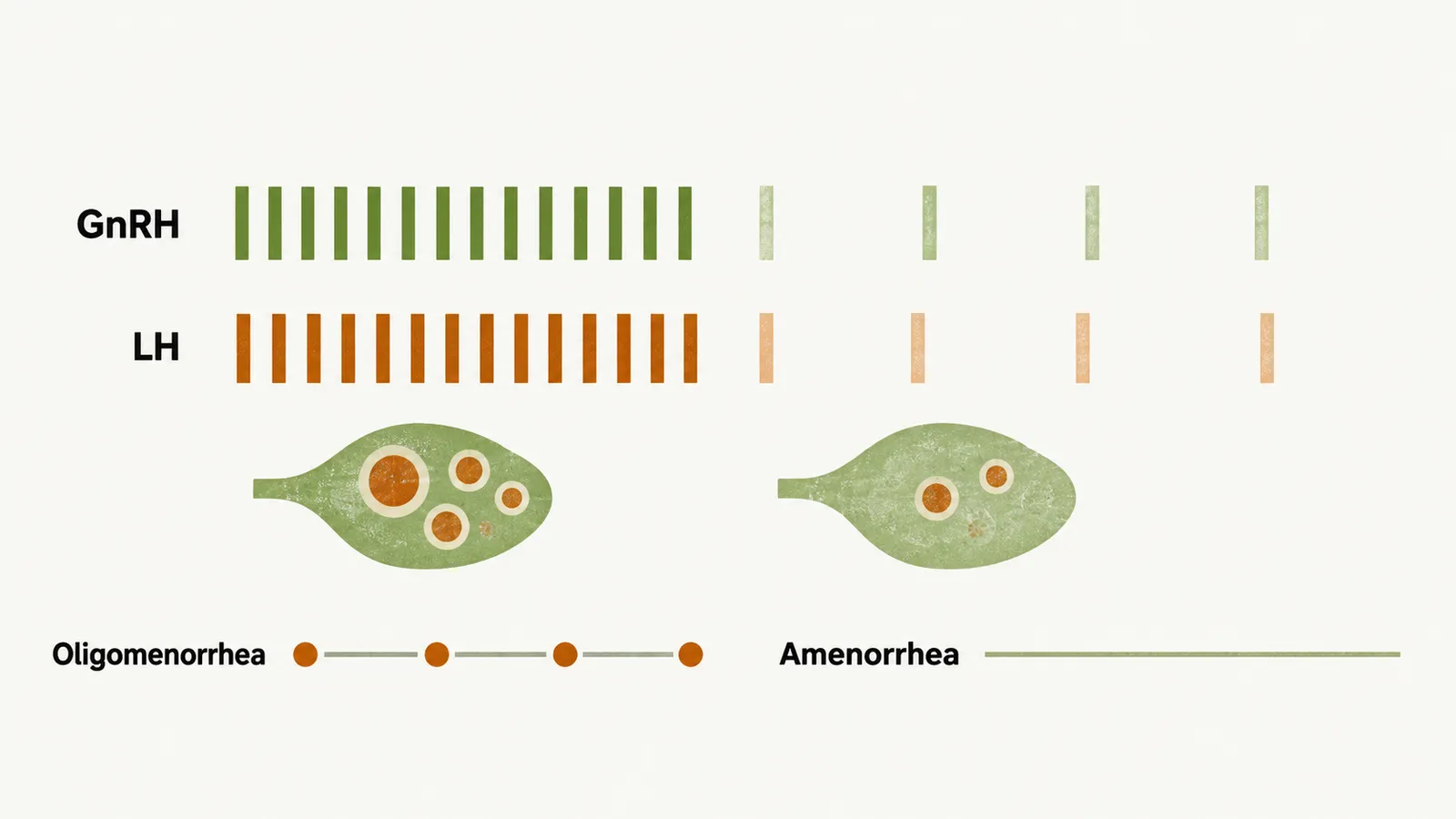
The chain explains the period change. So is prolactin the usual cause of a missed period?
Is a missed period a prolactin sign?
The association between amenorrhea and hyperprolactinemia is not symmetrical. Oligo- or amenorrhea is present in more than 85% of women with prolactinoma, and in more than 85% of them there is amenorrhea. Yet only in 15% of women with amenorrhea is there hyperprolactinemia. Among women who have both amenorrhea and hyperprolactinemia, the cause is a prolactinoma in more than half.
Before the first period the same chain works differently, so what happens then?
What happens before the first period?
Hyperprolactinemia mostly occurs after menarche. When amenorrhea comes before menarche, it leads to primary amenorrhea. The reason is that puberty starts when the GnRH pulse generator becomes active. GnRH pulsatility has an important role in the initiation of physiological puberty. If prolactin holds the pulses back before the first period, no period starts.
The same applies in a child of either sex. Hyperprolactinemia during childhood before puberty can lead to pubertal arrest, because it blocks GnRH pulsatility and so puberty does not begin.
In men the picture is different, so when do they show it?
What happens in men?
Men mostly show clinical manifestations in later stages, when the adenoma is quite big. In more than 80% of men the tumour is a macroadenoma, and the macroadenoma of men has more aggressive behaviour than that of women.
Tumour-related manifestations dominate in men: visual loss, thyroid dysfunction and adrenal dysfunction. This is the same mass effect as before. The bulk presses on the optic chiasm, and it crowds out the cells that make TSH and ACTH.
The hormone-induced effects are still present. Men’s GnRH pulses are suppressed in the same way, so LH falls and the testis is under-driven. Decreased libido is common in men, and so is infertility.
Long-term low sex hormone can also weaken bone, so why?
Why do the bones weaken?
If amenorrhea persists, bone density is reduced compared with others of the same age. This is due to the low estrogen level in these patients. Estrogen is needed for bone growth and peak bone mass, so long-term low estrogen harms bone density.
The same applies to persistent hypogonadism when it is long-term and without control. It can cause osteopenia. It can also cause reduced muscle mass and decreased beard growth.
Low estrogen is one target of prolactin, and the breast is the other, so what does prolactin do there?
Why does the breast make milk?
Prolactin is the hormone that stimulates milk production. That is why galactorrhea is a hormone-induced manifestation. Galactorrhea is present in about 85% of cases. The breast can make milk without pregnancy when prolactin is high.
Prolactin is the hormone of milk, yet the discharge is not present in every case, so what must the breast have before it will answer prolactin?