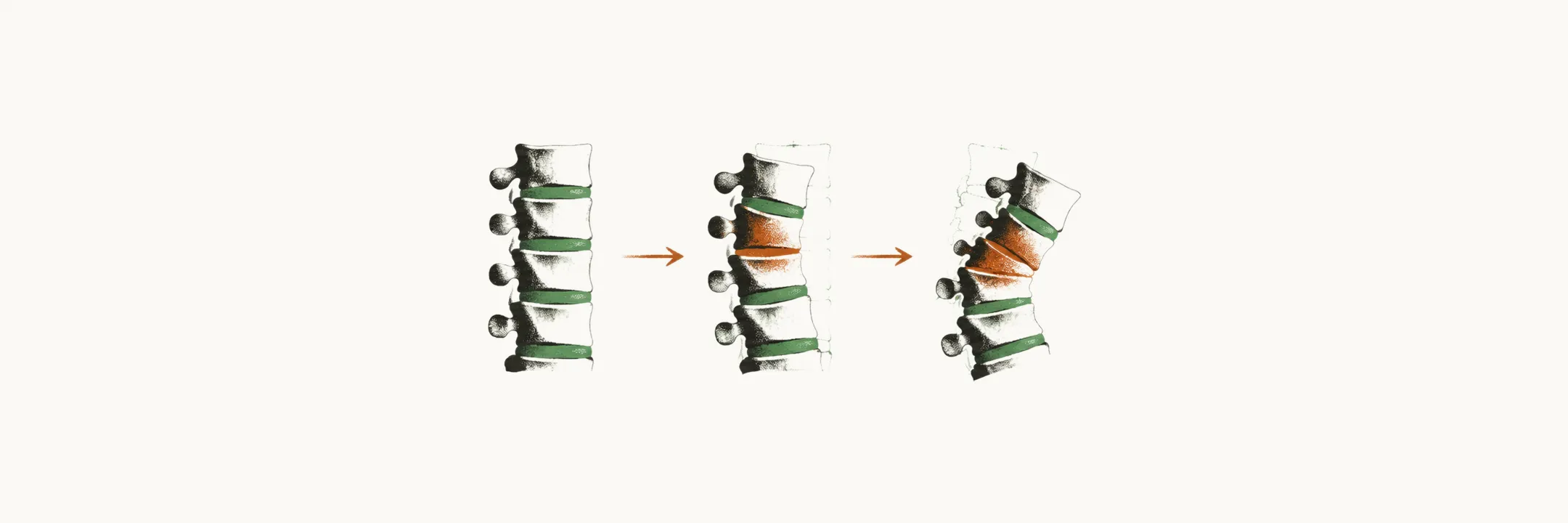
Osteoporosis is a common systemic skeletal disorder, characterised by low bone mineral density. It causes no symptoms until it breaks a bone. Osteoporosis weakens bone, so fractures are how it shows itself, and the clinical picture is made up of the fractures and their consequences. Those consequences are fracture, bone pain, disability and loss of independence.
The clinical picture has a second part. It is made up of the history and examination findings that point to a cause, or to a high risk of falling.
Where do the fractures happen?
Three fracture sites define the disorder, and they behave differently. Each one tells a different part of the story.
Vertebral fractures are the most common osteoporotic fracture. They come first in the count, and most of them say nothing.
Why are most spinal fractures silent?
Most vertebral fractures are subclinical: they cause no recognised symptoms.
A symptomatic minority cause back pain, loss of height and kyphosis. As height is lost, the back muscles shorten and must work hard to hold the posture, and the resulting muscle fatigue is a source of pain. In kyphosis, the spine bends forward.
What do spinal fractures do to the chest and abdomen?
A collapsed spine changes the shape of the trunk around it. Multiple thoracic fractures can restrict the lungs: a forward-bent thoracic spine leaves less space in the chest, limits the rib cage and restricts how far the lungs expand. Lumbar fractures can alter the abdominal cavity enough to cause constipation, abdominal pain, early satiety and weight loss.
Why is a broken hip the most disabling?
Hip fractures are the most disabling osteoporotic fractures. About 20% of patients need long-term nursing home care, and about 60% do not fully regain their pre-fracture independence.
What does a broken wrist tell us?
Wrist fractures are a different picture from the hip. They tend to occur earlier, between 50 and 60 years of age. Wrist fractures are about five times more common in women, and they are less disabling.
Even so, they matter. Any earlier fracture is a strong predictor of the next one, and the wrist is one such fracture: a wrist fracture predicts later fractures as strongly as hip and vertebral fractures do.
Why is a fracture a warning, not an accident?
A fracture that predicts another changes how it is read. A fracture in an adult aged 50 years or older should be treated as a sentinel event, not an accident.
A sentinel event marks a skeleton likely to fracture again, particularly in the year that follows. A previous fracture predicts the next one independently of bone mineral density.
Why does the history carry so much of the work?
The disorder is silent until it fractures, so the medical history carries much of the assessment work. With nothing felt before a break, the history must find the risk, the cause and the treatment, and it also shows the findings that point to a high risk of falling.
A thorough history in osteoporosis has three practical purposes:
- assessing the risk of future fractures;
- identifying possible causes of secondary osteoporosis;
- judging whether a particular therapy is suitable.
What does the history say about risk?
The first purpose is the risk of future fracture. The history helps decide who needs a bone density test and how great the fracture risk is.
It also supplies the input for FRAX, whose result is a 10-year fracture probability. The inputs are:
- age, sex, weight and height;
- previous fracture;
- a parent with hip fracture;
- current tobacco smoking;
- ever use of glucocorticoids;
- rheumatoid arthritis;
- secondary osteoporosis;
- alcohol intake of 3 or more units per day.
FRAX also takes femoral neck bone mineral density and trabecular bone score, but only if they are available.
What does the history say about the cause?
The second purpose is the cause. The history can show diseases, deficiencies and drugs that cause bone loss, so it is where the causes of secondary osteoporosis are looked for.
How does the history steer treatment?
The third purpose is whether a therapy suits the person. A drug can be unsafe in a given condition, so the history is checked against the drug before it is chosen. Selecting the most appropriate treatment therefore depends on identifying co-morbidities of clinical significance.
Which drugs does a history favour or rule out?
The conditions named in the history decide which drug fits.
- A high risk of breast cancer favours the use of raloxifene.
- A history of thrombophlebitis suggests raloxifene should not be used. Raloxifene has been reported to increase the risk of deep vein thrombosis and pulmonary embolism, so a past clot is a reason not to use it.
- Esophageal stricture is a contraindication to oral bisphosphonates. These are swallowed as tablets and can irritate the gullet, and clinicians avoid them when the risk of that irritation is higher. A narrowed gullet being such a setting is a proposed reason, not a settled one.
- A patient with a skeletal malignancy should not be treated with teriparatide.
What makes treatment work less well?
Even a suitable drug depends on what the person does and takes. The history shows factors that contribute to a suboptimal response to therapy: compliance and persistence with therapy, adequacy of calcium and vitamin D, and co-morbidities. Vitamin D is associated with maintaining the response to bisphosphonates, and it may be involved in optimising the therapy, though this is proposed.
Where does that leave the diagnosis?
The history raises suspicions about risk, cause and suitable therapy, but it does not make the diagnosis. Examining the patient and measuring bone density is how the diagnosis itself is made. So how is the suspicion turned into a diagnosis?