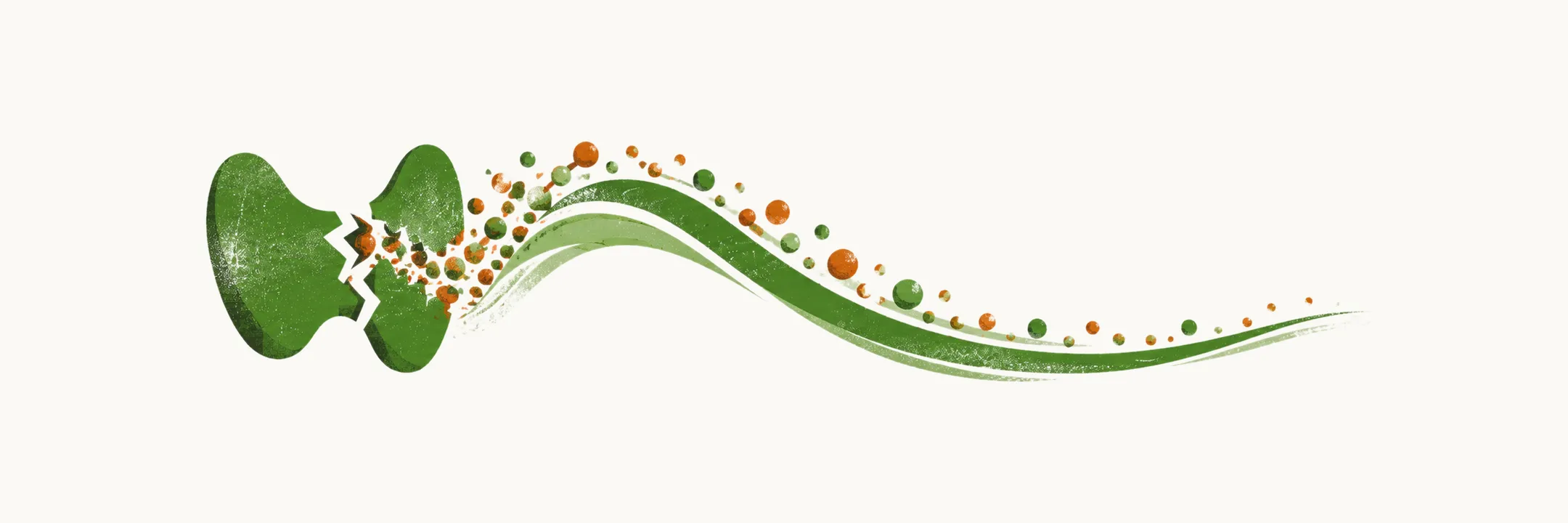
De Quervain thyroiditis, also called subacute thyroiditis or giant cell thyroiditis, is an inflammation of the thyroid that follows a viral infection. Think of the thyroid as a gland that keeps finished hormone in reserve, held inside its follicles in a protein store, so hormone can leave without being made first. In this disease the inflammation breaks some follicles open and the reserve pours into the blood. That is the whole idea: this is release from stores, not the making of more hormone.
It differs from other forms of thyroiditis such as Hashimoto thyroiditis. Hashimoto is a long-term autoimmune process of the gland, whereas this disease is a short inflammatory injury that burns out, so the two are told apart by their course and their cause.
What sets it off?
The disease follows a viral infection of the upper respiratory tract. The infection, not the gland’s own autoimmunity, starts the inflammation, which is why the disease is called post-viral.
It is seasonal, mostly in spring and autumn. Its peak incidence is between 30 and 50 years of age.
What happens inside the gland?
The disease is painful. After the viral infection, macrophages and giant cells infiltrate the gland, which becomes inflamed and swollen, and that inflammation is what hurts in the neck.
The inflamed follicles then rupture. Their walls lose their integrity as the inflamed cells break, so what they hold spills out. What they hold is thyroglobulin, and it is hydrolyzed. The hormone it frees was already made, so the inflammatory breakdown of the store releases preformed hormone.
Why does the thyrotoxic phase come first?
A whole reserve released at once makes the blood levels of T3 and T4 rise sharply. A large amount of T3 and T4 enters the bloodstream together, and this is the thyrotoxic phase.
The hormone comes from stored hormone, not from new synthesis. So when the store runs out, the excess ends by itself, and the thyrotoxic phase is self-limited.
How is it told apart from Graves disease?
A scan shows how actively the gland traps iodine, as the diagnosis note explained. Here the gland hands out stored hormone instead of building new, so little iodine is taken up and the scintigraphy is quiet. Uptake is low or absent. In Graves disease, uptake is high, and that separates the two.
What follows when the stores run out?
Once the store is exhausted and the gland cannot yet make more, the hypothyroid phase follows. The damaged gland has spent its reserve and cannot yet make hormone, so blood levels drop below normal.
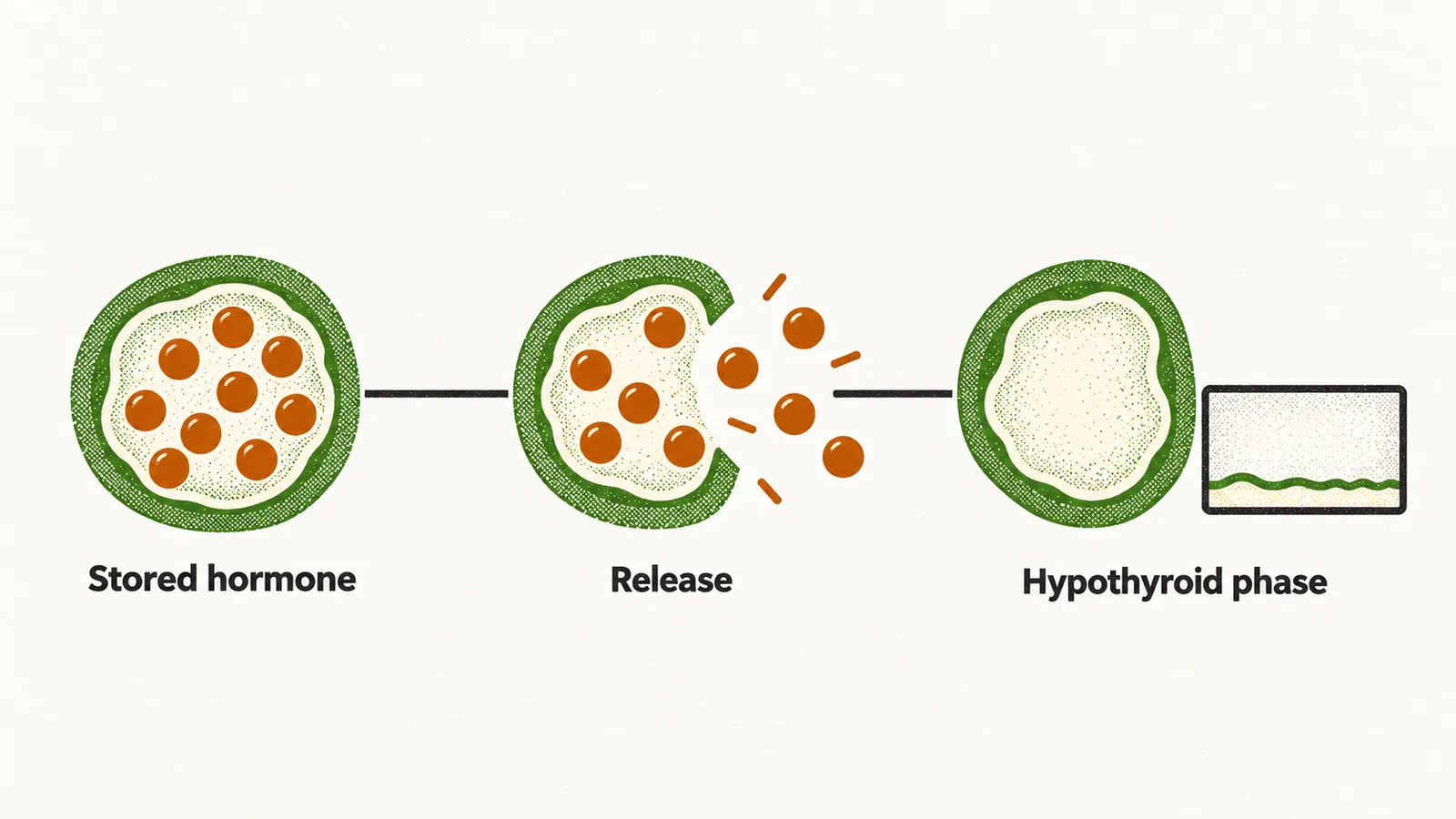
In this phase TSH is high and T3 and T4 are low, because the falling hormone releases the feedback that held TSH down. The anti-TPO antibodies are negative. ESR and CRP have normalised, as the inflammation settles.
The hypothyroid phase is usually mild. The gland recovers, so the low hormone is temporary, and levothyroxine is not required.
What do the blood tests show?
High hormone switches TSH off through feedback, the loop the earlier note described. So in the thyrotoxic phase TSH is low and T3 and T4 are high. The anti-TPO antibodies are negative.
ESR and CRP are increased, and both are markers of inflammation. ESR rises as fibrinogen speeds the settling of red cells, and CRP is made in response to inflammation. They show what the gland is going through, so they fall as it recovers, and in the hypothyroid phase they are back to normal.
How is it treated?
The disease is self-limiting and usually improves on its own, so treatment is for the symptoms.
NSAIDs relieve the pain. A beta-blocker controls the adrenergic symptoms of the thyrotoxic phase; it blunts them, as the treatment note showed. Glucocorticoids are used when the pain is severe or NSAIDs are not enough.
Antithyroid drugs are not used. Thionamides stop the gland making new hormone, as the treatment note showed. Here the hormone is released from stores rather than synthesized, so there is no new synthesis for them to stop.
Is there a version without pain?
Yes. Silent thyroiditis runs a very similar course: thyrotoxicosis followed by hypothyroidism. The route is the same, since inflammatory destruction of follicles releases preformed hormone, but the infiltrate is lymphocytic and there is no marked inflammation. There is no pain and the ESR is normal.
Under the microscope the infiltrate looks like that of Hashimoto thyroiditis, and for that reason silent thyroiditis is believed to have an autoimmune origin. The leaking follicles are thought to release thyroglobulin along with the hormone, and in silent thyroiditis thyroglobulin is increased.
Can the same picture come from a pill?
This distinguishes silent thyroiditis from factitious thyrotoxicosis, in which thyroglobulin is low. What happens when thyroid hormone is swallowed as a tablet and the gland has no part in it?