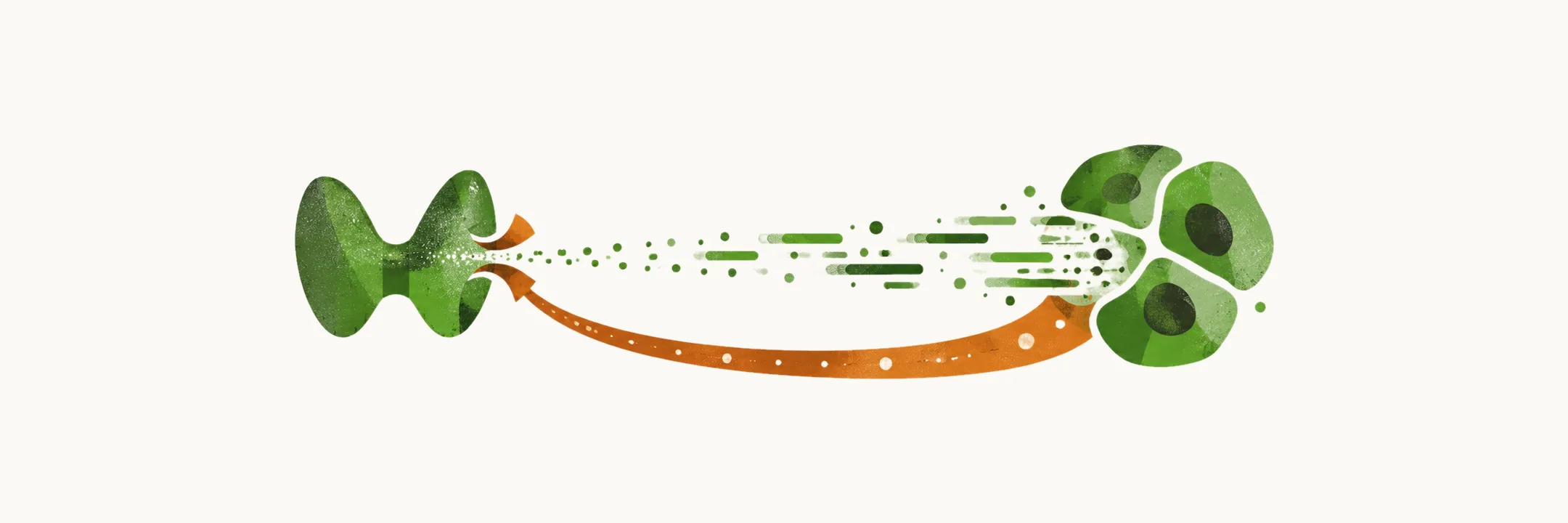
A thyrotoxic patient has two problems that need different fixes. The hormone already in the blood acts on the tissues at once, so the first layer of treatment controls that effect. The gland keeps making new hormone, so the second layer deals with the overproduction itself. Which of the two works fast?
Why does a beta-blocker work first?
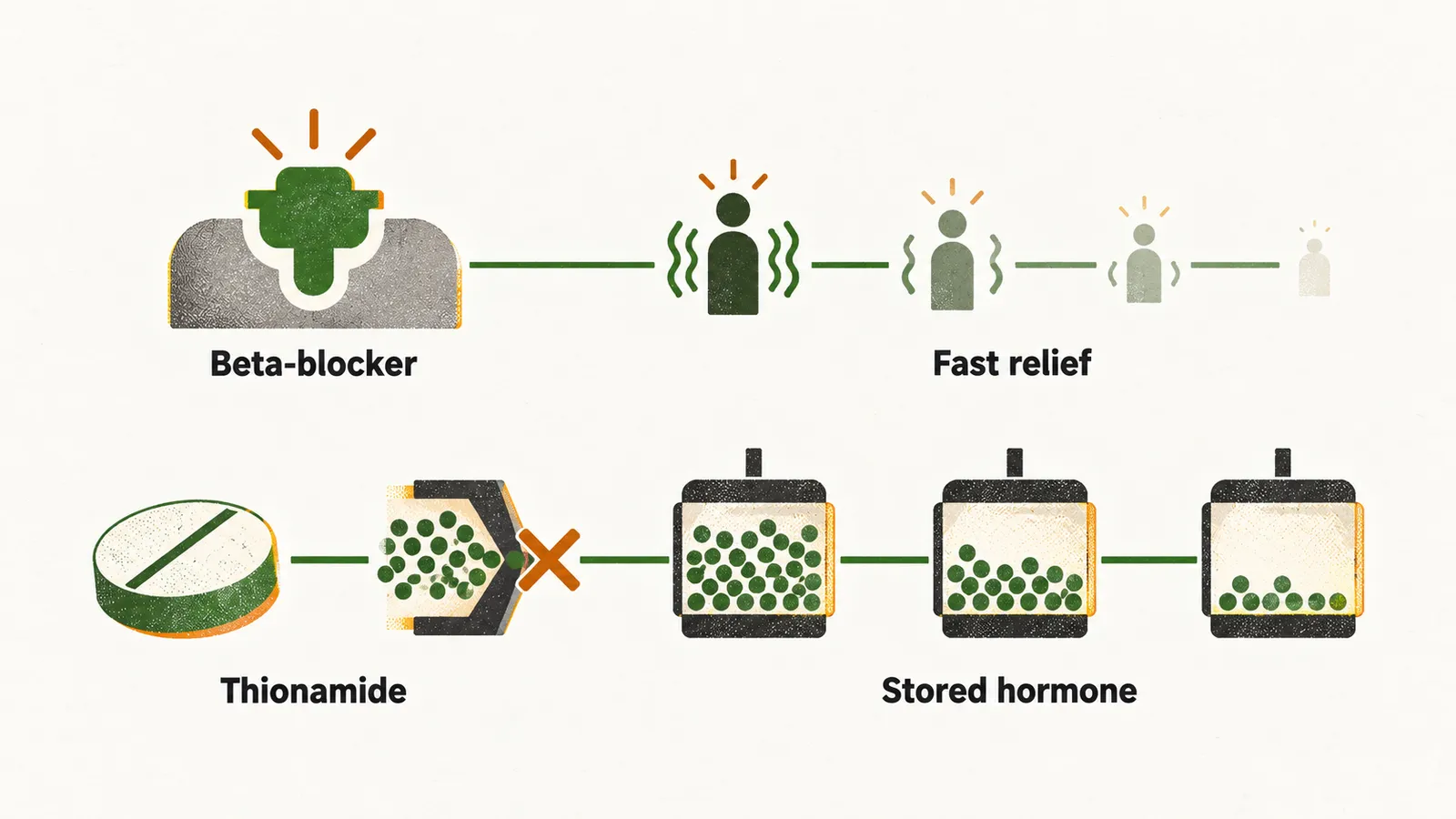
Beta-blockade gives the fastest relief. A beta-blocker blocks the adrenergic signal at its receptor, so the symptoms ease without waiting for the hormone level to fall. The symptoms come from thyroid hormone acting on the tissues, the effect the earlier note described.
A non-selective beta-blocker such as propranolol blunts the adrenergic symptoms: palpitations, tachycardia, tremor, anxiety and heat intolerance. Thyroid hormone raises the number of beta receptors in fat and skeletal muscle, so the adrenaline signal reaches more receptors, and the beta-blocker blocks those receptors.
Does propranolol do more than block the signal?
At higher doses it does. Propranolol also inhibits the peripheral conversion of T4 to T3, so less of the more active hormone is made. The tissues turn T4 into the more active T3, the conversion the earlier note described.
Why can the beta-blocker start before the cause is known?
The symptoms come from the hormone’s effect on the tissues, whatever the gland’s cause. A drug that treats the symptoms can therefore be started as soon as the diagnosis is made, before the cause is known.
The beta-blocker is also a mainstay in severe thyrotoxicosis and thyroid storm. In storm the adrenergic surge is the danger, and the beta-blocker is the drug that counteracts it. But it does nothing about the gland, so what treats the gland itself?
What treats the overproducing gland itself?
Overt Graves hyperthyroidism can be treated with any of three definitive modalities: antithyroid drugs (thionamides), radioiodine, or surgery. The choice among them depends on the patient.
How do thionamides stop the gland?
Methimazole, or its prodrug carbimazole, is used in almost every patient who chooses drug therapy. The gland makes hormone by adding iodine to thyroglobulin, a step run by thyroid peroxidase (TPO) that oxidizes iodide and attaches it to thyroglobulin, called organification. Thionamides inhibit TPO, so they block that step. A drug that blocks that step prevents the synthesis of new hormone.
Why does the effect take weeks?
The gland keeps a store of finished hormone, and so does the blood. Thionamides do not affect hormone that is already stored, so the fall in hormone comes as that store is used up. That is why the effect takes weeks.
What dose is used, and how is it lowered?
Methimazole is started at 10-30 mg daily. The dose is reduced as thyroid function returns to normal. The drug blocks new hormone, so less blocking is needed once the gland’s output returns to normal.
When is PTU used instead of methimazole?
Propylthiouracil (PTU) is used instead of methimazole during the first trimester of pregnancy, in thyroid storm, and when methimazole cannot be tolerated. Unlike methimazole, PTU also blocks the peripheral conversion of T4 to T3, the conversion the earlier note described.
What harms do the antithyroid drugs carry?
The serious adverse effects of antithyroid drugs are agranulocytosis and hepatotoxicity. Agranulocytosis occurs in about 0.2-0.5% of patients, usually within the first three months. Patients are warned to report a sore throat or fever.
How long does the course last?
A course of 12-18 months is usual, after which the possibility of remission is assessed.
How does radioiodine destroy the gland?
The thyroid takes up iodide, and radioactive iodine is taken up in the same way, like ordinary iodine. The radiation therefore reaches the overactive tissue, and the radiation it emits destroys the cells there. Radioiodine is not given during pregnancy or breastfeeding.
What happens at the start of radioiodine?
Radioiodine can release stored hormone and transiently worsen thyrotoxicosis. Because of this, beta-blockade is used around radioiodine treatment. In patients at high risk of complications, methimazole is given beforehand and stopped 2-3 days before radioiodine.
What follows radioiodine?
Most patients become hypothyroid within months. The destroyed tissue cannot make hormone, so output falls, and the fall shows over the following months as the stored hormone is used up. The destroyed tissue does not come back, so patients made hypothyroid by radioiodine need lifelong levothyroxine.
This hypothyroidism is the predictable result rather than a complication. Radioiodine is given to destroy overactive tissue, so the loss of hormone that follows is the expected outcome.
Why can radioiodine worsen the eyes?
Radioiodine can worsen active Graves ophthalmopathy. The orbit has its own TSH receptors, the target the pathogenesis note described. Radioiodine is recommended against in active moderate-to-severe or sight-threatening Graves ophthalmopathy, and antithyroid drugs or surgery are preferred instead.
When is surgery chosen?
Total thyroidectomy is chosen for a large or compressive goiter, a nodule suspicious for malignancy, severe ophthalmopathy, or patient preference.
What must happen before surgery?
Before surgery the patient is rendered euthyroid with antithyroid drugs and beta-blocked. Operating on uncontrolled thyrotoxicosis can precipitate thyroid storm.
What can surgery damage?
The recurrent laryngeal nerves are at risk. Injury to them is a known complication of thyroid surgery, and because the nerve moves the vocal cord, the voice changes.
The parathyroid glands lie close to the thyroid and can also be damaged. That causes hypoparathyroidism with hypocalcemia, because low parathyroid hormone lowers calcium.
Surgery also carries a risk of permanent hypothyroidism. The gland makes the hormone, so once it is removed nothing makes it, and replacement is needed afterward.
How is a toxic nodule treated?
For toxic multinodular goiter and toxic adenoma, radioiodine or surgery are the definitive options. Radioiodine permanently destroys the overactive tissue and surgery removes it. Antithyroid drugs control the hyperthyroidism in these conditions but rarely induce remission in autonomous tissue, so they are not used as definitive treatment. The drug blocks synthesis, and autonomous nodules ignore the usual feedback, as the earlier note explained.
What is thyroid storm?
Thyroid storm is a life-threatening exacerbation of untreated or partly treated thyrotoxicosis.
How is thyroid storm treated?
Treatment uses PTU, preferred because it also blocks the conversion of T4 to T3. It also includes a beta-blocker, iodine, glucocorticoids, and supportive care. Each drug answers one part of storm: the beta-blocker the adrenergic surge, the thionamide new synthesis, iodine the release of stored hormone, and the glucocorticoid the conversion of T4 to T3.
Iodine is given at least an hour after the thionamide so that it does not feed new hormone synthesis. The gland makes hormone from iodine, as the earlier note showed, so iodine is given after the thionamide has blocked the enzyme that would use it.
What changes when hormone levels are normal?
All of this concerns overt thyrotoxicosis, in which the circulating thyroid hormone levels themselves are raised. Is treatment still needed when the hormone levels are normal and only TSH is low?