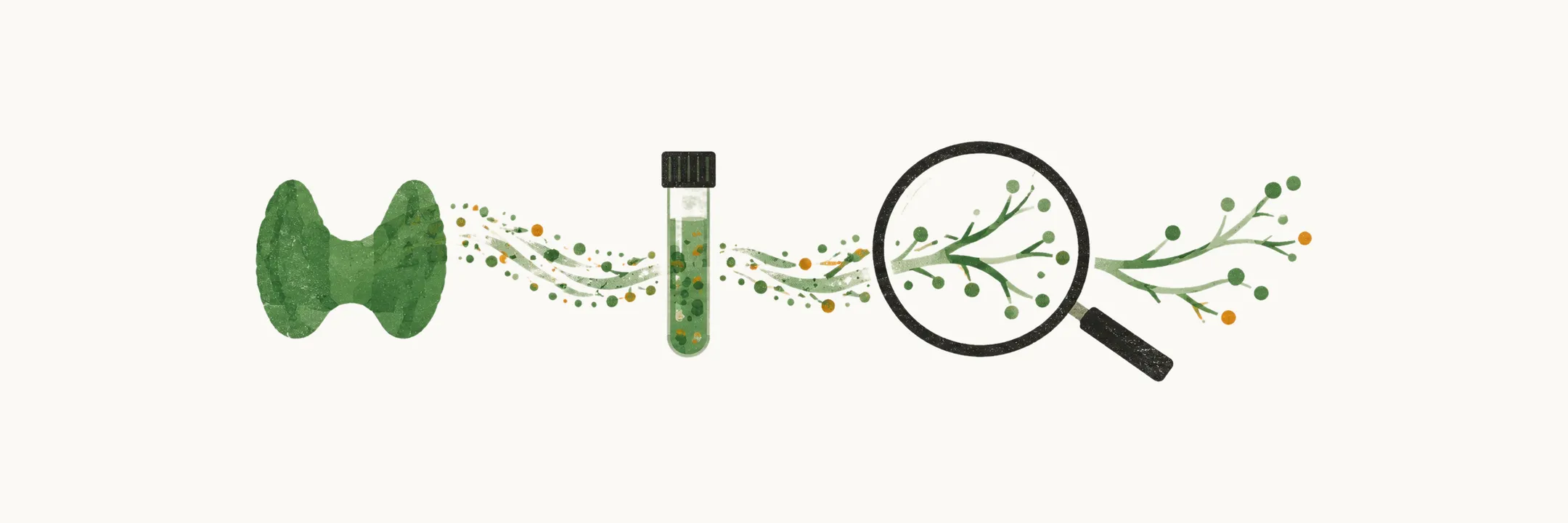
The thyroid makes thyroid hormone when TSH from the pituitary tells it to, and thyroid hormone feeds back on the pituitary, so when there is too much hormone the TSH falls. In Graves disease, antibodies switch the thyroid on in place of TSH. The blood then shows high hormone with a low TSH, and the question becomes what is driving the gland.
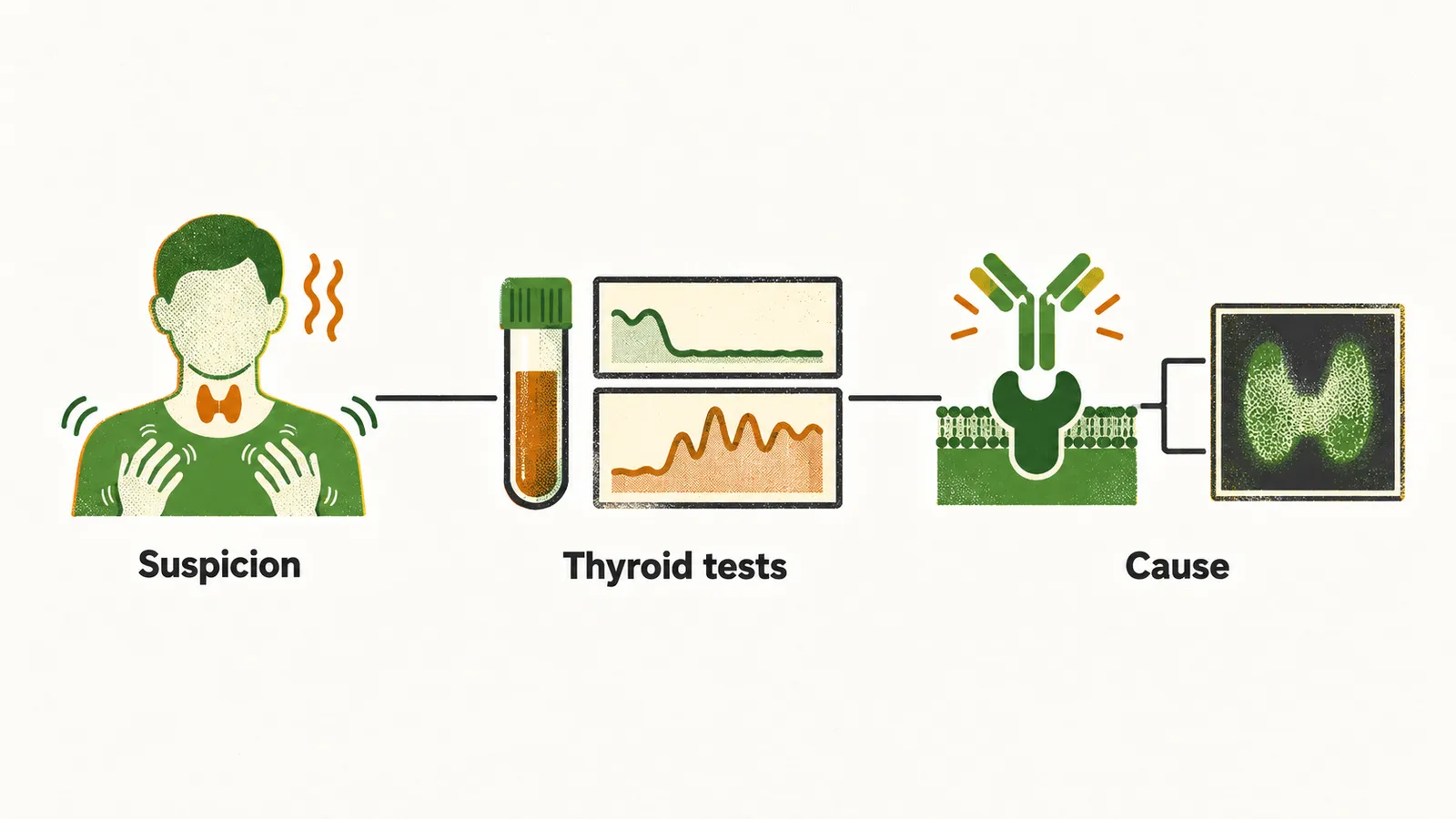
Diagnosis therefore has three steps. The first is recognising who may be thyrotoxic. The second is confirming thyrotoxicosis with thyroid function tests. The third is showing that the cause is Graves disease rather than another condition. The steps come in this order because the clinical picture raises the suspicion and the tests then confirm it.
Management later adds its own recommendations: some for eye disease and some for women of fertile age.
Who should raise the suspicion?
The history and examination come first, because the hormone tests only confirm what the clinical picture has raised. Hyperthyroidism, including Graves disease, should be suspected in patients with tachyarrhythmias, atrial fibrillation or heart failure. Thyroid hormone acts directly on heart muscle, the cardiac effects taught in Clinical manifestations of Graves disease.
Fatigue and weight loss should also raise the suspicion. Thyroid hormone speeds up the body’s use of energy, the reason taught in the same clinical manifestations note.
Do bone, cycles and blood count point the same way?
The suspicion should also arise in patients with osteopenia, an irregular menstrual cycle or anemia.
Does family history count?
Yes. Suspect hyperthyroidism, including Graves disease, in patients with a family history of autoimmune thyroid disease, or of another autoimmune condition such as vitiligo. Graves runs in families and alongside other autoimmune conditions, the genetic picture taught in Graves disease epidemiology, pathogenesis and ophthalmopathy.
Can thyrotoxicosis look like another illness?
It can, and that is why the suspicion alone is not enough. Thyrotoxicosis can mimic a panic attack: anxiety is among the common features of hyperthyroidism, and thyroid hormone acts directly on heart muscle. It can mimic mania, because the mood and restlessness of thyrotoxicosis overlap with mania. That is why a TSH level is commonly measured to rule thyrotoxicosis out.
It can also mimic weight loss from malignancy, since thyroid hormone raises the body’s use of energy. And it can mimic pheochromocytoma.
How is the suspicion confirmed?
Suspicion has to be confirmed biochemically. The symptoms overlap with many illnesses, so the hormone and TSH values have to be measured.
Thyroid hormone and TSH move in opposite directions. A high hormone level with a suppressed TSH is therefore the pattern that confirms excess hormone. In Graves disease the TSH is decreased, and free T4, free T3, or both, are elevated. Either hormone can be the one that is high.
In 2-5% of Graves cases only T3 is increased, which is called T3 toxicosis.
Which antibodies point to Graves?
TSI (thyroid-stimulating immunoglobulins) are present in Graves disease. The stimulating antibody switches on the TSH receptor in place of TSH, as Determinants of thyrotoxicosis severity and iodine-induced hyperthyroidism showed.
Anti-TPO (anti-thyroid peroxidase) antibodies are also present in Graves disease. They appear across autoimmune thyroid disease, in Hashimoto thyroiditis as well as in Graves disease, so they mark the autoimmune process rather than Graves alone.
How is Graves separated from other causes?
The antibody test against the TSH receptor is what points to Graves as the cause, rather than to excess hormone from any source.
The pattern of a suppressed TSH is also a limit. If the TSH is normal, the patient cannot be said to have Graves disease at all.
A TSH-secreting tumor can produce a diffuse goiter very similar to Graves disease without being Graves disease. It drives the thyroid from the pituitary, which is called secondary hyperthyroidism, and for that reason it can be mistaken for primary hyperthyroidism.
When is scintigraphy needed?
The diagnosis is mostly straightforward once the biochemistry is confirmed and the picture includes Graves-specific features, such as ophthalmopathy or a family history of autoimmunity. When those features are absent, a radionuclide scan (scintigraphy) can be used.
Graves disease shows diffuse high uptake of iodine on scintigraphy. This diffuse high-uptake pattern is not seen in toxic multinodular goiter.
What does the eye need?
In Graves disease with Graves ophthalmopathy, management follows a few recommendations. The patient should be referred to the thyroid-eye clinic, and the clinician should look for dry eye syndrome. The retracted lids and bulging eye described in Clinical manifestations of Graves disease leave the cornea uncovered.
Does smoking change the course?
The patient should stop smoking, because smoking is related to a higher risk of orbitopathy. Smoking is also related to resistance to therapy.
What is done about the thyroid?
The thyroid dysfunction is treated with antithyroid drugs. The aim is to avoid iatrogenic hypothyroidism, meaning hypothyroidism caused by the treatment.
What changes in pregnancy?
Thyrotoxicosis in women of fertile age needs planning before pregnancy. Maternal hyperthyroidism can seriously complicate pregnancy at each of its stages, so the disease has to be considered before conception. Those same complications are the reason thyrotoxicosis carries a higher risk of pregnancy complications.
Why must antithyroid drugs be avoided in pregnancy?
A woman with Graves disease who is taking antithyroid drugs should avoid conception. The reason is the detrimental effects of these drugs on neonatal development. The drugs cross the placenta and can lower the fetal thyroid hormone output, and less thyroid hormone in the baby can make the baby hypothyroid.
Can antibodies reach the baby?
Yes. A woman with a high level of TSI can pass the antibodies to the fetus, because antibodies pass from mother to fetus through the placenta. The passed antibodies can cause fetal hyperthyroidism, since they stimulate the baby’s thyroid, which gives neonatal hyperthyroidism.
Once Graves disease is confirmed, how is the overactive gland brought under control?