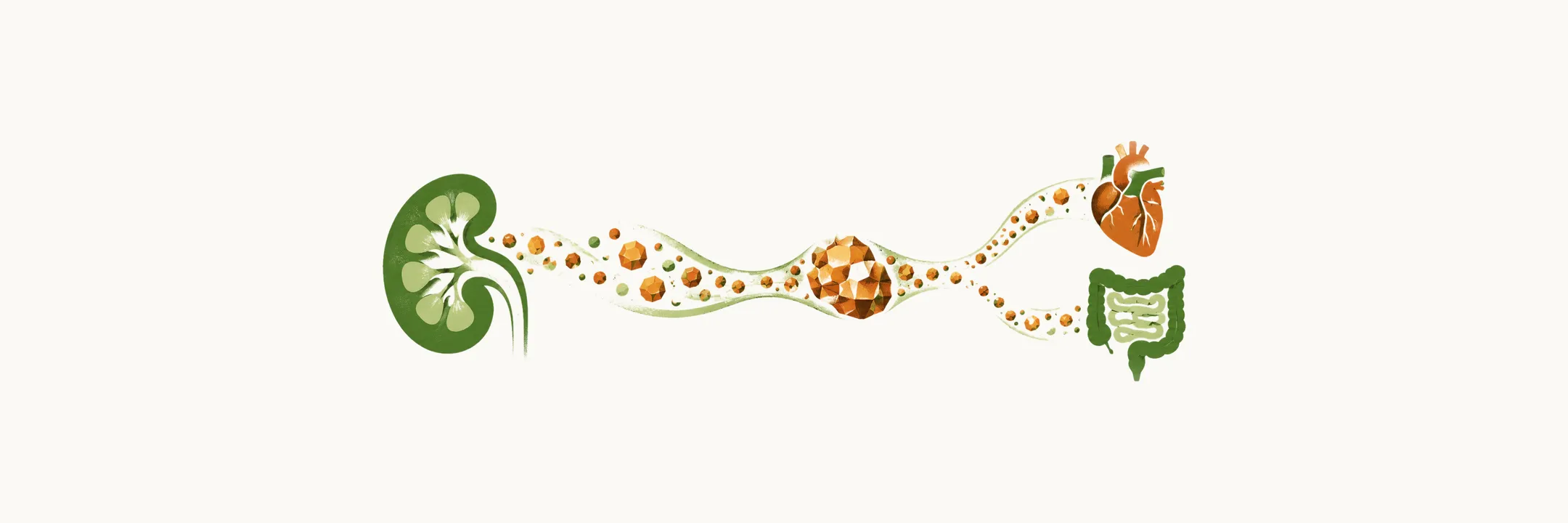
Blood calcium is held in a narrow range by three routes. Bone can release calcium, the gut takes it in from food, and the kidney filters all of it and takes back most of what the body needs. PTH pushes all three toward more calcium in the blood. It acts on bone to release calcium, on the kidney to keep more of what is filtered, and, through vitamin D, on the gut to absorb more. So the extra calcium does not stay in one organ. Primary hyperparathyroidism (PHPT) affects several organ systems, and the excess reaches the heart, nerves, muscle and gut as well as the bone.
The picture has changed over time. The severe disease of the past has shifted to disease that is found incidentally and is often asymptomatic. Most cases nowadays are diagnosed incidentally, in early stages, through screening of blood calcium. The kidney shows the excess most clearly, because it handles every bit of the calcium the blood carries, and it cannot always hold on to all of it.
Why does the kidney show the most classic finding?
The kidney is where calcium handling produces the most classic PHPT finding. It handles all the filtered calcium, and PTH acts there directly, so the excess shows most clearly in this organ.
PTH enhances calcium reabsorption in the kidney. It acts on the distal convoluted tubule, so less calcium is lost in the urine. Why, then, does the urine of these patients hold more calcium? Classically in PHPT there are hypercalciuria and nephrolithiasis. When urine holds more calcium, it comes closer to the point where crystals form, and a stone can start.
The explanation is a paradox. The kidney filters an amount of calcium that rises with the blood level. PTH raises what the tubule takes back, but the filtered amount is much higher than this reabsorption reserve, so the excess goes into the urine.
Where does the extra calcium come from?
The kidney’s load also depends on how much the gut lets in. In PHPT there is higher vitamin D production as calcitriol. Calcitriol increases intestinal calcium absorption.
Urine calcium level is correlated with vitamin D level, and vitamin D level is the main risk factor for hypercalciuria and nephrolithiasis in PHPT patients. A proposed explanation is that more active vitamin D means more calcium absorbed from food, so more calcium is filtered and more reaches the urine.
Who is most likely to get kidney stones?
The stones are the kidney’s classic picture, and they do not fall on everyone equally. Younger age and male sex are other important risk factors for kidney involvement in PHPT. Symptomatic nephrolithiasis is estimated to occur in about 15-20% of cases.
Are the stones always noticed?
Some stones are found without symptoms. Screening of asymptomatic patients for nephrolithiasis shows a higher prevalence of kidney stones, in asymptomatic form.
What does excess calcium do to the heart?
Calcium that the kidney does not remove stays in the blood and reaches the heart and vessels. Hypercalcemia is associated with hypertension, coronary artery disease, valve calcification, left ventricular hypertrophy, hypercontractility and arrhythmia. The data suggest that high PTH and high calcium may both be arrhythmogenic, so rhythm is one route by which the excess reaches the heart.
In PHPT, hypertension is especially common when the disease is associated with MEN syndromes. Both hypercalcemia and high PTH have been shown to be associated with a higher rate of coronary artery disease. Valve calcification happens mostly in severe PHPT. These are associations, not proven causes.
Does the degree of disease change the risk?
The outcome depends on how far the disease has gone. The degree of disease matters. Asymptomatic PHPT patients have very low cardiovascular-related mortality compared with symptomatic patients, and symptomatic patients have a higher rate of cardiovascular disease.
Why do muscles get weak and tired?
The nerves and muscles show the same excess. The most common neuropsychological complaints of PHPT are easy fatiguability and weakness. Growing evidence indicates that skeletal muscle is a direct target of PTH. Chronic PTH excess impairs muscle mitochondria and promotes protein breakdown, so muscle weakens and tires.
The classical form of PHPT is associated with a neurological syndrome: easy fatiguability, symmetric proximal muscle weakness and type II muscle atrophy.
Does PHPT affect mood and thinking?
The same excess reaches the brain’s chemistry, as a proposed route. Mild PHPT (calcium less than 12 mg/dl) has been suggested to be associated with depression, anxiety, fatigue, sleep disturbances and decreased quality of life. One proposed explanation is that hypercalcemia is associated with reduced tyrosine hydroxylase function, which lowers dopamine and norepinephrine.
Memory decline and impairment of other cognitive aspects are reported less commonly. Cognitive decline is hypothesized to be associated with cerebrovascular dysfunction caused by hypercalcemia.
Why do ulcers and pancreatitis appear?
The gut is the next organ system the calcium reaches. Peptic ulcer disease is common, in 10% of PHPT patients. In PHPT with MEN1 syndrome, peptic ulcer incidence is as high as 40%, due to Zollinger-Ellison syndrome and gastrinoma. In MEN1 the parathyroid overgrowth and the gastrinoma belong to one syndrome, so they appear together, and hypercalcemia from the parathyroids is one of the earliest signs.
How can high calcium inflame the pancreas?
The pancreas is the other GI condition linked to hypercalcemia, and here the mechanism is proposed. Hypercalcemia can underlie pancreatitis. The pathway is unclear, but hypercalcemia is considered to activate the conversion of trypsinogen to trypsin inside the pancreas, which damages the gland. Most studies show that pancreatitis is not increased in mild PHPT with calcium less than 12 mg/dl.
Which other conditions appear alongside PHPT?
Some conditions show up with PHPT, but the link is an association. Epidemiologically, though not etiologically, PHPT is related to hypertension, gout and pseudo-gout.
Does PHPT still damage the skeleton?
The skeleton is a principal target of PHPT, because PTH raises blood calcium partly by acting on bone so that osteoclasts resorb bone and release calcium. The classic radiographic signs are now rare, yet most patients still have subclinical bone involvement. So what does the bone lose, and how does it show?