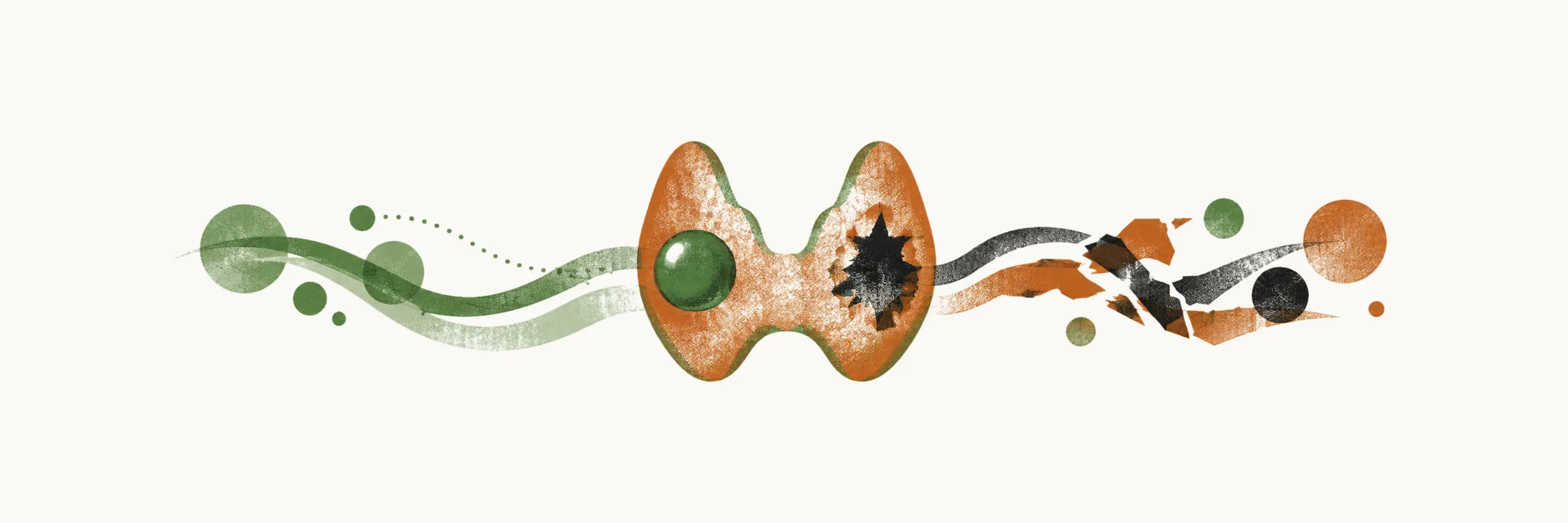
A goiter is an enlarged thyroid gland, and a thyroid nodule is a discrete lump within it. The enlargement can be diffuse, with the whole gland enlarged evenly, or nodular, built from separate lumps. The two overlap without being the same thing. A gland of normal size can carry nodules, and a diffusely enlarged gland can carry none. Once a nodule is found, what decides what it is?
The two questions
Two independent questions organise the topic. The first: does the nodule produce thyroid hormone on its own? Such a nodule is called “toxic”. The alternative is a nodule that still depends on TSH. The second: is the nodule benign or malignant? The two questions are explained in the toxic nodules note.
Most nodules are benign and silent, as the nontoxic goiter note showed. Only a small minority are cancers, and the workup exists mainly to identify the few nodules that matter. In what order do the notes take these questions?
The six notes, in order
The notes follow the order in which a nodular thyroid is met. The first two cover the enlarged gland and the benign nodule. The next two cover the nodule that makes hormone and the cancer. The last two cover investigation and treatment.
- Diffuse Non-Toxic Goiter: how the whole gland enlarges evenly, without nodules or hyperthyroidism, and what drives it.
- Non-Toxic Multinodular Goiter and Benign Thyroid Nodules: how multiple nodules replace normal tissue over years, the hyperplastic and adenomatous forms of benign nodule, and what a growing goiter does to the neck.
- Toxic Multinodular Goiter and Toxic Adenoma: nodules that make hormone independently of TSH, the TSH receptor mutations behind them, and the hyperthyroid picture they cause.
- Thyroid Cancer: the most common endocrine malignancy, its papillary, follicular and anaplastic types, its risk factors and prognosis, and why the overdiagnosis of small papillary cancers matters.
- Diagnosis of Thyroid Cancer: the biochemical panel, used mainly to rule out benign causes, the sonographic patterns and size thresholds that decide whether to biopsy, and what fine needle aspiration adds.
- Treatment of Thyroid Nodular Disease: what is done once the diagnosis is known, from observation of a benign nodule to radioiodine and surgery for nodules that work on their own, and surgery, radioiodine and hormone suppression for thyroid cancer.
Where to start
If the terms are new, start with the first two notes, which explain how the gland enlarges and how a nodule forms. The third and fourth notes follow the two questions. The diagnosis and treatment notes show how the two questions are answered and acted on. So how does a gland enlarge, and how does a lump form inside it?