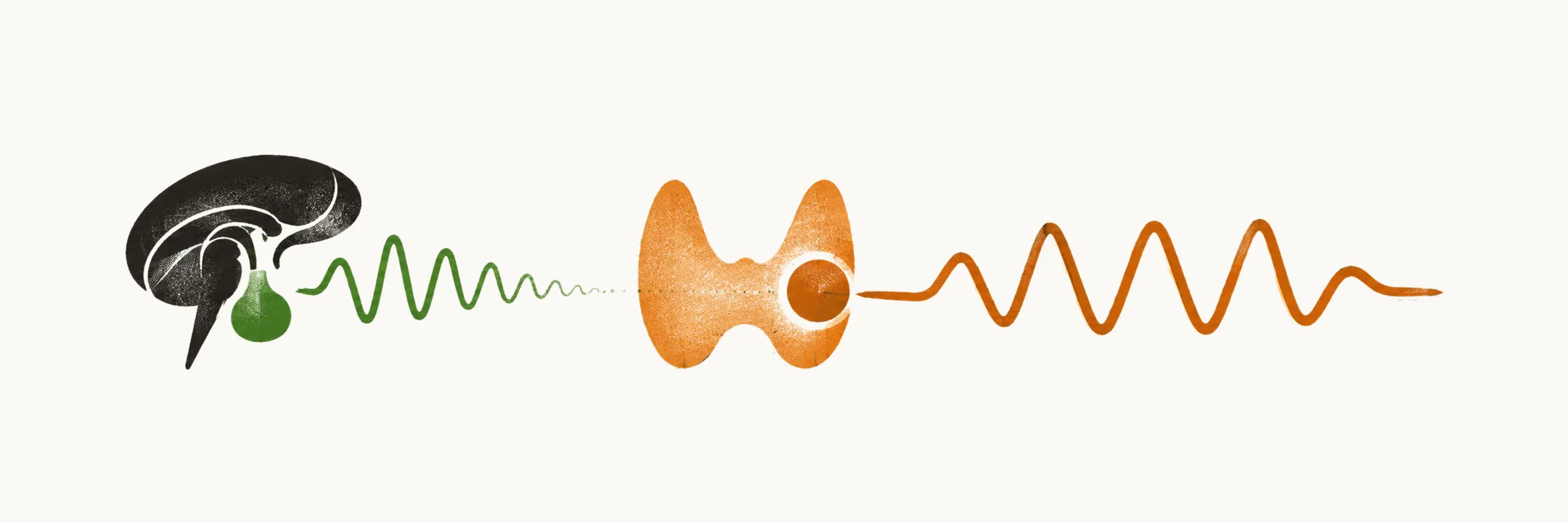
What does a toxic nodule do that a normal gland does not?
The normal control runs in one line. The pituitary sends TSH, TSH binds a receptor on the follicle cell, and that switches on hormone making inside the cell through cAMP. When thyroid hormone in the blood gets high, it feeds back and turns TSH down. The set point for TSH is a balance between a positive input from hypothalamic TRH and a strong negative influence from thyroid hormone.
A toxic nodule breaks the first link of this line. In a nodular thyroid, individual nodules can begin to make hormone without waiting for TSH. The earlier note on Non-Toxic Multinodular Goiter and Benign Thyroid Nodules explained that some nodules make hormone on their own. The earlier note on Diffuse Non-Toxic Goiter showed that the pituitary’s TSH drives the gland. Here that drive is no longer needed.
Toxic multinodular goiter (MNG) is the state in which autonomous nodules within the gland produce thyroid hormone on their own. Its pathogenesis is very similar to that of non-toxic MNG. Each nodule grows as its own clone, so toxic MNG, like non-toxic MNG, is made out of multiclonal nodules. Further expansion of cell clones ultimately gives “hot” and “cold” nodules that characteristically prevail together in multinodular goiters. So several clones can give several autonomous nodules in one gland.
The nodule makes hormone without waiting for TSH. How does one cell get that ability?
The receptor that gets switched on
The cells are driven by activating mutations in the TSH receptor (TSH-R). The receptor works like a switch. Normally TSH turns it on. A mutation can lock it on.
Most of these mutations are in the transmembrane region. A change there alters the signal the receptor sends inward to its G protein. The receptor then signals continuously, as if TSH were always bound. Activating TSH-R mutations increase second messenger signals without stimulation by TSH, which confers autonomous function on thyroid cells.
What does the switch turn on?
The receptor’s signal runs through cAMP. All activating mutations raise cAMP levels in the absence of TSH, so the intracellular pathways stay active without TSH. Many steps of iodine metabolism and of T4 and T3 synthesis and secretion are mediated by cAMP. Most of them are increased because of the stronger cAMP signal. That is why the cells produce hormone independently of TSH.
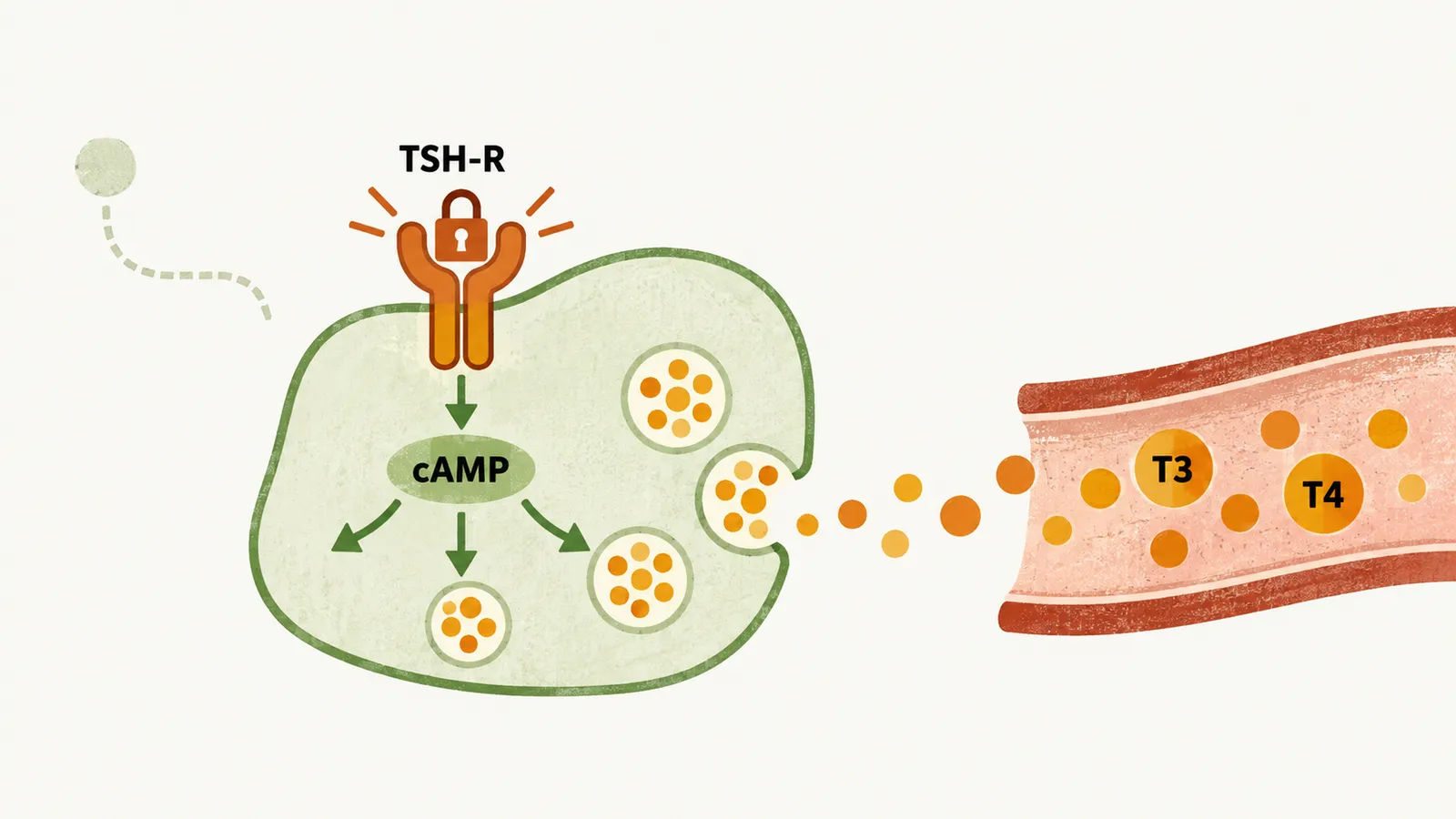
The receptor is not always the part that changes. In a minority of cases the mutation lies instead in the Gs protein the receptor couples to. Either change raises the cAMP signal in the same way.
One nodule, one clone
A solitary, autonomous functioning nodule in the thyroid gland is a toxic adenoma. Its pathogenesis is the same kind of activating mutation in the TSH-R that is found in toxic MNG, now in a single nodule. This mutation leaves the receptor’s intracellular pathways active without TSH. Most mutations found in toxic adenoma are in the transmembrane domains of the TSH-R.
Thyrotoxicosis from a toxic adenoma is usually rare. It becomes likely only once the nodule is larger than 3 cm.
What does the blood show?
Hormone made without TSH is measured in the blood as high hormone and low TSH. The result is the picture of hyperthyroidism. The raised hormone feeds back on the pituitary, so TSH is decreased. In a toxic adenoma, TSH is mostly slightly subnormal.
Thyroid hormones are increased, T3 and also T4. The increase is more prominent for T3 than for T4. This is probably because more T3 is secreted and because T4 is converted to T3 in peripheral tissues.
Why does the patient feel it?
Thyroid hormone raises metabolic activity and the sensitivity of peripheral tissues to catecholamines. Many of the symptoms, such as nervousness and tachycardia, are β-adrenergic mediated. The classic complaints of hyperthyroidism are weight loss, tremor, tachycardia, atrial fibrillation and nervousness. Toxic MNG is mostly seen in elderly patients.
Which question is left?
Whether a nodule makes hormone is one of two questions about it. The other is whether it is malignant. A toxic nodule answers the first question, not the second. What kinds of cancer can a nodule that makes no hormone turn out to be?