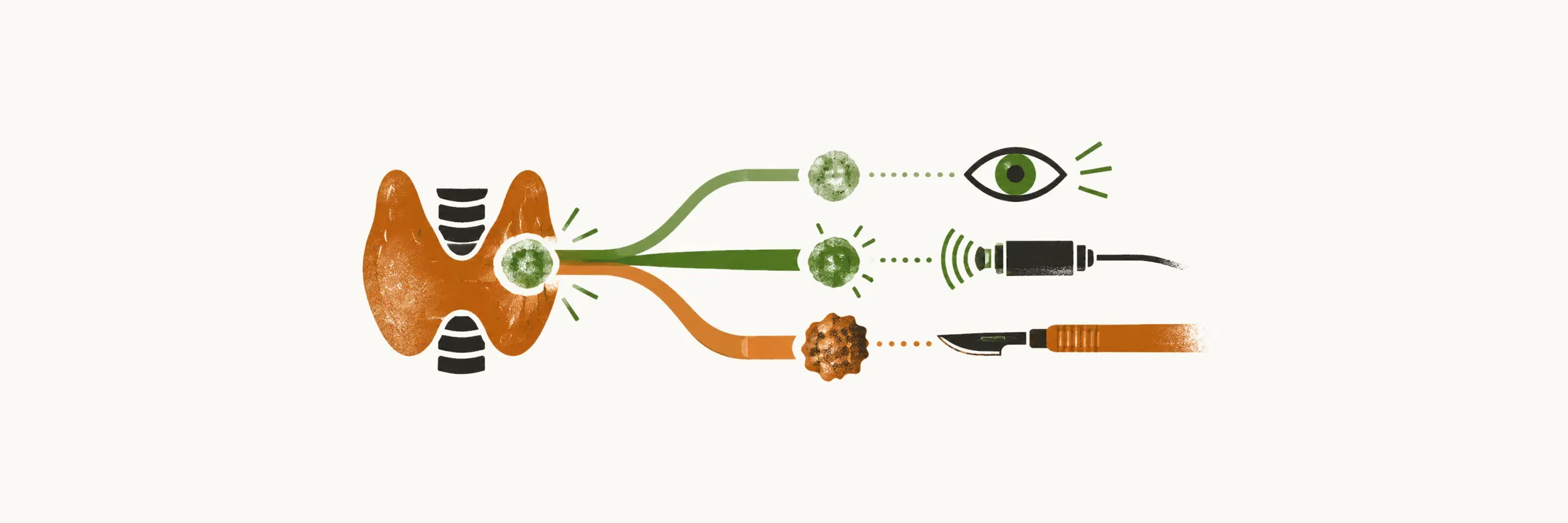
The thyroid sits in the front of the neck, in front of the windpipe, and a nodule is a lump inside it. Most nodules are benign and silent, as the nontoxic goiter note showed, so most need no treatment. The workup exists to find the minority that do.
Three questions decide what is offered. A lump can cause trouble in three ways, and each way asks its own question:
- Is the nodule benign or malignant?
- Does it produce thyroid hormone on its own, causing thyrotoxicosis?
- Does it press on the structures of the neck?
A benign, silent nodule is watched. An autonomous nodule is treated for its hormone excess. A cancer is treated to remove and control it. So what happens to the nodule that does none of these things?
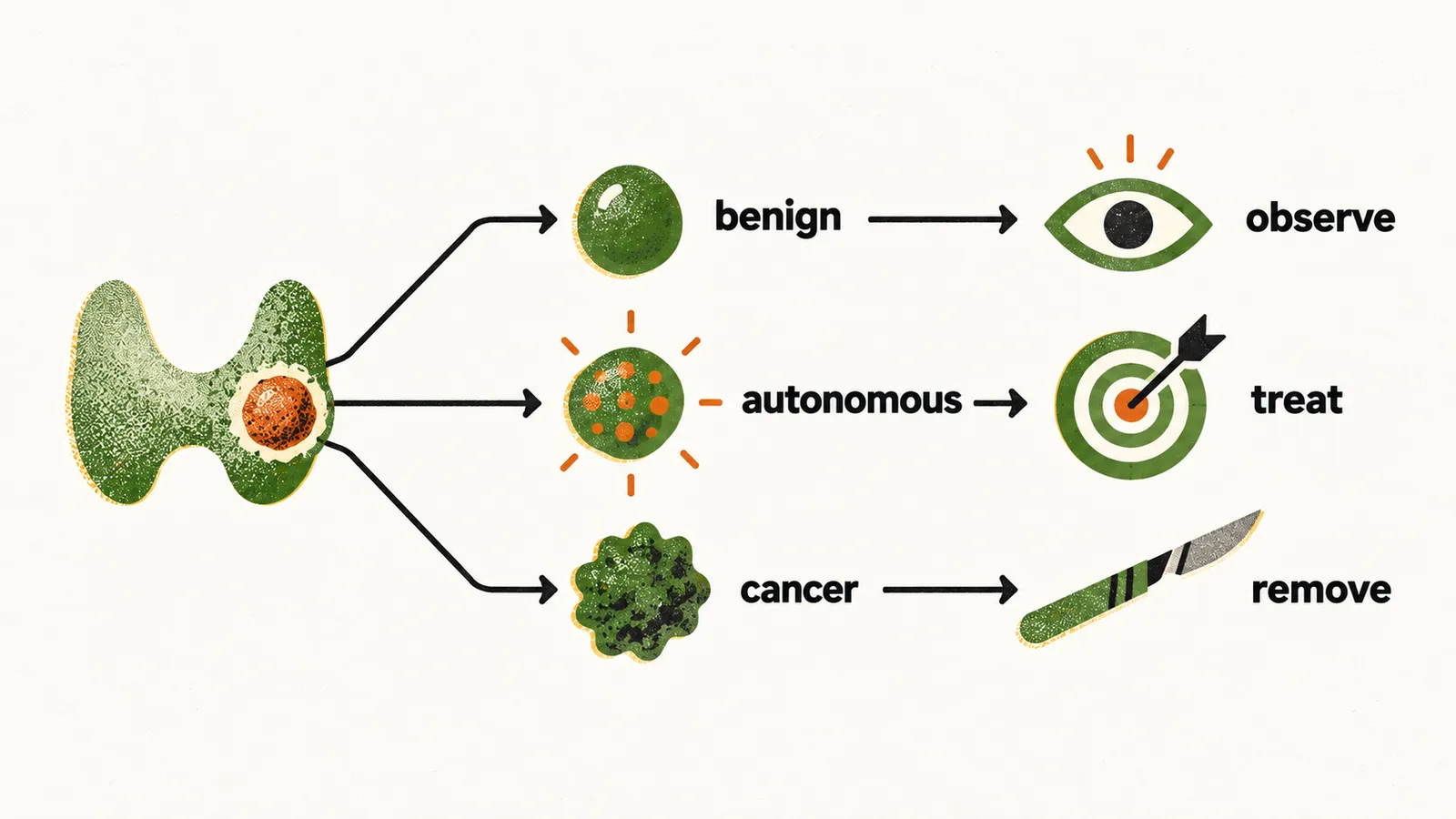
The silent benign nodule
The first question has a quiet answer. A nodule that is benign on cytology and causes no symptoms is observed rather than removed. A benign nodule is a separate cell group growing on its own, as the nontoxic goiter note showed. It is a structural problem and not a hormonal one.
Giving levothyroxine to suppress TSH does not shrink a benign nodule. Suppressive therapy has no role in the management of a benign nodule. But what harm can a lump do when it grows large?
When the lump presses on the neck
The third question is about pressure. A large goiter presses on the windpipe, the gullet or the neck veins, as the nontoxic goiter note showed. The result is dysphagia, breathlessness or venous congestion of the neck.
Two treatments can reduce a goiter, and they differ in time. Radioiodine works slowly. Its beta radiation destroys cells gradually, so the gland loses volume over months and not at once. A large non-toxic goiter in a patient who cannot have surgery can be reduced with radioiodine. Radioiodine is taken up by the cells that keep the iodine pump, and its radiation destroys them, as the cancer note explained. Its effect on a large non-toxic goiter develops over months.
Surgery takes the tissue out at once. Surgery is reserved for the goiter that compresses, causing dysphagia, breathlessness or venous congestion of the neck. Surgery is reserved too for a goiter that extends substantially behind the sternum, as the nontoxic goiter note showed. It is also reserved for a goiter that is growing, one that is cosmetically troubling, and one that is suspicious for malignancy.
What if the nodule makes hormone on its own instead?
A nodule that makes its own hormone
The second question is about hormone. Some nodules make hormone on their own, without waiting for TSH, as the toxic nodules note showed. Treatment of an autonomous nodule therefore has two aims. The first is to settle the thyrotoxicosis. The second is to remove the source of the thyrotoxicosis.
Both aims are needed because of how this nodule behaves. Unlike Graves disease, an autonomous nodule is not autoimmune and rarely, if ever, remits. Waiting does not solve it, so treatment must act on the nodule itself. If the hormone is the harm, can drugs simply hold it down?
Drugs settle the hormone, not the nodule
Drugs answer the first aim. Antithyroid drugs (methimazole or propylthiouracil) lower the hormone level. Methimazole inhibits thyroid peroxidase, so less hormone is made.
Beta-blockers work differently. The symptoms of extra hormone come through the adrenaline receptors, as the toxic nodules note showed. Beta-blockers block the effects of adrenaline at those receptors, so they relieve tremor, palpitations and tachycardia. They calm the symptoms and do not change the hormone level.
Neither kind of drug cures an autonomous nodule. A toxic nodule that keeps its own switch on keeps making hormone, as the toxic nodules note showed. Hyperthyroidism returns when antithyroid drugs and beta-blockers are stopped.
The drugs still have a use. They prepare a patient for definitive treatment, and they control the disease while the patient waits for it. The wait matters because radioiodine takes months to work. Drugs leave the nodule in place, so what removes it?
Removing the source
Radioiodine and surgery are the two definitive options for an autonomous nodule. Radioiodine destroys the overactive tissue, and it cures hyperthyroidism in the large majority of patients. A large toxic multinodular goiter may need more than one radioiodine dose.
Surgery depends on the disease. Surgery for a toxic adenoma removes the affected lobe. A toxic multinodular goiter has several clones, each making hormone on its own, as the toxic nodules note showed, so surgery removes the whole gland.
The choice again follows time. Radioiodine’s effect is slow. Surgery is generally preferred for larger nodules in younger patients. It is generally preferred when the goiter is compressive, because surgery relieves the pressure at once. It is generally preferred when the goiter needs rapid control, for the same reason. Cancer is treated differently, so what must surgery do for a cancer?
Cancer treatment starts with surgery
The treatment of differentiated thyroid cancer is built on surgery. How much thyroid is removed follows the risk. A small, low-risk cancer confined to one lobe can be treated by lobectomy. The risk can change at operation, so a lobectomy may have to be converted to a total thyroidectomy, or completed afterwards, if higher-risk features emerge.
Total thyroidectomy is called for in three situations: a larger tumour, bilateral disease, or suspicious lymph nodes. In multifocal papillary cancer the spread shows a predilection for the central nodes on both sides, so removal on both sides makes sense. Some tissue or cancer can be left behind, so what is done about it?
What is left is destroyed with radioiodine
In higher-risk disease, radioiodine is used for remnant ablation after total thyroidectomy. Thyroid cells, normal and malignant alike, take up iodine, as the cancer note showed. So a therapeutic radioiodine dose destroys the remaining thyroid tissue, and it destroys any iodine-avid tumour deposits.
With the gland gone, levothyroxine replaces the missing hormone. It has a second job. TSH is a growth signal for thyroid cells, not only a stimulus, as the goiter note showed. Levothyroxine is used to keep TSH suppressed in patients whose cancer carries a higher risk of recurrence. Once the gland is gone and TSH is held low, how does the team know the cancer is gone?
Follow-up looks for what is left
Follow-up looks for residual or metastatic disease. For the tests to work, the patient is put into the condition of a very high TSH level. This can be done by withholding levothyroxine. Hormone in the blood turns TSH down, as the toxic nodules note showed, so stopping the hormone lets TSH rise. The other way is to give recombinant TSH, which raises TSH without stopping the hormone, so the patient avoids the withdrawal state.
Two tests are then performed. One is the thyroglobulin (Tg) level. Thyroglobulin is made by thyroid follicular cells, so a raised level after the gland is removed points to tissue left behind, as the cancer note explained. The level is raised only in the presence of residual malignant tissue. The other test is iodine uptake scanning, because cells that take up iodine show up on the scan, as the cancer note showed. Both tests are repeated to measure the response to treatment.
For any patient with a thyroid nodule, which of the three questions is this patient answering, and what does the team do with the answer?