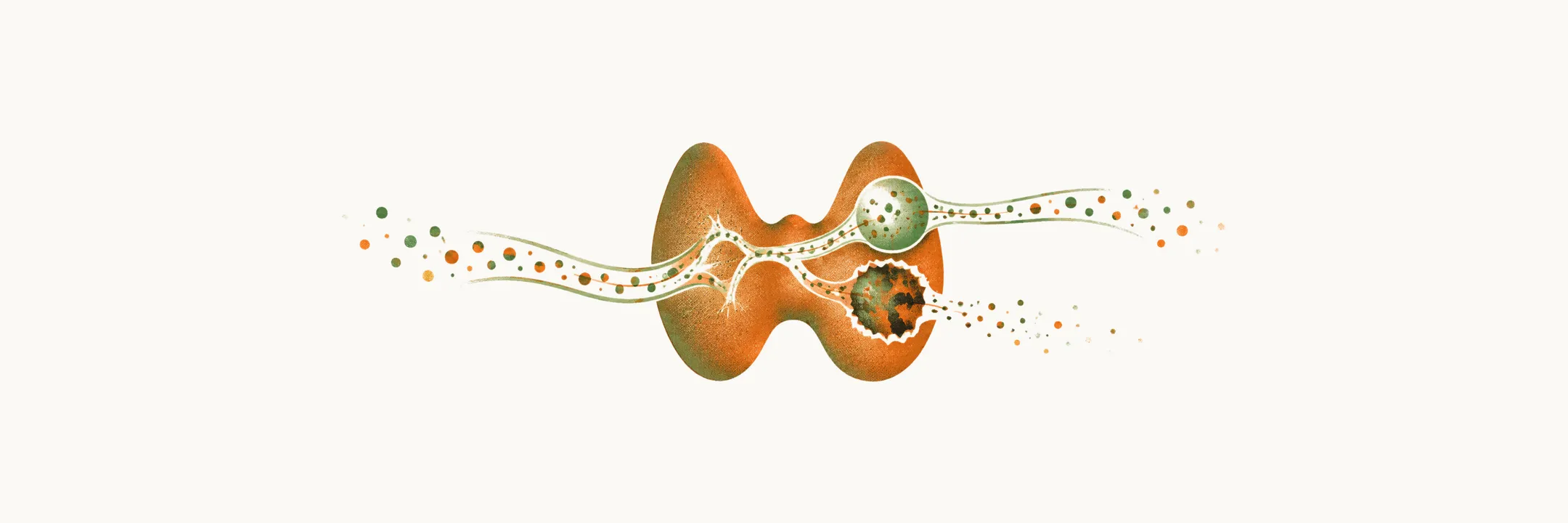
The other question about a nodule is whether it is malignant, and the malignant ones of this kind start in the follicular cells.
What kind of cell does it start from?
The thyroid is a gland at the front of the neck. Its follicular cells make thyroid hormone, and thyroid cancers are mostly derived from them. Thyroid carcinoma is the most common malignancy of the endocrine system.
A cancer keeps some of the traits of the cell it grows from. So these cancers keep, to a degree, the gland’s own machinery. How many traits they keep decides how they behave, and that is the idea this note follows: what the cancer kept decides how it behaves and what can be done about it.
A malignant nodule is recognised by its histology. Several mutations recur in thyroid cancer: BRAF, RET, RAS, P53 and PPAR.
Why are there three types?
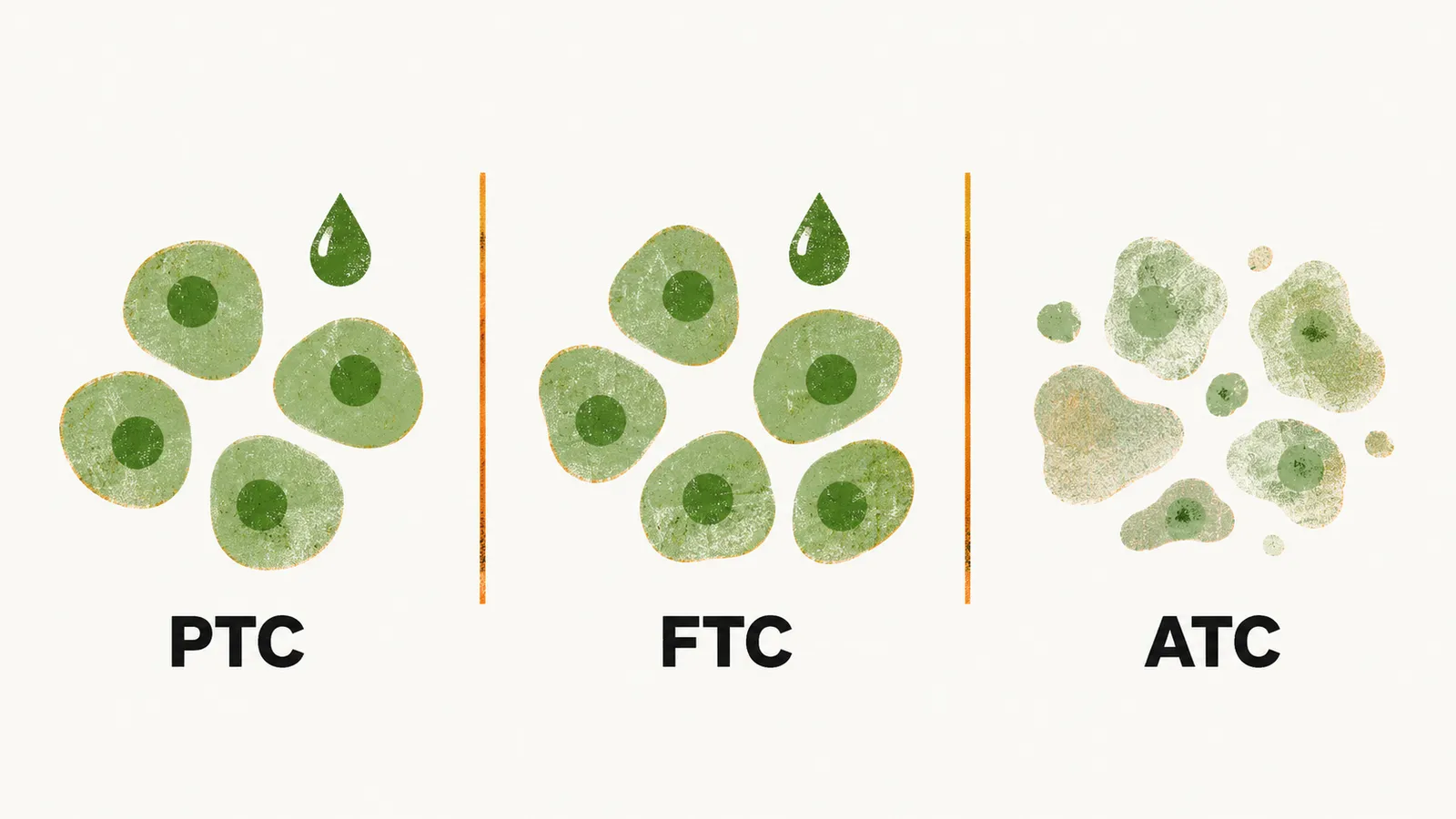
If all three start from the same cells, what separates them? Based on histological findings, thyroid cancers are classified into three main groups: papillary (PTC), follicular (FTC) and anaplastic (ATC). The answer is how much of the follicular cell’s character each one keeps.
PTC and FTC are well differentiated. They keep features of follicular cells, so they still behave like follicular cells. ATC has lost those features, and this difference makes its behaviour very different.
What does losing that character do?
Anaplastic cancer is the case where the character is lost, and that changes what it does. The loss is progressive and includes thyroid-specific functions such as iodine uptake. With it, the cancer grows faster and spreads more, and because it takes up little iodine, radioactive iodine has little to act on. Thyroglobulin is usually absent as well.
ATC is very aggressive. Its prognosis is much poorer than that of PTC and FTC.
What do the well-differentiated cancers still keep?
Papillary and follicular cancers keep the traits the gland uses, and two of those traits can be followed and attacked.
The first is iodine uptake. As the goiter note showed (Diffuse Non-Toxic Goiter), the gland takes up iodine from the blood and makes thyroid hormone when TSH drives it. Well-differentiated cancers remain able to take up iodine, and they remain able to respond to TSH. The same TSH that drives the gland also drives the cancer’s iodine pump, and TSH moves more of that pump to the cell surface, which iodine transport needs.
The second is thyroglobulin (Tg). Follicular cells make it, so it points to thyroid tissue. Well-differentiated cancers still make it, and so it stays a usable marker for follow-up. Anaplastic cancer usually lacks it.
Why does that make treatment possible?
Because these cancers still take up iodine and answer TSH, treatments that use those traits can reach them. Surgery can remove well-differentiated cancers. Radioiodine can destroy what remains: radioactive iodine is taken up by the cells that kept the iodine pump, so the dose reaches them.
PTC and FTC have a very good prognosis if diagnosed in the first stages. Where does that come from? It does not come from a drug specific to them. It comes from their biology. Well-differentiated cancers grow slowly, whereas anaplastic growth is accelerated. A cancer with more of the iodine pump also tends to have a better outcome, though this is an association and not a proven cause.
How does it show itself?
The question is what the nodule feels like and what else it does.
Most thyroid cancers present as a nodule. The nodule is usually solitary and is often noticed incidentally. Three features raise suspicion of malignancy:
- A hard nodule fixed to surrounding tissue.
- Hoarseness from laryngeal nerve involvement. The recurrent laryngeal nerve runs beside the gland and moves the vocal cords (see Non-Toxic Multinodular Goiter and Benign Thyroid Nodules).
- Palpable cervical lymph nodes. The gland drains into the nodes of the central and lateral neck, and cancer spreads through these lymphatic routes.
Rapid enlargement, pain and stridor are rare.
Who is at risk?
Some people are more likely to have a nodule that proves to be this cancer. Several factors raise the risk of thyroid cancer:
- Previous irradiation of the head and neck. The latency is 5-40 years, mostly about 20 years.
- Family history.
- Pre-existing thyroid disorders.
- Ethnicity: Chinese men and people in Iceland are among the higher-risk groups.
- A single nodule at age less than 16 or at age more than 60.
Thyroid cancer is twice more prevalent in women than men, but the severity of the disorder in men is worse.
Why are more cancers found while deaths stay the same?
The risk factors say who gets it; the figures say how many are now being found. During the last 30 years, the incidence of thyroid cancer in the USA increased from 5 to 15 per 100,000. The mortality rate has barely changed. If the cancers were becoming more dangerous, deaths would be expected to rise with diagnoses, and they have not.
This rising incidence with nearly flat mortality led to the idea of overdiagnosis of thyroid cancer, which Davies and Welch suggested reflects detection rather than a true rise in disease. Many newly found cancers would never have caused symptoms.
The increase in total incidence is mainly due to an increase in the incidence of PTC. It is specifically an increase in small T1 papillary thyroid cancer, where the nodule is less than 2 cm.
This shapes the modern approach to small T1 cancers. Treating every one of them would treat cancers that were not going to harm the patient. So the approach is to raise the threshold at which such nodules are investigated and treated, rather than treat every one of them.
If many small cancers would never have caused harm, how does a doctor tell, before any surgery, which nodule is the one that matters?