What does a diffuse goiter look like?
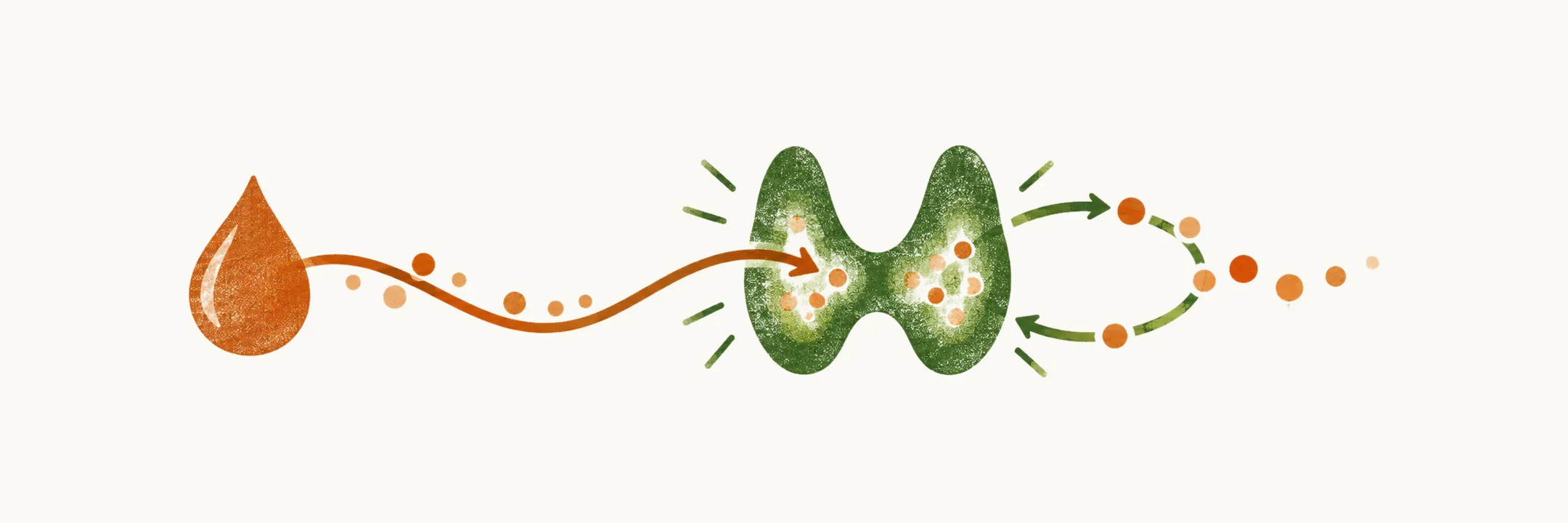
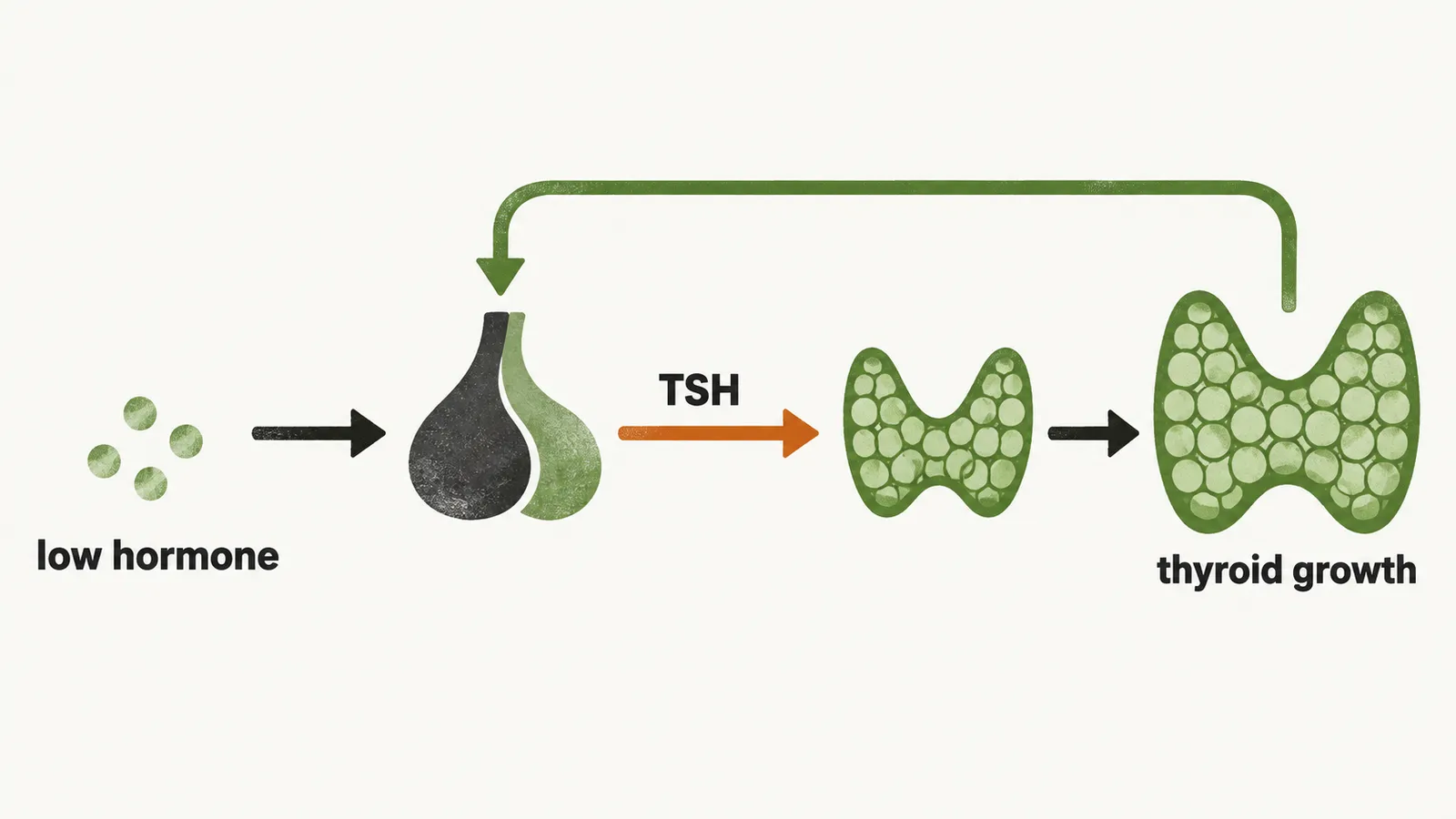
The thyroid gland makes its hormone from iodine and tyrosine, and the pituitary’s TSH drives the gland. The two form a loop. The pituitary watches the hormone level, and when the level falls it sends more TSH. TSH pushes the gland to make more hormone and to grow. A goiter is what that push looks like when it lasts.
Diffuse non-toxic goiter is enlargement of the thyroid gland without nodules and without hyperthyroidism. The whole gland grows evenly, with no lumps and no extra hormone. It is also called simple goiter or colloid goiter. Uniform enlargement is not the only pattern, but it is the one taught here. The loop is the thing to hold: a gland that is short of hormone is pushed harder, and it grows.
Why does a gland that is short of hormone grow?
Goiter has several causes. They share one feature: goiter is the gland’s adaptive reaction to any process that blocks hormone production. Two faults are easy to place on the loop.
- A biosynthesis defect in one of the enzymes that build thyroid hormone leaves the gland making too little hormone.
- A shortage of iodine, the raw material of thyroid hormone, does the same.
In both cases the pituitary responds to the low circulating hormone by raising TSH, because hormone and TSH are linked by negative feedback. Why does that make the gland bigger? Because TSH is a growth signal as well as a stimulus. It stimulates hypertrophy and hyperplasia of the follicular cells, so a sustained push means more cells and a bigger gland.
Can something other than a shortage push the gland?
Blocking hormone is one route to a goiter. Autoimmune disease enlarges the gland in two different ways.
In Graves’ disease, thyroid-stimulating immunoglobulins (TSI) stimulate the gland directly. They bind the TSH receptor much as TSH does and switch on the same pathway, so the gland makes hormone and grows.
In Hashimoto’s thyroiditis the route runs through the loop. Destruction of follicular cells lowers hormone output, and the fall in hormone production raises TSH. The raised TSH then pushes the gland, as in the shortage described above.
Which cause is most common, and where?
The most common cause is iodine deficiency. Iodine is the raw material of the hormone, so a population short of it starts the loop in many people.
Where more than 5% of the population is affected, the enlargement is called endemic goiter. Where iodine deficiency is not endemic, the same diffuse enlargement is called sporadic goiter. The cause of sporadic goiter is mostly unknown.
Can food cause the same shortage?
Food can work in the same direction. Endemic goiter may also be due to the use of goitrogen-containing foods. These include cruciferae plants, cassava root, and milk in areas with grasses containing goitrogen material.
In some areas, then, food supply and lifestyle can cause iodine deficiency endemically.
Why does an enlarged gland have a normal TSH?
In an endemic area of iodine deficiency, goiter is a compensatory mechanism for the lower synthesis of thyroid hormones. The raised TSH drives cell growth in an attempt to normalise hormone levels.
The TSH result is the odd part. A gland short of hormone normally gets a higher TSH, so a normal result is the surprise. Yet in iodine-deficient goiter the TSH level is normal or only slightly increased. This is a surprising finding, and it suggests increased sensitivity to TSH.
Who is most affected, and when does the need rise?
Goiter is more common in women than in men. This is probably because autoimmune thyroid disease is more common in women and because the demand for iodine rises during pregnancy. The fetal thyroid draws iodine across the placenta, so the mother’s need for iodine rises.
How is iodine deficiency prevented?
Because deficiency is the cause, endemic goiter is prevented at population level by iodising salt. The shortage is of iodine itself, so iodine added to a food eaten across a population fixes it for that population.
Endemic goiter is not prevented by treating each person individually. Because the shortage is shared across the population, the fix must be shared.
Why would one part of the gland start to grow on its own?
A gland that is even today need not stay even. Over the years, the same gland can develop discrete nodules instead, so what makes one part of a uniformly pushed gland begin to grow on its own?