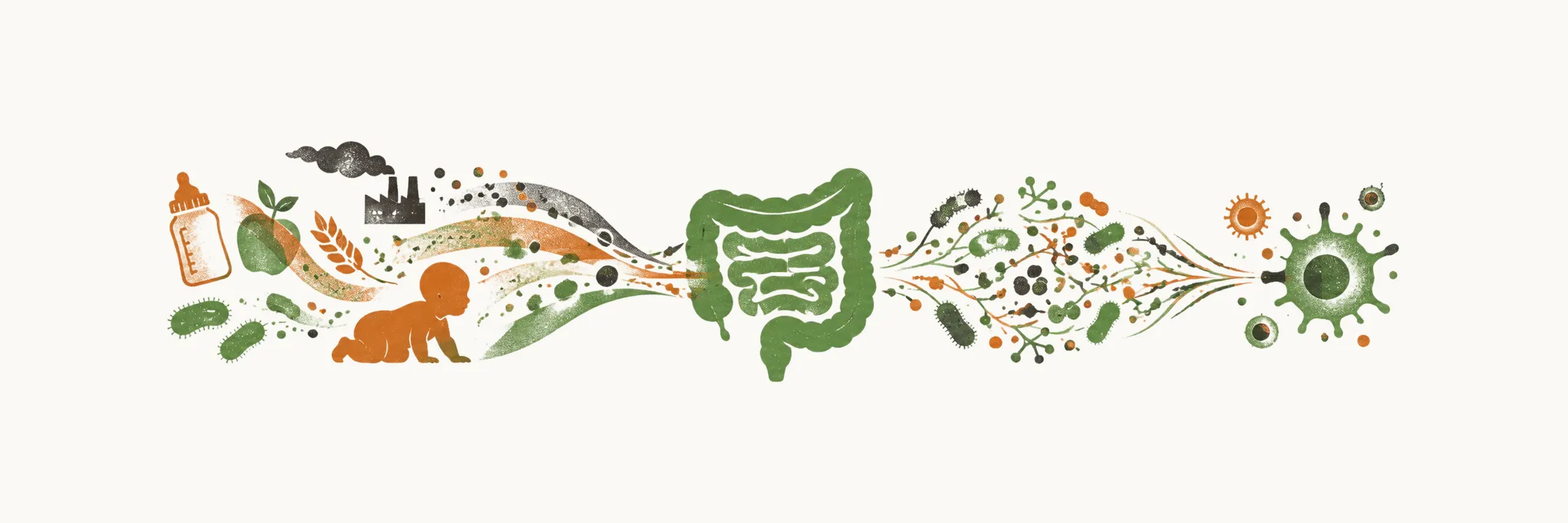
Type 1 diabetes (T1D) has genetic and environmental contributors. Genes alone do not decide who becomes ill, as the epidemiology note showed. So which environmental exposures matter, and when do they act?
Why does early life matter?
The early years of life are when several environmental candidates act. The reason is that the immune system is still being set up in those years, and part of that set-up is learning what to attack and what to leave alone. It learns partly from what reaches it: microbes, food and infections. What reaches the immune system then is therefore thought to have a role.
The evidence is uneven. For pre-natal factors, study results are still inconsistent on their effects on T1D pathogenesis. For early-childhood factors there is some information on what can influence T1D.
What does early contact teach the immune system?
The hygiene hypothesis gives the idea. It says that early exposure to microbes trains and improves the immune system. On this view, the same training helps the immune system avoid autoimmunity. This is a hypothesis, not something shown.
Where does this contact happen? Much of it happens in the gut. Immune cells meet the microbes there, in the Peyer’s patches of the intestinal wall. The gut microbiome is mainly established during the first 3 years of life. That is the same period in which the immune system matures, so the two develop together.
So the first years are when the immune system is being set up, and the gut is where much of the setting up happens.
Why would less contact raise the risk?
If microbes train the immune system, the next question is what happens when they are fewer. Early exposure to microbial agents has fallen sharply with the urbanization of human life. This fall has been proposed as an explanation for the recent rise in T1D. The rise is too fast to be explained by genes, as the epidemiology note showed.
The gut microbiome offers a more specific version of the idea. Patients who develop T1D seem to have less gut microbiome diversity, and less protection from the gut microbiome. A proposed route is that less diversity means less of the training described above, and so less protection.
Does breastfeeding protect?
Several dietary exposures have been examined, and the evidence for them ranges from suggestive to inconclusive. Breastfeeding is the clearest dietary candidate, and it is linked directly to the infant’s gut microbiome.
The results are mixed. Several studies suggest that breastfeeding has a protective effect against T1D, while other studies show no protective effect. One pooled analysis found weak protective associations, and that may be part of why the studies disagree.
The hypothesis behind a protective effect is that breast milk improves the gut microbiome. Breastfeeding is thought to increase the diversity of the gut microbiome and the protection the microbiome provides. Per this hypothesis, an improved gut microbiome can play an important role in preventing T1D. The proposed chain runs from milk to gut microbes and from gut microbes to immune maturation. Each link in that chain remains a proposal.
What about other foods and vitamin D?
Breastfeeding has the most evidence, and the other dietary candidates are less clear.
- Cow’s milk. Milk proteins can provoke an immune response, and a proposed route is that early exposure to cow’s milk could matter. Cow’s milk has been proposed to contain cow’s insulin, which could accelerate the course of T1D. There is not enough informative data on cow’s milk to draw a conclusion.
- Gluten. Gluten introduction has been studied at two ages in the newborn diet, 6 months and 12 months. T1D pathogenesis did not differ between them.
- Vitamin D. Vitamin D is harder to study than the other dietary candidates. Vitamin D supplementation in newborns is already recommended, and that makes a randomized controlled trial impractical.
Why is vitamin D proposed at all? It acts on innate and adaptive immune cells, so a deficiency is proposed as one way the immune system could be affected. The supporting evidence is not conclusive. Northern European countries with a higher prevalence of vitamin D deficiency also have a higher incidence of T1D. Rates are higher farther from the equator, as the epidemiology note showed.
Can infections start it?
Infections form the last group of candidates. The evidence for infections is limited to a few associations.
Congenital rubella is associated with T1D, but this is an association, not a proven cause. For other viral infections there is no conclusive information.
Still, a clinical pattern is well recognised: viral infection very commonly precedes clinical T1D. Viruses are proposed to damage beta cells directly, which would add to the autoimmune damage. It is possible that an acute viral infection converts sub-clinical T1D into clinical, symptomatic T1D. A proposed explanation is that the infection adds inflammation and damage to islets that are already under attack. This is proposed, not shown.
How do genes and these early exposures together set the autoimmune attack going?