What has to go wrong?
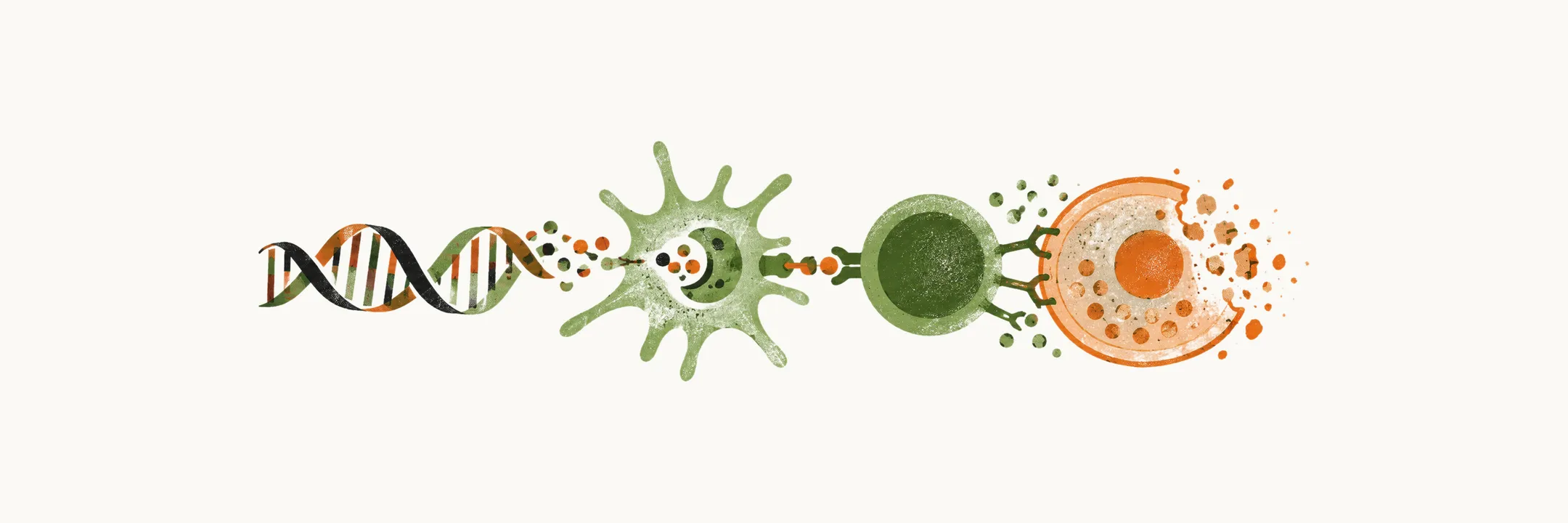
The insulin-making beta cells sit in the islets of the pancreas. In type 1 diabetes (T1D) the immune system damages these cells. Immune cells, T cells and macrophages, move into the islets and destroy them, so insulin falls and glucose rises.
Why does the immune system turn on the beta cells in some people and not in others? Two kinds of factor take part: genetic susceptibility and environmental factors. Neither alone is the whole story. The genes that matter most are the HLA genes. Their molecules show protein fragments to the immune system, and the version a person inherits changes which fragments are shown. So genes set who is susceptible. The rest of this section asks what then pushes a susceptible person toward disease.
Genes come first, so the first question is whether the disease runs in families.
Does type 1 diabetes run in families?
When we talk about the genetic basis of a disease, we tend to think it runs in families. That is not always true, and T1D is a good example. More than 85% of patients with T1D have no family history of diabetes mellitus.
Still, a relative with T1D does raise the risk. The relative risk goes up about 15-fold. Relatives share genes with the affected person, so this raised risk points to genetic factors. But most relatives never develop the disease despite the raised risk. The genes make the disease possible, not certain, and that is why the environmental factors must also act.
Relatives do carry more risk, but the amount depends on who they are.
How close does the family link have to be?
The prevalence of T1D at age 20 in a person with an affected relative depends on who the relative is:
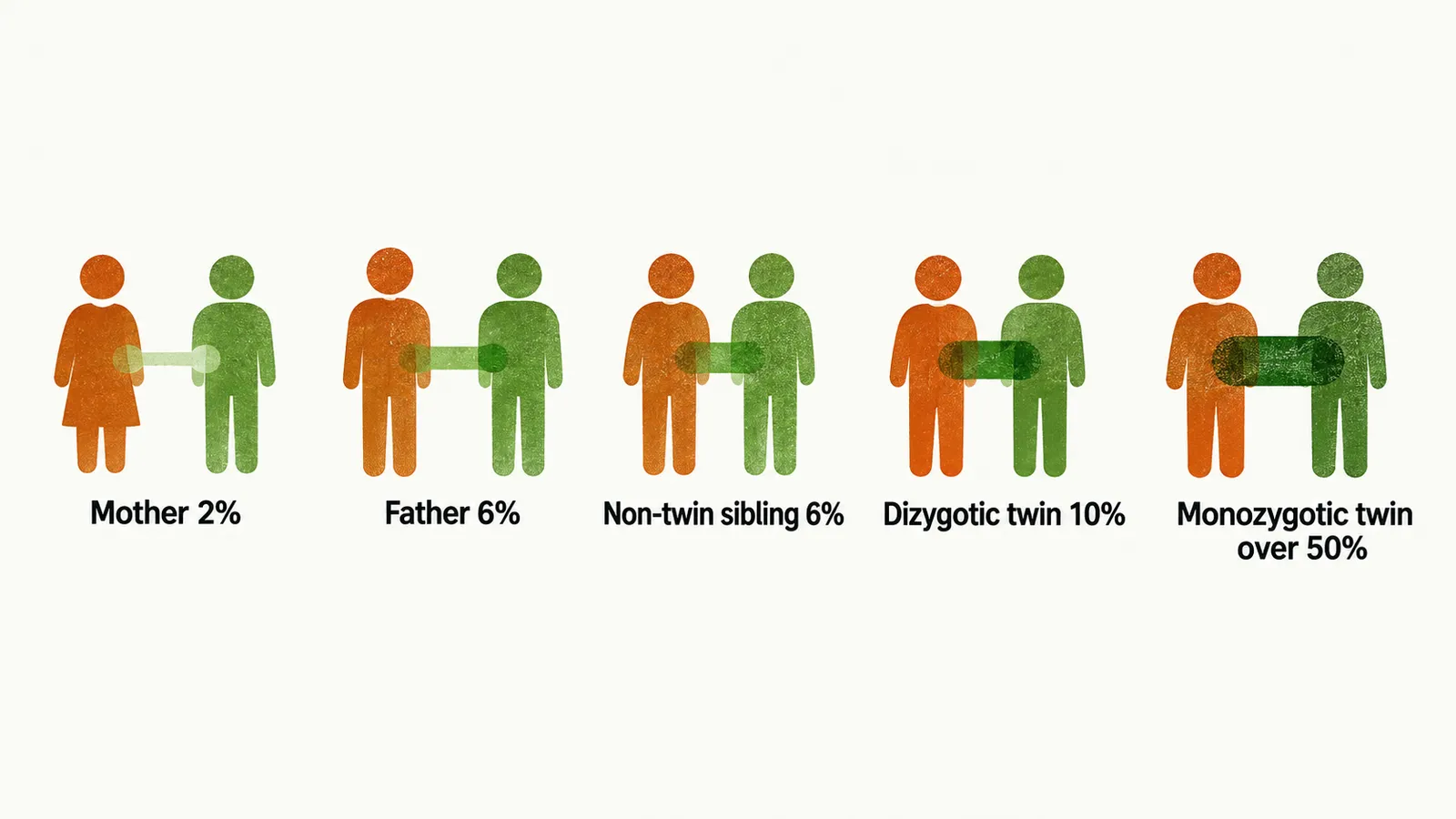
- Mother with T1D: 2%.
- Father with T1D: 6%.
- Non-twin sibling with T1D: 6%.
- Dizygotic (fraternal) twin with T1D: 10%.
- Monozygotic (identical) twin with T1D: more than 50%.
The closer the relative, the more genes are shared, and identical twins are the limit case. They carry the same genes, so a jump to over 50% shows how strong the genetic contribution is.
Yet the figure stops short of 100%. This shows that genes alone are not sufficient, as the epidemiology note also sets out.
Which genes carry the risk?
The most important genes in T1D pathogenesis are the human leukocyte antigen (HLA) genes. They carry the main inherited risk, so other genes come second. Other, non-HLA genes are believed to have a minor effect by comparison.
Of the genes, HLA matters most. What HLA genes do is the next question.
What do HLA genes do?
The HLA genes are the same region that presents antigens to the immune system. The molecules display protein fragments to T cells, so a different version changes which fragments the immune system sees.
HLA genes are also involved in the formation of autoantibodies by the adaptive immune system, and they make a person genetically more susceptible to forming T1D-related autoantibodies. A possible mechanism, not settled, is that beta-cell fragments such as proinsulin are shown on these molecules in the lymph nodes that drain the pancreas. That would be a route into the autoimmune response. It would also fit the statement that genetics start the autoimmune process.
The molecules show fragments, so the question becomes which versions carry the risk.
Which HLA versions carry the most risk?
Patients carrying the HLA class II DR3 and DR4 haplotypes have the highest risk of T1D progression. DR3 and DR4 are serological names for haplotypes that carry DQ2 and DQ8 risk alleles.
The effect of carrying one or two risk haplotypes is measurable. Each haplotype carries its own version of these molecules, and a proposed reading is that the risks add. Two susceptible HLA polymorphisms raise the risk of T1D up to about 6.5. One susceptible HLA polymorphism gives about 2.5.
Carrying two risk versions is not the same as carrying one.
Has the genetic share changed?
The strength of the genetic effect seems to be changing. It is believed that in the past the effect of high-risk HLA genes was more pronounced than it is now. The rise in incidence has been attributed to environment, which would imply a lesser role for genetic susceptibility. This again points to environmental factors becoming relatively more important over time.
If the same genes weigh less now, something else is doing more of the work.
What pushes the process to disease?
Genetics set the susceptibility, and genetics start the autoimmune process. Environmental factors, together with non-HLA genes, are believed to act in the course of T1D pathogenesis, and to progress established autoimmunity to overt clinical disease.
So the environment tilts autoimmunity toward clinical diabetes. This is why identical twins differ: they carry the same genes, so when one has the disease and the other does not, the difference lies outside the genes. It is also why incidence changes faster than any gene pool could, because genetic change is too slow to explain such a rise.
This is where Environmental and early-life factors in type 1 diabetes takes over. Once autoimmunity has begun, how does it move from antibodies to beta-cell loss, and can that course be followed?