The diagnosis note set out that the deficiency is absolute, so the question is what takes its place.
What takes over when the beta cells are gone?
In type 1 diabetes the beta cells are destroyed. The epidemiology note showed that the body cannot make insulin for life, so insulin has to come from outside. Treatment is therefore insulin given from outside, and everyone with type 1 diabetes needs it for life.
Why can nothing else do the job? No diet, exercise programme or tablet that lowers glucose by another mechanism can replace insulin. Insulin does more than lower glucose. It also reverses the state in which the body breaks down fat and protein for fuel, it prevents ketosis, and it reduces the excess of glucagon. So without insulin the patient returns to the ketoacidosis that untreated type 1 diabetes produces. As the presentation note explains, fat is broken down and ketone acids build up.
Insulin must do a job that the other measures do not do. What does that job look like across a day?
What does a normal pancreas do with insulin across a day?
The whole task of treatment is to match insulin to the body’s need across the day. The replacement therefore has to copy a pattern, not hold one level.
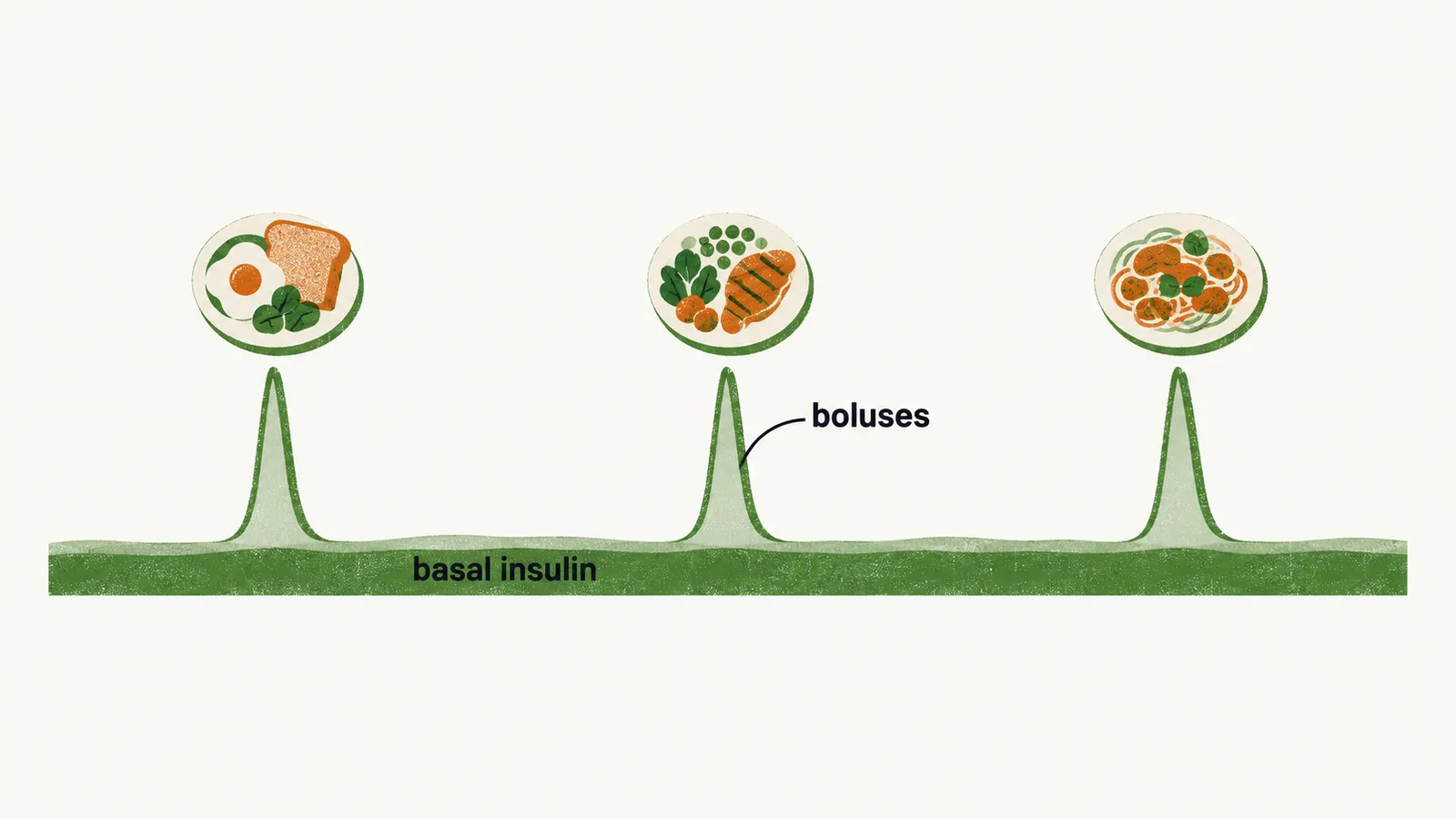
Normal insulin secretion has two parts. The first is basal insulin: a low background level between meals and overnight. Its job is to suppress glucose production by the liver, so glucose does not rise while no food is arriving. The second is the boluses: sharp surges at meals.
How is that pattern copied?
Treatment is built to copy this pattern of normal pancreatic secretion. Each part has its own insulin.
A long-acting insulin analogue provides the background. It does the job that basal insulin does in the healthy body: holding the liver’s glucose output in check between meals and overnight.
A rapid-acting analogue is given before meals to cover the carbohydrate eaten. Because normal meal insulin is a sharp surge at the meal, the meal dose has to be fast-acting and timed to the food. Extra doses of rapid-acting analogue can also be given to correct a high glucose.
The two rhythms, background and meal surge, are copied in two ways of delivery:
- Multiple daily injections (MDI): several injections a day using a pen or syringe.
- Continuous subcutaneous insulin infusion (insulin pump): a small device delivers rapid-acting insulin as a continuous basal rate and as on-demand boluses. This makes the copy continuous, a steady rate for the background and boluses on demand.
What moves the dose?
A fixed copy cannot follow food, activity and illness, so the dose has to follow them. Patients are taught to count carbohydrate and adjust insulin, rather than taking a fixed dose.
Exercise increases glucose demand and changes insulin sensitivity, so the dose must be adjusted to prevent hypoglycaemia.
How do people see whether a dose worked?
Glucose is measured by capillary fingerstick testing. It is increasingly measured by continuous glucose monitoring (CGM), which shows trends and alarms between tests.
CGM measures glucose in interstitial fluid, while a fingerstick measures it in blood.
Each reading is a snapshot or a trend. What do they add up to? HbA1c summarises average glucose over the previous two to three months. The test measures haemoglobin over the life of the red cell, so the value reflects the average over that period. Time spent in target glucose range is now used alongside HbA1c as a measure of control.
What is the target, and why aim for it?
HbA1c and time in range are the measures of control. For many non-pregnant adults, the HbA1c target is less than 7% (53 mmol/mol). The target is set individually.
Why aim for it at all? So lower average glucose lowers the risk of long-term complications of diabetes, and intensive control is therefore the aim.
Where does the aim stop?
The limit on how tight control can be is hypoglycemia. A lower target brings a higher risk of it.
Hypoglycemia is a low-glucose emergency from having too much insulin on board.
Treatment is therefore always a balance between the protection of tight control over years and the low-glucose risk day to day. Tight control lowers the risk of long-term complications over years, so what do years of glucose above target do to the body?