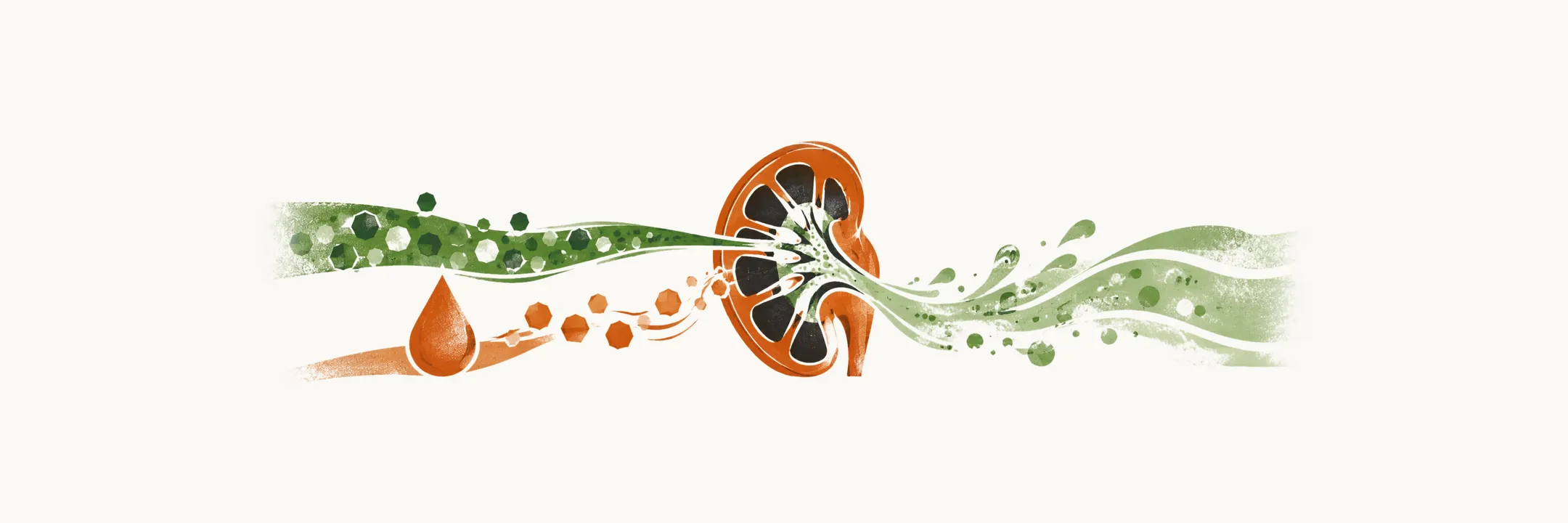
Insulin is what lets glucose pass from the blood into cells. When insulin is missing, the blood fills with glucose that the cells cannot take in, so the cells starve while the blood runs high. The kidney filters glucose out of the blood and takes almost all of it back. When more arrives than the tubule can take back, the surplus stays in the urine, holding water with it. Starved cells then burn fat and protein for fuel, and burning fat makes ketone acids that build up in the blood.
Why does the sugar stay in the blood?
The natural-history note showed that symptoms appear when the beta-cell reserve is spent (Natural history and staging). Type 1 diabetes becomes visible once enough beta cells are lost that blood glucose can no longer be held down.
Glucose cannot enter cells without insulin. So with too little insulin, the glucose stays in the blood and the cells are starved of it. The blood is full and the cells are empty.
Where does the extra sugar go?
The kidney is the other exit for sugar the cells cannot use. Normally the glucose filtered by the kidney is reabsorbed almost completely, so little reaches the urine. But this take-back has a limit. In diabetes, once the filtered load exceeds what the proximal tubule can take back, the surplus is left in the urine.
That glucose is a solute, and it holds water with it. The result is osmotic diuresis: urine volume rises. The urine volume is large, often with waking at night, and that is polyuria.
The water lost in urine leaves the body short of fluid, and thirst is the drive to drink. The thirst is excessive, and that is polydipsia. Polyuria and polydipsia are the two symptoms that most often bring a patient to attention. Together with polyphagia they are often named the three Ps of diabetes. The water lost in urine is why the patient is thirsty.
Why does the body waste away while eating more?
Starved cells call on other fuel, so the body breaks down fat and protein instead. The stores go while appetite rises, because the carbohydrate eaten cannot be used. Weight falls despite normal or increased appetite, which is polyphagia.
Fatigue is common. It may come from muscle wasting in the catabolic state of insulin deficiency, and from the fluid lost in urine.
Why do the eyes blur?
The same high glucose reaches the lens of the eye. Because of the osmotic difference, water moves into the lens, and the swelling changes its focus, so osmotic shifts in the lens cause blurred vision. These changes pass as glucose changes, so the blurring comes and goes with the glucose level. The blur tracks the glucose.
What happens when fat is burned for fuel?
The body burns fat when the cells cannot use carbohydrate, and burning fat leaves ketone acids behind. When insulin deficiency becomes severe, fat is broken down and the liver converts the released fatty acids into ketone bodies: acetoacetate, beta-hydroxybutyrate and acetone. Two of the three ketone bodies are acids, and they build up faster than the kidneys can clear them, so the blood becomes acidic. This is a metabolic acidosis.
Acetone is volatile, so it leaves the blood through the lungs and the breath smells of acetone.
The acid lowers the blood pH. The brain’s breathing control responds with faster, deeper breathing, which blows off carbon dioxide and so reduces the acid. This deep, sighing breathing is Kussmaul respiration.
Nausea, vomiting and abdominal pain are frequent. Dehydration follows the fluid lost in urine, and drowsiness follows. Untreated, ketoacidosis progresses to coma and death.
Does everyone get the same picture, and when?
The picture above is the disease once it shows itself, but it does not say how fast it starts or who it strikes. Onset ranges from a gradual build-up of symptoms over days or weeks to the metabolic emergency of diabetic ketoacidosis. Symptomatic onset is usually measured in days to weeks rather than months.
Type 1 diabetes can begin at any age. In children, incidence peaks at about 10-14 years. Yet 25-50% of cases are diagnosed during adulthood, and up to 40% of adults older than 30 with type 1 diabetes may first be misdiagnosed with type 2 diabetes.
Some people never present with symptoms. The natural-history note showed that antibodies can be found before glucose changes (Natural history and staging), and autoantibody screening detects type 1 diabetes while it is still pre-clinical and normoglycemic. The early symptoms are easy to dismiss until glucose is measured, so the picture can be missed. That is why recognising it matters.
How is the picture recognised before it becomes an emergency?
The acid picture is the dangerous one, so the question is how to notice it early. About two in five children with newly diagnosed type 1 diabetes (roughly 40%) are already in diabetic ketoacidosis at the time of diagnosis. Vomiting, deep breathing and feeling generally unwell are the acid and fluid picture described above, so ketoacidosis should be suspected in any child with these signs and a recent history of heavy urination and weight loss.
New polyuria, nocturia, weight loss, fatigue or blurred vision in a child, adolescent or young adult is the ordinary presentation. The immediate test is a capillary blood glucose. Blood or urine ketones should be checked in anyone who is unwell, because ketones are what fat burning under insulin shortage makes, so finding them shows that this has started.
These symptoms come from the high glucose itself. So a random plasma glucose of 200 mg/dL (11.1 mmol/L) or more together with classic symptoms is enough to confirm that diabetes is present.
Once diabetes is confirmed, the autoimmune cause has to be established: which kind of diabetes is it, and how is the autoimmune cause shown?