
Hepatitis C persists because the virus evades both the innate immune response (the rapid, non-specific first defence) and the adaptive immune response (the specific response of antibodies and T cells). The ways it does so explain why most infections become chronic, and why an immune response strong enough to clear the virus in some people is not enough in others.
How the virus enters cells
HCV infects two main cell types, hepatocytes (the main liver cells) and B cells (the antibody-producing lymphocytes). It attaches through several surface molecules. These include CD81, the scavenger receptor class B type I (SR-B1), and tight junction proteins such as claudin and occludin. The virus can also enter indirectly, by coating itself in LDL or VLDL and entering the hepatocyte along with those lipoproteins.
How it escapes the immune response
The pathogenesis of HCV is mainly related to evasion of the activity of interferon (IFN), an antiviral signalling protein, and to prevention of cell death. HCV interferes with IFN responsiveness and with other intracellular cascades. Under-expression of HLA-I lowers the natural killer (NK) cell response. And because HCV exists as a quasispecies, the immune system must continually generate new clones against a shifting target.
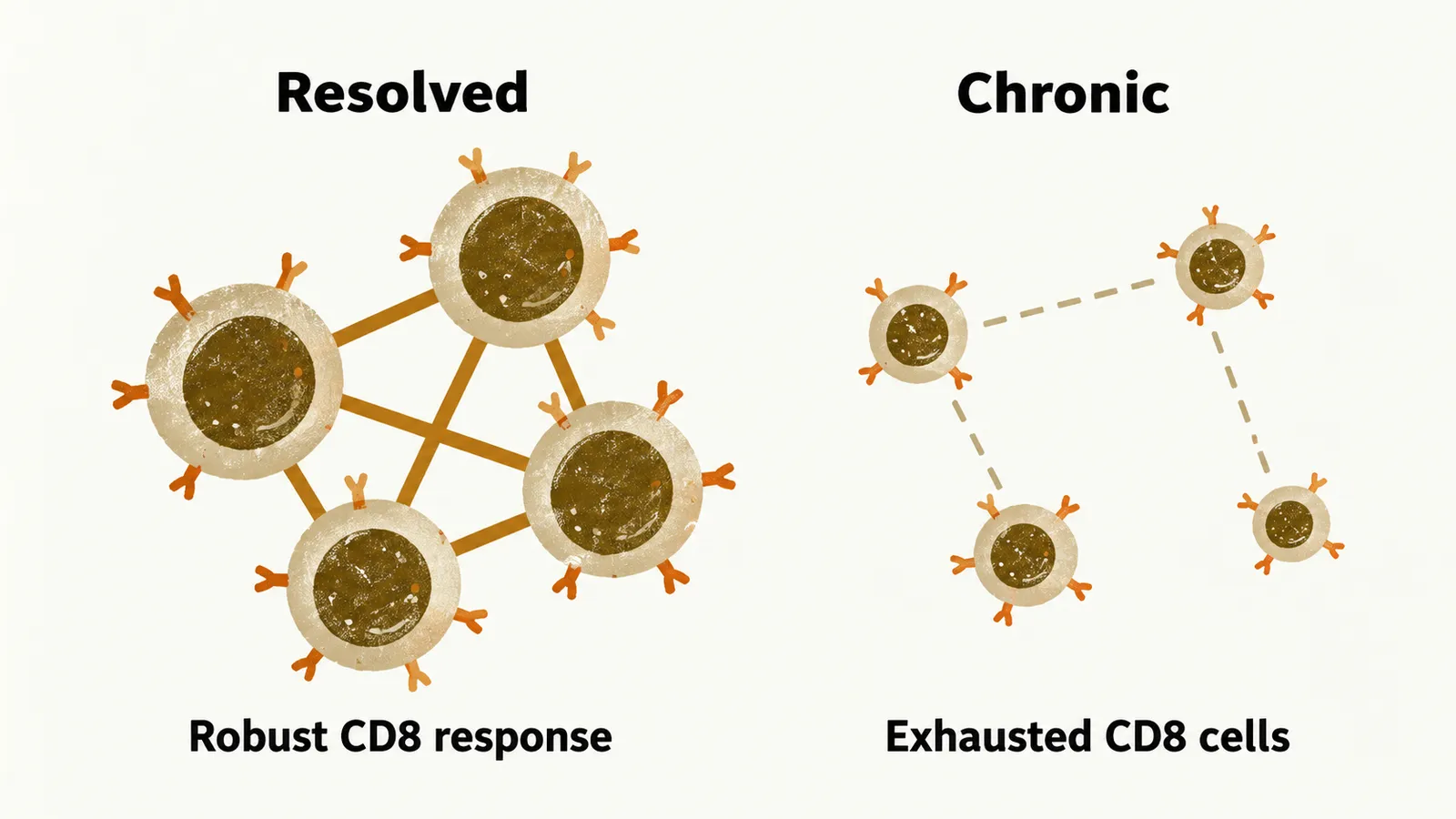
The adaptive response fails as well. Antibodies made against HCV are not protective, and because the infection persists, virus-specific CD8+ T cells, the cells that kill infected cells, become exhausted. This shows up as a difference between outcomes: the CD4+ and CD8+ T cell responses are much more robust in people who resolve the infection than in those who remain chronically infected.
Several findings track with the chance of chronicity. CD4+ T cells can show a proliferation defect, which weakens the helper response that would otherwise sustain CD8+ killing. Mutations in the HCV antigen presented by MHC on hepatocytes can escape recognition, so no cytotoxicity from CD8+ cells follows.
One consequence of this persistence is a reservoir outside the liver. HCV infection can reappear in patients who have had a liver transplant, which suggests the virus is also carried in peripheral blood mononuclear cells, dendritic cells (DCs), T cells and B cells. Whether the immune response clears the virus or fails to, and what follows in each case, is what the clinical course shows.