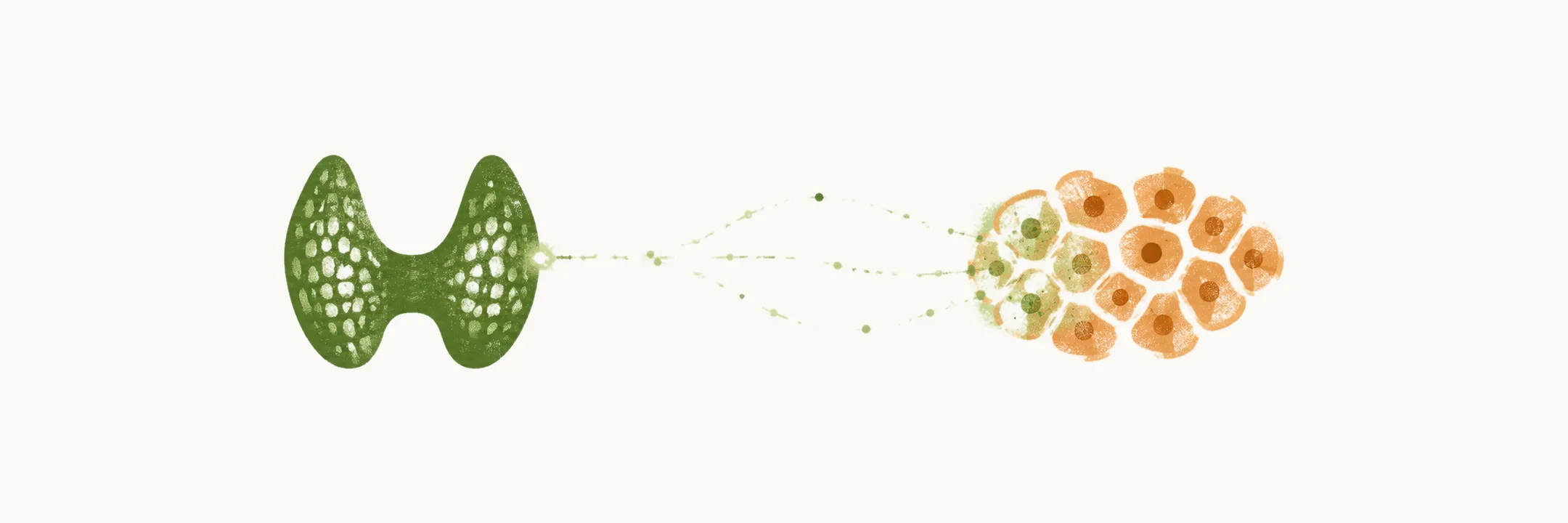
Hypothyroidism is low production of thyroid hormone by the thyroid gland. The gland may itself fail, which is primary hypothyroidism, or it may be under-driven because the pituitary produces too little TSH, which is central hypothyroidism. Less commonly, the hormone is made but the tissues respond poorly to it.
Why does one shortage matter everywhere?
The three routes all end in the same place: a shortage of thyroid hormone at the tissues. Thyroid hormone acts on almost all cells, so the shortage reaches the tissues whichever link failed. That is why it slows the metabolism of nearly every organ system, a picture that Clinical manifestations of hypothyroidism explains. If the shortage is the same, what do the routes change?
Which branch is the patient on?
The shortage is the same, but the break is not, and the break decides what to do. The causes are so different that hypothyroidism is one subject with several branches. Trustworthy tests and appropriate treatment depend on which branch the patient is on. In particular, the site of the fault decides which test is trustworthy, a point taught in Causes and classification of hypothyroidism.
What does each note explain?
The notes run in learning order.
- Causes and classification of hypothyroidism: where the failure starts, and what each start means for tests and treatment.
- Subclinical hypothyroidism: the early phase, when a compensatory rise in TSH keeps the hormone level apparently normal, and the consequences of that compensation for the heart, the liver and pregnancy.
- Congenital hypothyroidism: the form present from birth, found by screening rather than by clinical signs.
- Autoimmune hypothyroidism: Hashimoto’s thyroiditis and atrophic thyroiditis, its subclinical and overt phases, its appearance that may follow pregnancy and its link with infertility.
- Pathogenesis of autoimmune hypothyroidism: how lymphocytes and cytokines destroy the gland, how antibodies against TPO and thyroglobulin amplify the damage without starting it, and how genetic and environmental factors raise the risk.
- Clinical manifestations of hypothyroidism: the slowing of organ systems as cardiovascular, musculoskeletal, neurological and reproductive effects.
- Laboratory evaluation of hypothyroidism: TSH as the first and most sensitive test, free T4 and the antibody assays, and the other laboratory abnormalities that occur.
- Treatment of hypothyroidism: levothyroxine replacement, how the dose is set and monitored, and myxedema coma as an emergency.
Start with the causes note, which asks where in the chain the fault sits.