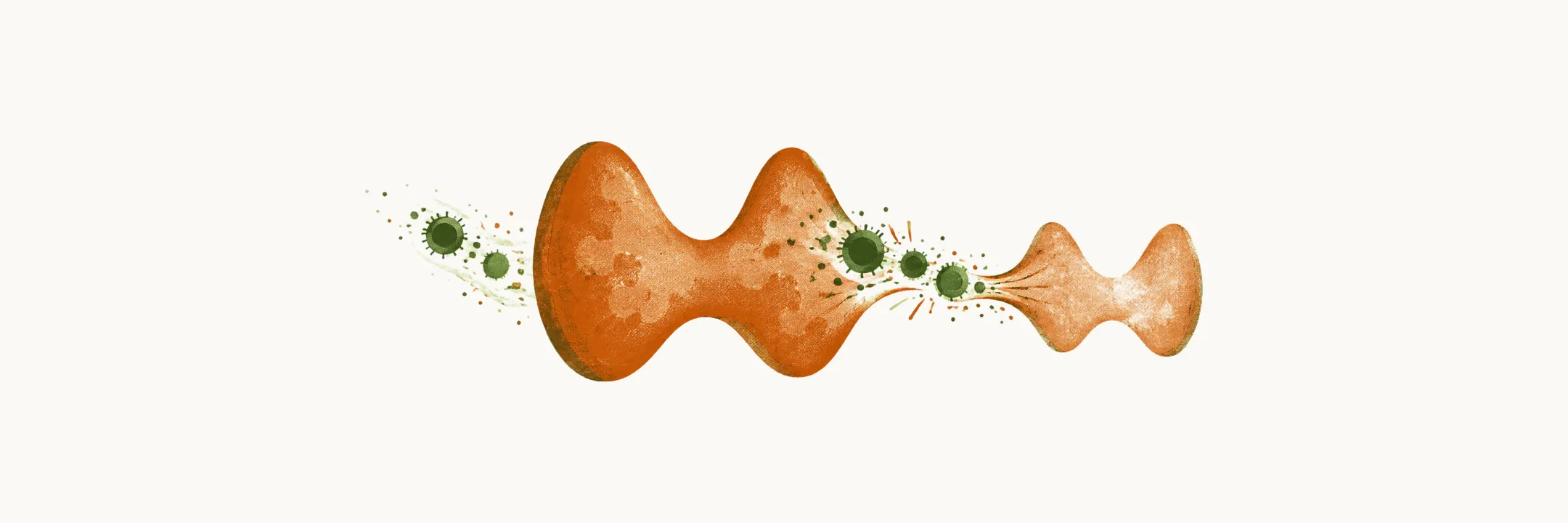
In autoimmune hypothyroidism the immune system turns on the thyroid. Normally the immune system leaves the gland’s own proteins alone. Here it forms autoantibodies against them, including thyroid peroxidase (TPO) and thyroglobulin.
These autoantibodies can affect thyroid hormone action, and they are also aimed at the gland itself. But antibodies do not act alone. The gland is destroyed mainly by cells, in which T cells take part. How that destruction proceeds is taught in Pathogenesis of autoimmune hypothyroidism.
What decides who gets it?
The attack is slow, but the next question is why it starts in some people and not others. The disease is the product of several factors acting together, and hormonal factors help explain how it is distributed.
Progesterone and androgens are considered immunosuppressive. So the hormonal balance across life shapes who is at risk. This is the explanation the reviews offer for the sex gap: because of the effect of hormonal changes on autoimmune thyroid disease (AITD), AITD is about 8 times more prevalent in women than in men.
Does diet play a part?
Hormones explain the sex gap; iodine is another factor the reviews point to. Iodine is required to build thyroid hormone, and in iodine-sufficient areas autoimmune thyroiditis is the most common cause of hypothyroidism. The incidence is higher in Japanese people. This is perhaps due to a genetic predisposition combined with an iodine-rich diet. A proposed explanation is that excess iodine makes thyroglobulin more visible to the immune system, so that iodine intake and a genetic predisposition may combine.
Does the disease pass through stages?
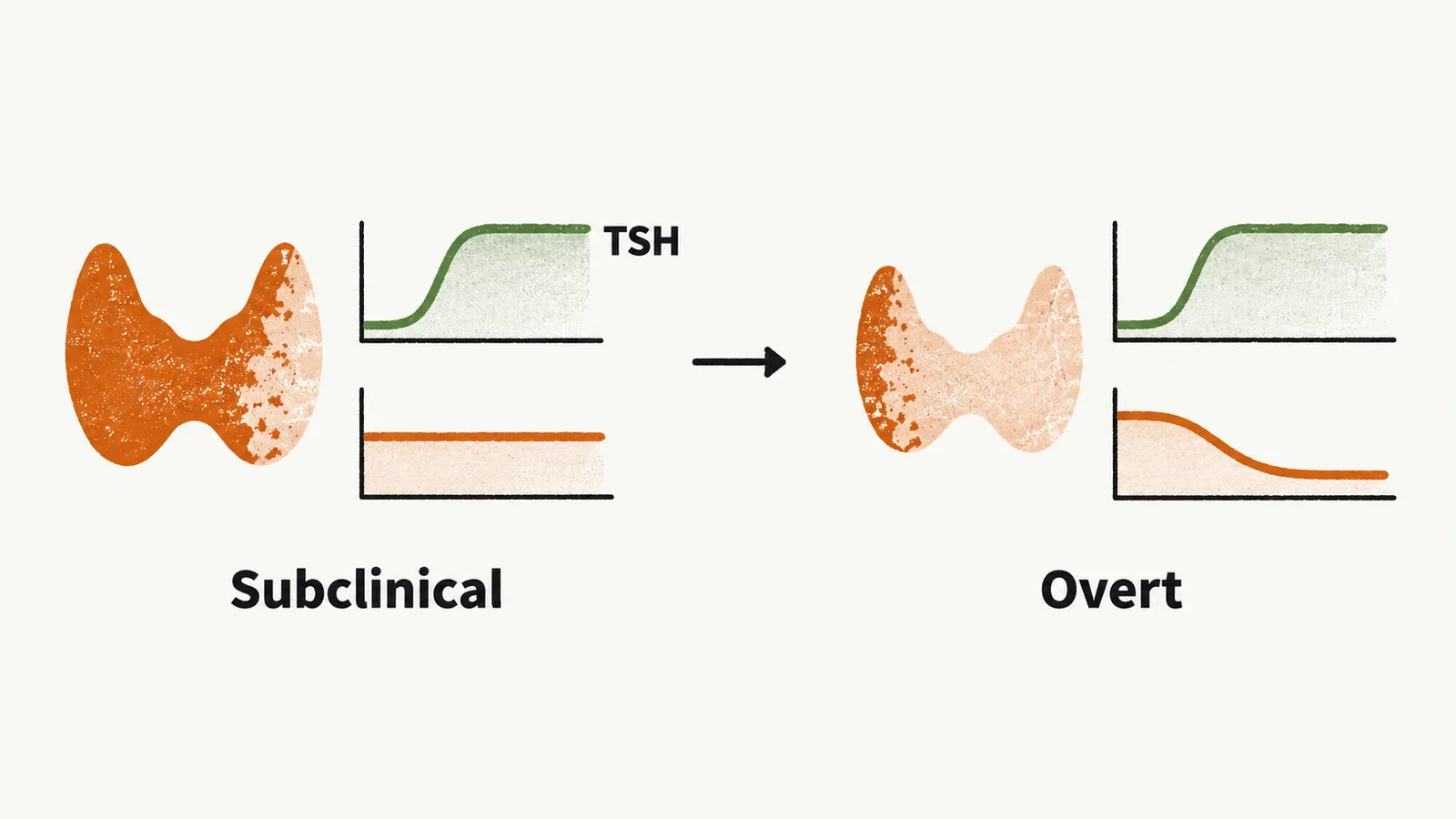
Because the attack is slow, the gland can sit in one stage for a long time before it changes. Autoimmune hypothyroidism passes through two phases. They are separated by how well the pituitary can compensate for the failing gland.
In the subclinical phase the thyroid hormone falls slightly. The pituitary raises TSH to push the remaining gland, so the hormone level stays normal for a time. Most patients at this stage have no symptoms.
In the overt phase the fall is too large for the rise in TSH to compensate. Thyroid hormone itself falls, and symptoms appear.
How common is each stage?
The stages differ in how many people they touch. Subclinical hypothyroidism is found in 6-8% of women and 3% of men. Overt hypothyroidism has an incidence of about 4 new cases per 1000 women per year and about 1 new case per 1000 men per year.
Why does the gland end up swollen or shrunken?
The same attack does not always leave the gland in the same shape. The same process can produce two different appearances.
In the goitrous form the gland enlarges. Lymphocytes infiltrate it, and that infiltration is what swells it. This form is called Hashimoto’s thyroiditis.
In the other form, atrophic thyroiditis, follicles are lost and fibrosis replaces them. The gland shrinks until minimal residual thyroid tissue remains, and little working tissue is left to make hormone.
Why does the disease touch fertility?
Fertility is affected even before pregnancy. AITD touches reproduction both before and after pregnancy. Patients with AITD are more infertile than the general population, and two mechanisms have been proposed to explain this.
What does low thyroid hormone do to the cycle?
The first route is the hormone itself. Thyroid hormone helps set the release of the hypothalamic and pituitary hormones that drive the ovary. So hypothyroidism can disturb the ovarian cycle, and through that effect it can reduce fertility.
What if hormone levels are normal?
A second route applies to euthyroid AITD patients, whose thyroid hormone levels are normal. Euthyroid AITD patients have a higher prevalence of other autoimmune conditions. Autoimmune disorders frequently coexist, and a shared susceptibility is proposed to explain it, not proven.
What does pregnancy do to the immune attack?
Pregnancy is the next setting where the attack changes. High progesterone in pregnancy increases immunosuppression: it shifts CD4 T cells toward regulatory cells and reduces inflammatory responses. Pregnancy is therefore a quieter immune state. Less immune attack means less damage, so autoimmune disease that is already present in the subclinical state is held in check during pregnancy.
What happens when pregnancy ends?
The quiet of pregnancy has an end, and that is when the flare comes. When pregnancy ends and the immunosuppression is withdrawn, the disease flares. The progesterone effect that held the attack in check during pregnancy wears off after delivery. That withdrawal can bring postpartum thyroiditis (PPT). PPT is the postpartum flare of AITD: the existing disease reactivates once the suppression is lifted.
When does the disease appear after the birth?
Withdrawal after delivery explains the timing of the first signs. AITD can appear in the postpartum period, and postpartum AITD occurs in 5-10% of women. Women who develop hypothyroidism after pregnancy have most often had subclinical Hashimoto’s thyroiditis beforehand, so the gland was already being driven by a raised TSH before the pregnancy. PPT usually shows as hypothyroidism within the first year after delivery.
PPT occurs mainly in women who are TPO antibody positive. A positive TPO antibody is a clinical marker of autoimmune thyroid disease, so it may flag women whose gland is already under attack.
Who needs checking after a postpartum flare?
Anti-TPO positive women should have a TSH test about 6 months after delivery. Women who have had PPT have a higher risk of overt hypothyroidism over the following 5-10 years, and annual screening is recommended for them. But what is the immune system doing to the gland cell by cell, and what makes one person’s immune system the one that attacks?