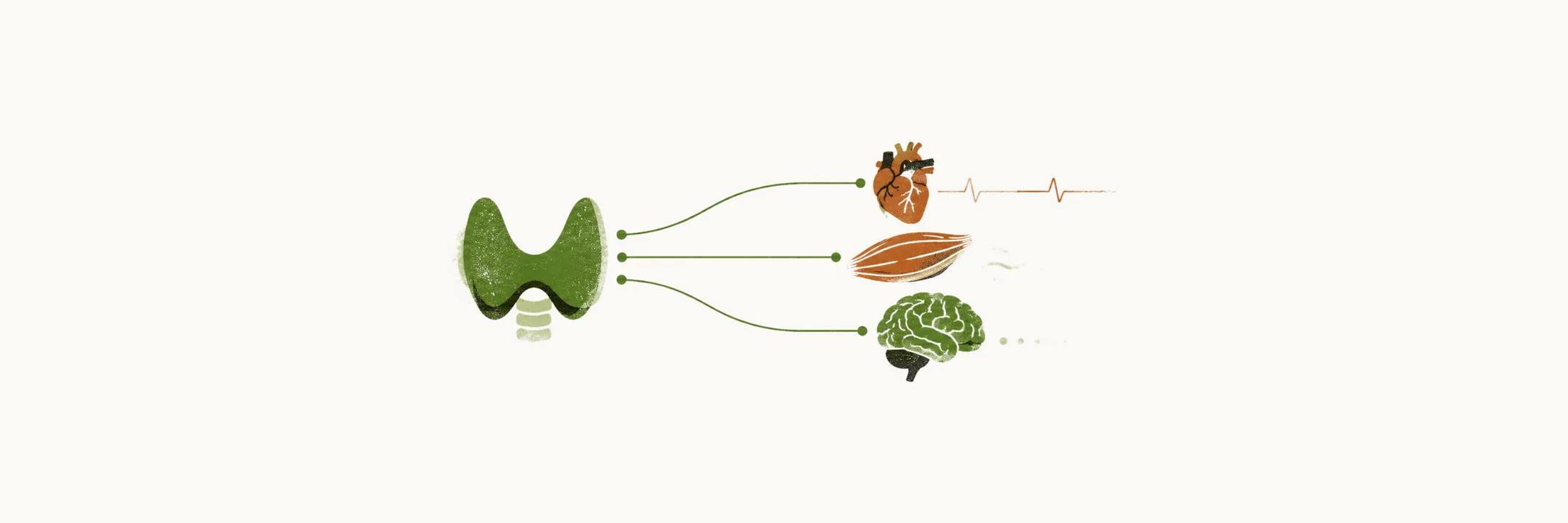
Thyroid hormone sets the pace at which the body’s cells work. When it is low, the pace falls in many organs together, so the signs come from several systems at once rather than from one faulty part. Hypothyroidism therefore slows many organ systems, and the picture ranges from a goiter alone to the full classical syndrome. The organs affected include the heart, the vessels, the fluid balance, the muscles and nerves, the brain and the reproductive system. Each is taken in turn, and the last question is how a clinician separates these signs from other causes.
What decides how far the picture goes?
The lead shows a range, so what sets it? The picture depends on how long the hormone has been low and how far it has fallen. The pituitary raises TSH to push the remaining gland, so T4 stays normal for a time, as the subclinical note explained. The gland also fails slowly, over years, as the pathogenesis note showed. How the picture looks depends on how far the destruction has gone, as the pathogenesis note showed, and the clinical manifestations of Hashimoto’s vary between patients. Some patients have no manifestation of hypothyroidism at all and present with a goiter alone.
What does a goiter alone feel like?
Some patients have only the gland enlarged, so what does that gland feel like? The goiter is not very large. The gland is irregular and firm. Fibrosis is what makes the gland firm, as the pathogenesis note described. The goiter is rarely painful.
Why does atrophic thyroiditis always show the full picture?
The goiter stage is not the end, so what happens when the gland is spent? All patients with atrophic thyroiditis develop the classical signs and symptoms of hypothyroidism. By then the gland has almost no follicles left, as the pathogenesis note showed, so little working tissue remains. When the loss is too large for the TSH rise to hold, T4 itself falls, as the subclinical note explained.
Why do so many signs share one cause?
The full picture is one shortfall acting in many organs. Thyroid hormone sets how fast cells use energy, so when it is low many processes slow down together. All the signs and symptoms described here are produced by that low level of thyroid hormone. Because the slowing is so general, it produces symptoms that are easy to attribute to other causes.
The symptoms are fatigue and lethargy, cold intolerance, constipation, dry skin, hoarseness and slowed thinking. Cold intolerance arises because thyroid hormone raises heat production, so with less of it the body makes less heat. Constipation arises because food moves more slowly through the intestines.
Why does weight rise without eating more?
Weight is another sign, and it does not follow food. Weight rises despite a normal or reduced appetite. Contrary to the popular idea, the increase is mainly due to fluid retention, not higher food intake. Tissues accumulate glycosaminoglycans, which hold a lot of water, so the extra weight is mainly water held in tissue.
Why does the heart slow and pump less?
Fluid and slowing put the heart in focus. Hypothyroidism reduces myocardial contractility, so the heart muscle contracts less strongly and each beat pushes out less. It also reduces the heart rate, so the heart beats more slowly. Because output depends on rate and the volume per beat, a slower rate with a smaller beat lowers cardiac output overall.
Why do the vessels narrow and the pressure rise?
A weaker pump is paired with narrower vessels. The vessels narrow because the endothelium makes less nitric oxide, and the pressure rises, as the subclinical note explained. This peripheral vasoconstriction leads to hypertension and to peripheral cooling.
Why does fluid collect in the body?
The heart’s fluid sac is one place the fluid goes, but it is not the only one. Fluid accumulates in different parts of the body. It leaks out of the small vessels and is drained less well, so it gathers slowly in the tissues. Most often it collects as pericardial effusion, in about 30% of cases, and this effusion is attributed to leaky capillaries, albumin leakage and mucopolysaccharide accumulation. Fluid also collects in the middle ear, leading to conductive deafness. It also collects in the pleural space, which is thought to follow the same leak and poor drainage.
Why do muscles and nerves slow?
The slowing that reaches the heart and vessels also reaches the muscles and nerves. Thyroid hormone is a main regulator of muscle mitochondria, so muscle slows as well. Hypothyroidism can cause stiffness of muscle, leading to cramps and muscle pain. A likely cause, proposed rather than proved, is that muscle metabolism is altered. Hypothyroidism can also cause slow relaxation of tendon reflexes.
Why does the wrist nerve get squeezed?
Hypothyroidism can cause carpal tunnel syndrome. The median nerve runs through a tight tunnel in the wrist, and tissue swelling around it squeezes it.
What happens in the brain?
Memory and concentration can be impaired. Thyroid hormone receptors are richly expressed in the hippocampus, and this is proposed as the reason its learning and memory functions are impaired. PET scanning can show reduced brain glucose use in the amygdala, hippocampus and some other areas. This reduced glucose use improves after treatment.
What is Hashimoto’s encephalopathy?
The brain can be affected in a separate way, as a further neurological complication. Hashimoto’s encephalopathy is considered to be immune, but its pathogenesis remains debated. It is steroid-responsive. Antibodies mark the process rather than start it, as the pathogenesis note explained, and the encephalopathy is associated with TPO antibody. It is also associated with myoclonus (sudden involuntary muscle jerks) and with slow-wave electroencephalography.
Why does prolactin rise?
The pituitary also responds to the same low hormone. Prolactin level is raised in some cases. The likely reason is a rise in TRH production, because low thyroid hormone no longer holds TRH back through feedback. TRH acts on both the TSH-making cells and the prolactin-making cells, so it stimulates prolactin production alongside TSH production. Raised prolactin can cause galactorrhea, although this is unusual.
How does this reach the ovaries and the cycle?
Prolactin is one reason the reproductive system is affected. Raised prolactin changes libido and fertility. Hypothyroidism affects sexual activity in both men and women, and its effects include decreased libido, oligomenorrhea and amenorrhea, reduced fertility and an increased risk of miscarriage. Thyroid hormone affects the ovarian cycle, as the autoimmune note explained.
Do other autoimmune diseases come with it?
Autoimmune thyroid disease often comes with other autoimmune diseases, as the autoimmune note explained. Such diseases include type 1 diabetes mellitus, SLE, Addison’s disease, arthritis or vitiligo.
If the signs cannot name the cause, what can?
Many of these features are easy to attribute to other causes, so the signs overlap with other diseases. That is why diagnosis rests on laboratory testing. Which test comes first, and what does it measure?