Treatment of hypothyroidism replaces the hormone the thyroid gland no longer makes. The standard preparation is levothyroxine, a synthetic form of T4. The gland’s main product is T4, so the tablet copies what the gland normally secretes. The body converts T4 into the active hormone T3, as the causes note explained. Giving T4 therefore restores both T4 and T3.
Does every raised TSH need replacement?
The lead says replacement restores what the gland no longer makes, so the next question is when that is needed. Not every raised TSH calls for full replacement. Subclinical hypothyroidism is a raised TSH with a normal free T4. A raised TSH with a normal T4 means the pituitary is working harder for a gland that is still coping, as the subclinical note explained. Overt disease begins when that reserve is used up, as the subclinical note explained. Subclinical hypothyroidism is not automatically treated.
A trial of levothyroxine is more reasonable when TSH is above 10 mIU/L, and when symptoms are present. The symptoms are the slowing that the clinical manifestations note described.
Why are pregnancy and age treated as separate cases?
A raised TSH is only the start of the decision; who has it decides more. A trial of levothyroxine is also more reasonable in pregnancy. The mother’s thyroid hormone crosses the placenta, and the fetal brain depends on it early in pregnancy, as the congenital note explained.
In older adults with mildly raised TSH, observation is often preferred. The cardiovascular benefit of treatment is uncertain in this group.
Why is levothyroxine chosen over T3?
Once replacement is decided, the question is which hormone to give. Levothyroxine is preferred over T3 preparations for its steady level in blood. It has a half-life of about 1 week.
Why does the level take weeks to settle?
A long-lived tablet keeps the level steady, but the level also moves slowly. After a dose change TSH has not yet settled immediately afterwards. A recheck before the level has settled would read a value that is still changing. That is why TSH is rechecked about 6 to 8 weeks after starting or changing a dose.
What can stop the tablet from being absorbed?
The blood level depends on what the gut takes up. Absorption is affected by what is taken with the tablet: it is increased by fasting and decreased by food. Levothyroxine is therefore taken on an empty stomach, where absorption is greatest and gastric acid helps the tablet dissolve.
Calcium, iron, and drugs that reduce stomach acid are separated from levothyroxine by several hours. They bind levothyroxine or reduce its absorption. Acid-reducing drugs raise the pH of the stomach, which is presumed to reduce how well the tablet dissolves.
If they are not separated, less hormone gets through. The pituitary raises TSH when the hormone falls, as the causes note explained, so these drugs can otherwise cause an unexplained rise in TSH.
How is the dose judged?
A TSH that rises for no clear reason can mean poor absorption, so the dose has to be judged by TSH. The dose is adjusted against TSH. TSH moves far more than the hormone itself, so it is the sensitive guide, as the laboratory note showed.
In primary hypothyroidism the aim is a TSH within the laboratory reference range, roughly 0.4 to 4.0 mIU/L. The pituitary lets TSH settle when the hormone is back to normal. Once the level is stable, TSH is checked every 6 to 12 months.
What changes when the pituitary is the failing part?
TSH is the guide while the pituitary can raise it. In central hypothyroidism TSH cannot be used to guide treatment because the pituitary is the failing part, as the causes note explained. The free T4 level is followed instead.
Why is the full dose not given to everyone?
A level can be set, but the heart decides how fast it can be reached. In an otherwise healthy adult with overt primary hypothyroidism, the full replacement dose is about 1.6 mcg/kg per day. It is not given at full strength to everyone.
The heart pumps less and beats more slowly in hypothyroidism, as the clinical manifestations note showed. A heart adapted to a low metabolic rate can be strained by a sudden increase in demand. Cardiovascular problems compromise the usual starting dose and the upward titration. So when hypothyroidism is mild, or the patient is older or has cardiac disease, treatment starts lower and is built up gradually. The milder the hypothyroidism and the more fragile the heart, the slower the build-up.
Why does cortisol need covering first?
The same hormone that changes the heart’s pace also changes how fast cortisol is lost. Thyroid hormone increases clearance of cortisol. A patient who may have adrenal insufficiency, for example in hypopituitarism, has no reserve to meet that faster clearance, and starting levothyroxine can induce an adrenal crisis. For this reason replacement is preceded by glucocorticoid replacement. Glucocorticoid comes first so that an adrenal crisis is not unmasked.
Why does pregnancy need its own dosing?
Pregnancy is a case where the dose usually changes, and TSH is the guide through it. In pregnancy, levothyroxine requirements rise, and the dose is usually increased. The dose is adjusted to keep TSH inside the range suited to each stage of pregnancy, so TSH is checked regularly through the pregnancy.
Why is the newborn the exception?
In a developing baby the same hormone is needed on a different clock. A newborn with congenital hypothyroidism is the exception to the usual approach. Replacement is started urgently, and the weight-based dose is much higher than in adults. The developing brain depends on this hormone early, and damage that has begun is not undone by late treatment, as the congenital note explained.
What is myxedema coma?
The newborn and pregnancy cases are the same hormone on a different timetable; myxedema coma is the far end of the adult range. The picture runs from goiter alone to the full classical syndrome, as the clinical manifestations note showed. At the severe end, hypothyroidism can decompensate into myxedema coma, which is decompensated severe hypothyroidism.
Its features are a decline in consciousness, hypothermia, bradycardia, hypotension, and hypoventilation. Hypoventilation follows a blunted ventilatory response. Hypotension follows peripheral vasoconstriction with loss of protective mechanisms. Bradycardia follows the slowed heart, which pumps less.
Myxedema coma is often accompanied by hyponatremia and hypoglycemia. The hypoglycemia may be seen as a result of down-regulation of metabolism or of adrenal insufficiency.
How is myxedema coma treated?
The features set the treatment, starting with the gland’s hormone and the adrenal cover. Myxedema coma is an emergency with high mortality. Treatment is started on clinical suspicion, before laboratory confirmation, so that treatment is not delayed.
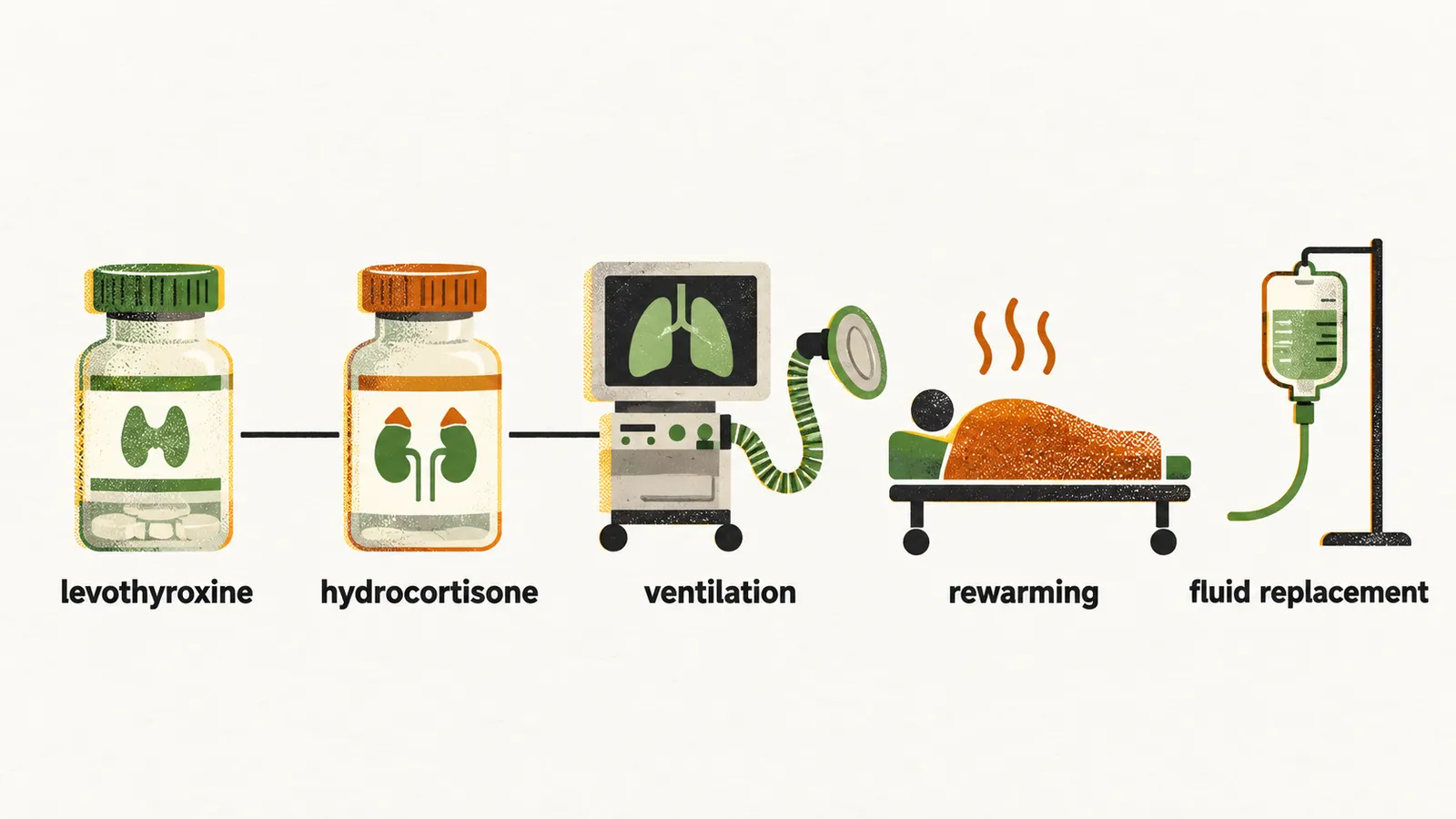
Management combines intravenous levothyroxine, given as a loading dose followed by daily maintenance.
Stress-dose hydrocortisone is given before or with the thyroid hormone, because adrenal insufficiency may coexist. Thyroid hormone accelerates the metabolism of cortisol, so untreated adrenal insufficiency worsens with thyroid hormone.
Supportive care follows the features. Mechanical ventilation answers the hypoventilation. Rewarming is gentle. Fluid replacement is careful, and any precipitating infection is treated.
All of this assumes the cause is known, so which form of hypothyroidism is a given patient in, and how is that decided?