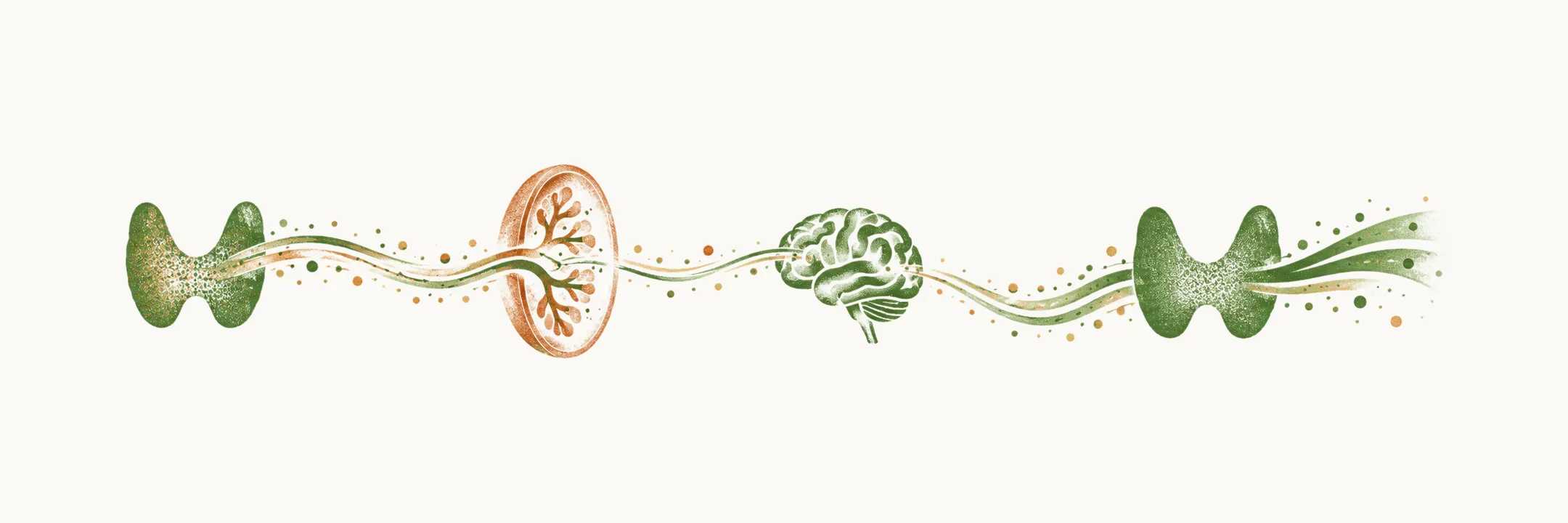
Congenital hypothyroidism is thyroid hormone deficiency present from birth. Most cases are found by screening rather than by clinical signs.
Where does the baby’s hormone come from before birth?
A deficiency present from birth has to start somewhere, so the first question is where the baby’s hormone comes from before it is born.
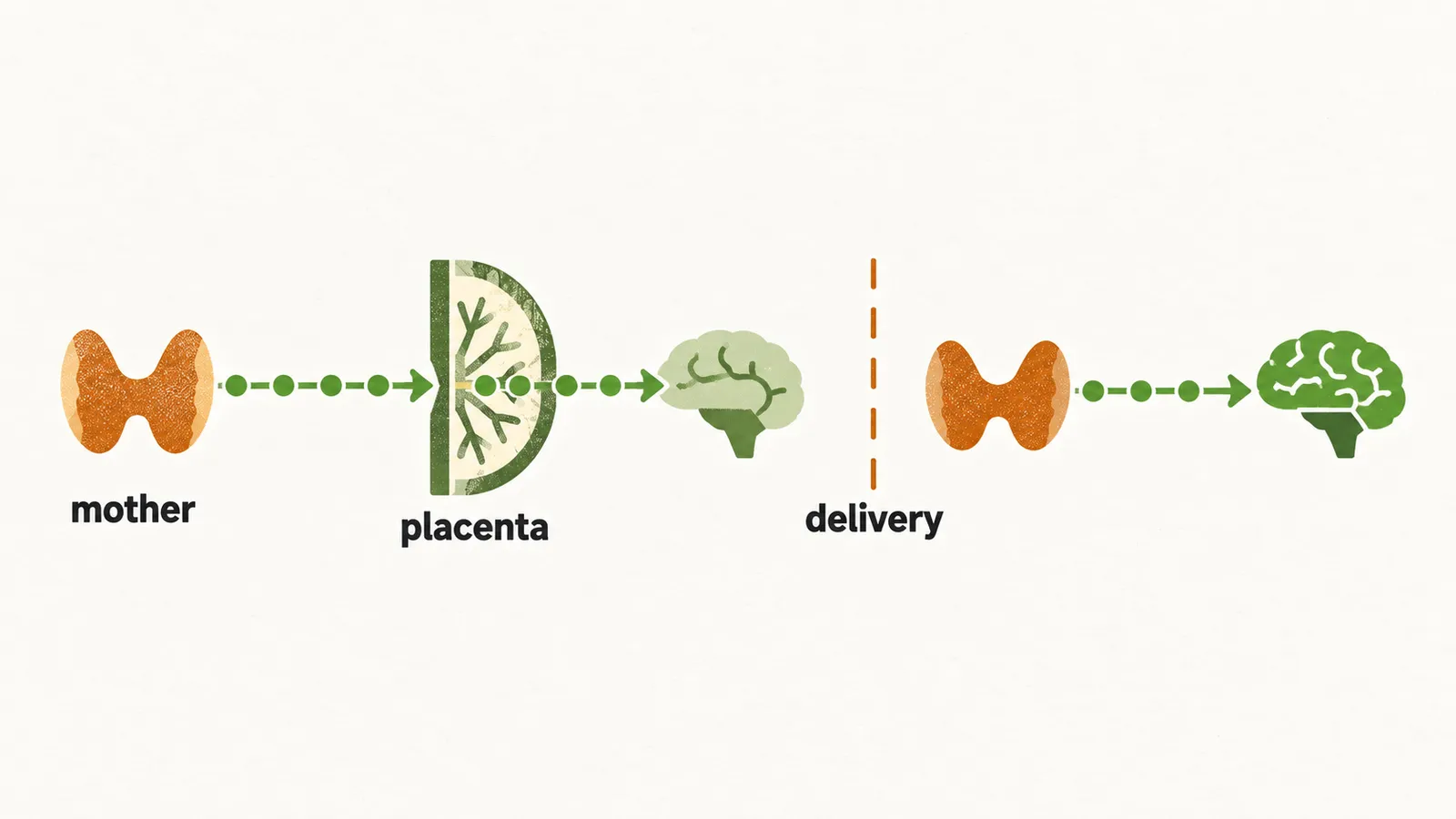
Before birth, thyroid hormone passes across the placenta from the mother. In early pregnancy the fetal brain depends on the mother’s thyroid function, because her hormone is present in the fetal compartment. For this reason, a fetus with congenital hypothyroidism is not hormone-deficient in the womb.
The deficiency appears only when the maternal supply ends at delivery. After that, only the baby’s own gland can supply the hormone, so a failing gland shows itself once the mother’s contribution is gone.
What does low hormone do to the developing brain?
Once the supply ends at delivery, the question is what a shortfall does to the brain that is still forming.
Thyroid hormones influence the formation, migration and myelination of brain cells. A shortfall while these processes are under way therefore damages the brain, and the damage from low thyroid hormone to the developing brain is already underway at birth.
Thyroid hormone acts on brain-development genes only within a fixed window. The supply has to be there while the window is open, and a short deficiency inside it can cause damage that does not reverse. That is why timing matters. Treatment started in the first weeks protects development. Treatment started late does not recover development.
Delay leaves the brain short of hormone for longer, because the window does not wait. This is why delayed neurological development is a sign when treatment is delayed.
Why are the signs easy to miss?
The brain can be harmed before any sign shows, so the signs cannot be relied on.
At birth the signs are subtle and non-specific. Hypothyroidism in the newborn period is almost always overlooked, and delayed diagnosis leads to the most severe outcome of congenital hypothyroidism, mental retardation. The delay between birth and obvious signs is the reason screening exists. Only a minority of newborns with congenital hypothyroidism are diagnosed on clinical grounds.
Which signs appear when they are present?
Only a minority are recognized from signs, and these are the signs that do appear:
- prolonged jaundice
- feeding problems
- hypotonia
- an enlarged tongue
- delayed bone maturation
- an umbilical hernia
Bone maturation is delayed because thyroid hormones are essential for skeletal development.
Is the heart affected too?
The signs above are about the body, and the heart is a further concern. Newborns with congenital hypothyroidism have a higher risk of cardiac malformations, about four times that of unaffected newborns. This is an association that has been observed, not one that is explained here.
How is it found on screening?
Because the signs are late and few, the cases are found by screening, usually on a blood spot from each baby. Most newborns with congenital hypothyroidism are found during screening. The condition affects about 1 in 2000-4000 newborns, and most industrialized countries screen for it.
Screening is based on measuring TSH and T4. When the gland’s output falls, the pituitary raises TSH, so TSH is the first marker. The test is usually done on a blood spot taken a few days after birth, once the normal postnatal surge of TSH has settled.
What happens after a positive screen?
A screen points to the diagnosis, but it does not confirm it alone. A result suggesting the condition is confirmed by repeat thyroid function tests, and by imaging of the gland where available.
Why does the gland fail?
Once the diagnosis is confirmed, the question is which part of the chain is broken. The gland can fail by being built abnormally, or by being built but unable to make hormone. Blocking antibodies are a third route. The main causes are thyroid gland dysgenesis, dyshormonogenesis and TSH-R blocking antibodies.
- Thyroid gland dysgenesis accounts for 65% of cases. The gland has not developed normally. It is twice more common in females than in males.
- Dyshormonogenesis accounts for 30% of cases. It is an error in thyroid hormone synthesis: the gland is present, but the chemistry of making hormone is wrong.
- TSH-R blocking antibodies account for 5% of cases. They stop the gland being told to work, so it makes too little hormone even though it is intact.
Why are there three groups of mutations?
The causes group by the part of the chain each mutation touches. The responsible mutations fall into three groups: the TRH/TSH axis; gland dysgenesis; and hormone synthesis, which is dyshormonogenesis. A central cause is a loss of the pituitary or hypothalamic drive to the gland.
Can the cause be temporary?
One of the causes, blocking antibodies, also explains a temporary form. A minority of newborn cases are transient rather than permanent.
Transient cases are caused by maternal TSH-R blocking antibodies crossing into the newborn, where they block the receptor on the baby’s gland. Transient cases are also caused by the mother’s use of antithyroid drugs. Recognizing this group matters because it resolves as the maternal antibodies clear.
How is it treated?
Where the gland cannot make enough, the baby needs the missing hormone. Once the diagnosis is confirmed, T4 replacement is started at 10-15 microgram per kg per day. The dose and the baby’s development are followed closely.
What if the gland formed normally?
Replacement fills the gap, but all of this concerns glands that never formed or worked normally from the start. Hypothyroidism that begins later in life in a normally developed gland raises a different question: what damaged the gland? In iodine-sufficient areas, damage to the gland is often an autoimmune attack, so what sets that attack off?