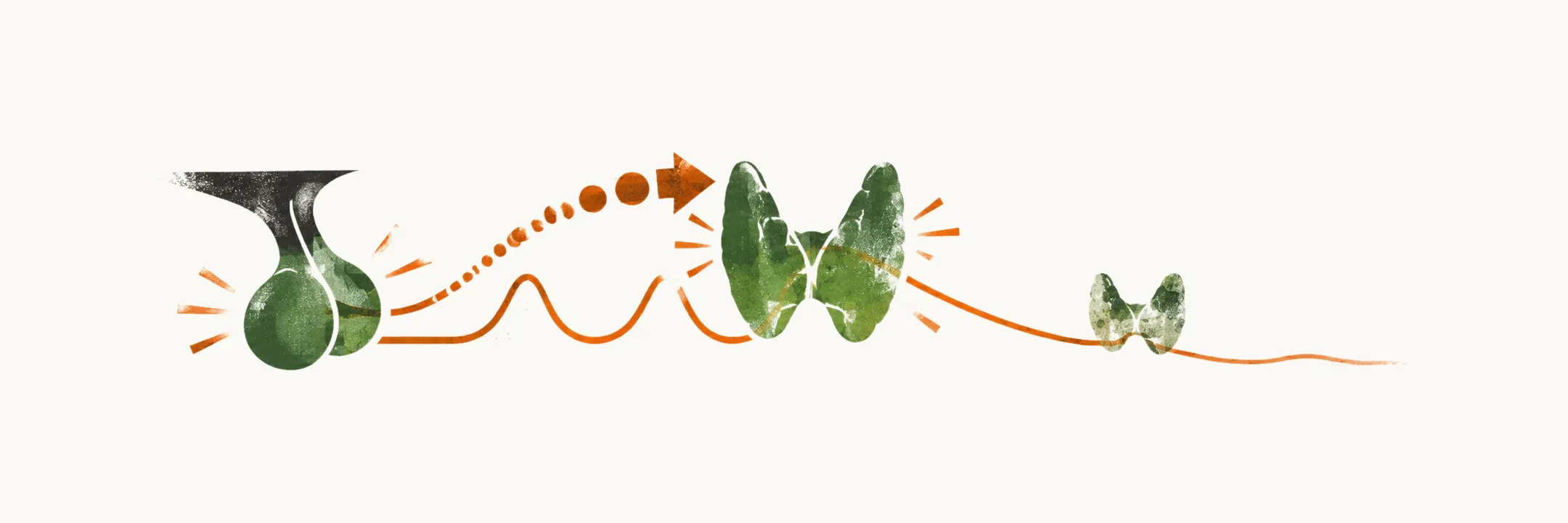
Subclinical hypothyroidism is the early stage of thyroid failure. The thyroid gland makes T4 in its follicular cells. The pituitary raises TSH when the hormone falls, as the causes note explained. That extra drive pushes the cells that remain harder, and they make enough T4 to hold the blood level normal. The result is a TSH that is raised while T4 still reads normal. When so much tissue is lost that the extra drive can no longer cover the shortfall does T4 itself fall, and that is overt hypothyroidism.
Why does the TSH rise before the hormone falls?
The rise in TSH is compensatory. At this stage the loss of functioning follicular cells is not yet large enough to lower the hormone itself. It is large enough, though, that the pituitary has to work harder, and it raises TSH.
The higher TSH is the drive that makes the remaining gland produce more hormone. That is how the T4 level stays normal, and that is why thyroid hormone levels look apparently normal even though the gland is already failing.
So the condition is defined by a raised TSH with a normal T4. Overt hypothyroidism is the opposite situation. The loss is too large for the compensation to hold, and T4 itself falls.
How is the stage graded?
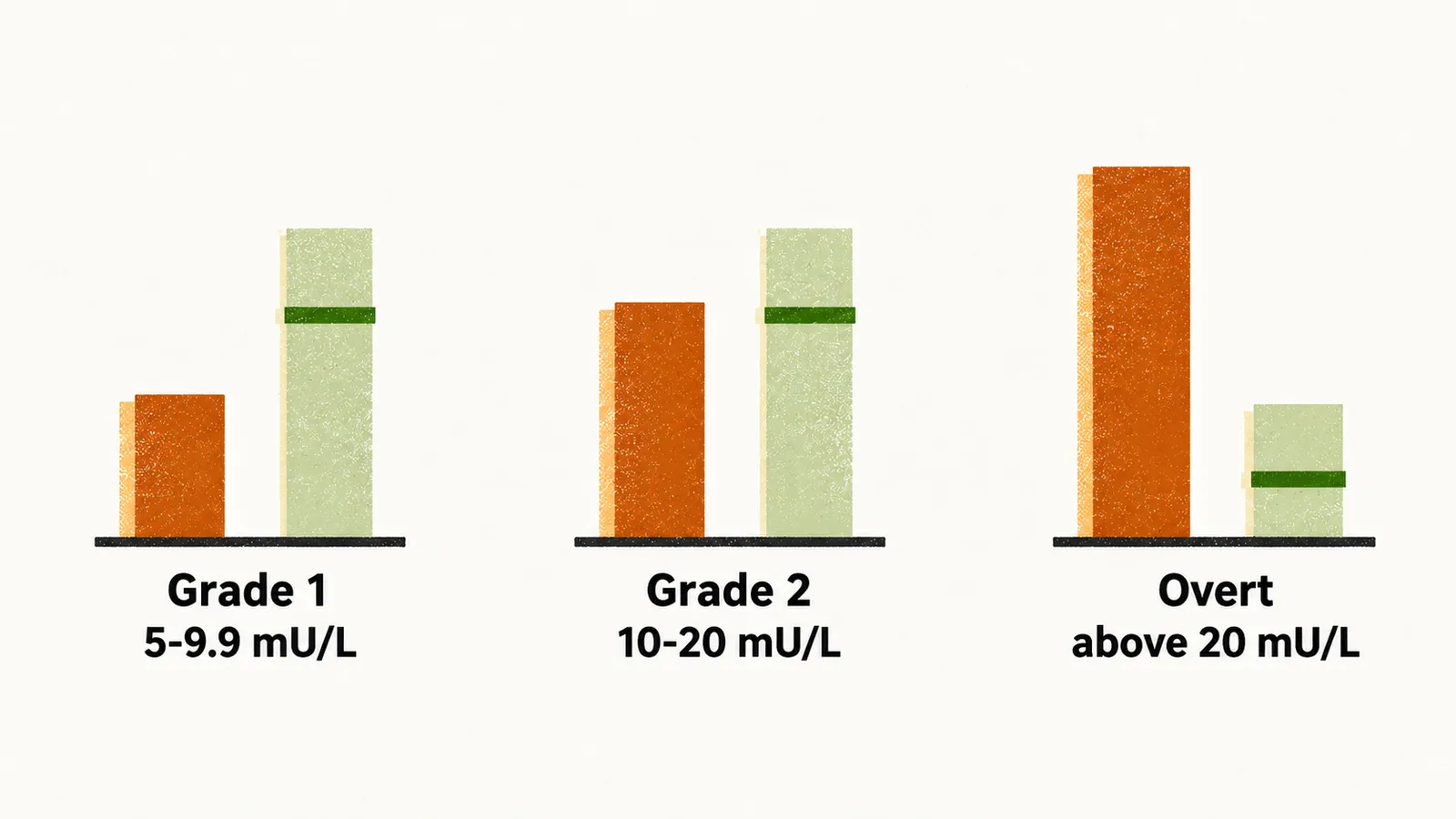
Hypothyroidism is often classified by TSH because the process is graded: the more tissue is lost, the harder the pituitary has to push. TSH is also the sensitive first test, because the pituitary raises it as soon as the hormone falls. The grades are:
- Subclinical, grade 1: T4 normal, TSH 5-9.9 mU/L.
- Subclinical, grade 2: T4 normal, TSH 10-20 mU/L.
- Overt: T4 low, TSH above 20 mU/L.
Is one high TSH enough to diagnose it?
A single raised TSH is not the diagnosis, because TSH fluctuates. It varies with illness, with sleep and with the time of day. TSH is secreted in pulses and follows a daily rhythm with a surge at night, so one high value may simply reflect that variation.
The measurement is repeated after about 3 months, before subclinical hypothyroidism is confirmed and treatment is decided.
Why does a normal T4 still matter?
A normal T4 does not make this stage harmless. Even mild changes in thyroid hormone can affect the cardiovascular system, and the changes begin while the hormone level still reads normal.
The raised TSH is associated with three consequences: a higher risk of cardiovascular events, a higher risk of liver fibrosis, and a higher risk of pregnancy loss. These consequences are the reason the stage is recognised and sometimes treated.
What does the raised TSH do to the heart and blood vessels?
The most important consequence of mild or subclinical hypothyroidism is a higher risk of cardiovascular events. The mechanisms are the changes that a falling hormone produces across the system. Early diagnosis and treatment aim to prevent the cardiovascular events that would follow.
What changes in cholesterol?
The falling hormone reaches the liver and the vessels. In the liver, thyroid hormone acts on the LDL receptors. With less hormone there are fewer receptors, so LDL is cleared more slowly. The lipid profile shifts towards higher cholesterol.
What changes in the vessel lining?
The lipid change is not the only one. Endothelial dysfunction is another of the mechanisms, and it is linked to atherosclerosis. Coronary artery dysfunction is a further one, and there are others.
Does treatment depend on age?
Whether to treat is settled by age rather than by TSH alone. Studies show that in quite old subjects it is better not to treat with levothyroxine to lower TSH to the normal range. In younger subjects levothyroxine is suggested to lower TSH and reduce cardiovascular events.
What about the liver?
The liver is another organ that thyroid hormone reaches, since the hormone has prominent effects on its handling of fatty acids and cholesterol. Subclinical hypothyroidism is associated with a higher risk of liver fibrosis, beyond the cardiovascular events. This is an association, and a mechanism is not given here. Levothyroxine can be considered as part of the regimen.
What about pregnancy?
Mild or subclinical hypothyroidism is associated with a higher risk of pregnancy loss. Early in pregnancy the fetus depends on the mother’s thyroid hormone, which reaches it through the placenta. Control of subclinical hypothyroidism reduces that risk.
If a fetus depends on its mother’s thyroid hormone early in pregnancy, what happens when a baby is born with no working thyroid of its own?